Short version: The perimenopause must-haves with the best evidence are not all things you buy. A sleep skill (CBT for insomnia), a plain moisturizer, a vaginal moisturizer, and enough fiber cover most of the daily friction. In one trial of 106 women, 70% of those who did phone-based CBT for insomnia slept in the normal range after 8 weeks.
- Sleep: CBT for insomnia, a fan and light layers.
- Skin: a fragrance-free moisturizer, plus a vaginal moisturizer and lubricant.
- Gut: fiber toward 25 g a day, and water to go with it.
- Skip: herbal "hormone balance" blends. They have not beaten placebo.
Last updated November 2026.
Perimenopause rarely shows up as one big symptom. It shows up as small ones. You wake at 3 a.m. Your skin feels tight. Your gut runs slower than it used to.
So a "kit" makes sense. Not a shopping spree, though. This guide sorts the perimenopause must-haves by need, and grades each one on the evidence. Some cost nothing. A few are worth buying. Some are best left on the shelf.
What are the perimenopause must-haves?
Here is the short kit. Each row says what the item is for and how strong the proof is.
| Item | For | Evidence |
|---|---|---|
| CBT for insomnia (app, phone, or in person) | Sleep | Strong: a randomized trial in midlife women |
| Fan, light layers, cool room | Night sweats | Weak, but cheap and harmless |
| Fragrance-free moisturizer | Dry skin | Reasonable: estrogen loss is tied to drier skin |
| Vaginal moisturizer and lubricant | Dryness, painful sex | Good: first-line in expert guidance |
| Fiber from food, or a supplement | Regularity | Good: pooled trials in constipation |
| A doctor's visit | Hot flashes that wreck sleep | Strong: hormone therapy works best |
Notice what is missing. There is no "perimenopause support" pill. We explain why below.

What helps perimenopause sleep the most?
A skill, not a product. Cognitive behavioral therapy for insomnia, or CBT-I, has the best proof for midlife sleep.
In a randomized trial, 106 women aged 40 to 65 had insomnia and at least 2 hot flashes a day. Half got 6 phone sessions of CBT-I over 8 weeks. The other half got menopause education. See McCurry et al. (JAMA Internal Medicine, 2016).
Insomnia scores fell 9.9 points with CBT-I and 4.7 points with education. At 8 weeks, 70% of the CBT-I group no longer scored as having insomnia, against 24% of the other group. At 24 weeks it was 84% versus 43%.
One honest detail: the number of hot flashes did not change. What changed was how much they got in the way. CBT-I teaches you to sleep through a disruption, not to stop it.
CBT-I uses a few core tools. You keep a set wake time. You only go to bed when sleepy. You get up if you lie awake for a long stretch. Many apps and sleep clinics teach it.
Do cooling products help night sweats?
Maybe a little, but the proof is thin. In its 2023 review, The Menopause Society listed cooling techniques and avoiding triggers as not recommended for hot flashes. The reason was weak evidence, not harm. See The Menopause Society nonhormone position statement (Menopause, 2023).
So keep it cheap. A bedside fan, cotton or light layers, and a cooler room are fine to try. Skip the pricey "menopause pajamas" unless you just like them.
The same review did recommend CBT and clinical hypnosis. It also backed some prescription options.
What should be in a perimenopause skin kit?
Start with a plain, fragrance-free moisturizer. Estrogen helps keep skin thick and springy. As estrogen drops, skin loses collagen and tends to get drier, per a review in Best Practice and Research Clinical Obstetrics and Gynaecology (2013).
No cream can replace lost estrogen. But a daily moisturizer eases the tight, itchy feel many women notice in their 40s.
The second skin item is one people skip: a vaginal moisturizer and a lubricant. Dryness, burning, and painful sex are part of what doctors call the genitourinary syndrome of menopause, or GSM.
It affects about 27% to 84% of women after menopause. Over-the-counter lubricants and moisturizers work for many women. See The 2020 GSM position statement (Menopause, 2020).
What's the difference? A moisturizer is used a few times a week to keep tissue hydrated. A lubricant is used during sex. Most women do best with both.
If those don't help, low-dose vaginal estrogen is the next step. That needs a prescription.
What belongs in a perimenopause gut kit?
Fiber, water, and a little patience. Gut changes are common in midlife. In a study of 228 women, 38% of those past menopause reported a change in bowel habits, versus 14% before menopause. See Triadafilopoulos et al. (Women Health, 1998).
Most women are short on fiber to begin with. US women average about 15 g a day. The goal is 25 g a day before age 51, and 21 g after. See the NHANES data brief on fiber intake.
Closing that gap helps. A 2022 meta-analysis pooled 16 randomized trials with 1,251 adults who had chronic constipation. 66% responded to fiber, against 41% on control. Gains showed up above 10 g a day, taken for at least 4 weeks. Read the AJCN meta-analysis of fiber supplementation.
Food comes first: beans, oats, berries, and vegetables. A supplement can fill the rest. Add fiber slowly over a few weeks, and drink more water as you go. Going too fast can cause gas, as NIDDK notes.
For more detail, see how to relieve perimenopause constipation and perimenopause bloating.
What can you leave out of a perimenopause kit?
Herbal hot flash blends are the big one. The Menopause Society did not recommend supplements or herbal remedies for hot flashes in its 2023 review. Black cohosh, the top seller, has not beaten placebo.
Our guide to botanical supplements for menopause goes herb by herb. For vitamins, bone health, and creatine, see the best perimenopause supplements.
Also skip anything that says it "balances hormones." No supplement has shown it can do that.
When is a kit not enough?
When hot flashes wreck your sleep, or symptoms get in the way of work or mood. Then it's time to see a doctor.
Hormone therapy is still the most effective treatment for hot flashes and vaginal dryness. For women under 60, or within 10 years of menopause, the benefits usually outweigh the risks if there's no medical reason to avoid it. See The Menopause Society hormone therapy position statement (Menopause, 2022).
It isn't for everyone. Our guide to perimenopause treatment options compares hormone and non-hormone choices side by side.
Where Seya fits, honestly
Seya sells one product today: a vegan fiber gummy. It covers one row of the kit, the gut row. It does nothing for hot flashes, sleep, or skin.
3 gummies give you 6 g of fiber from resistant tapioca fiber, prebiotic soluble fiber, and cellulose, plus magnesium citrate and ginger root. See our product page.
That is below the 10 g a day where trials saw the clearest effect. So think of it as one piece of your daily fiber, next to food. It supports regularity. A Seya creatine gummy is coming January 2027. We will share its details when it launches.
These statements have not been evaluated by the Food and Drug Administration. This product is not intended to diagnose, treat, cure, or prevent any disease.
Frequently asked questions
What products help with perimenopause symptoms?
The best-tested ones are simple. Vaginal moisturizers and lubricants help dryness. A fan and light layers may ease night sweats. Fiber supports regularity. For sleep, CBT for insomnia beat education alone in a 106-woman trial.
What should be in a perimenopause kit?
A plan for sleep (CBT-I and a cool room), a fragrance-free moisturizer, a vaginal moisturizer and lubricant, and enough fiber to reach about 25 g a day. Add a doctor's visit if hot flashes disrupt your life.
Do menopause supplements belong in the kit?
Mostly not for hot flashes. The Menopause Society does not recommend supplements or herbal remedies for them. Fiber is a different case: it has good evidence for regularity.
Does CBT for insomnia work in perimenopause?
Yes, in trials. With 6 phone sessions over 8 weeks, 70% of women no longer scored as having insomnia, versus 24% with education only. It did not reduce the number of hot flashes.
Is a vaginal moisturizer the same as a lubricant?
No. A moisturizer is used a few times a week to keep tissue hydrated. A lubricant is used during sex to reduce friction. Many women use both.
How much fiber do women in perimenopause need?
About 25 g a day before age 51 and 21 g after. Most US women average about 15 g, so many need to add 10 g or so. Increase slowly and drink water.
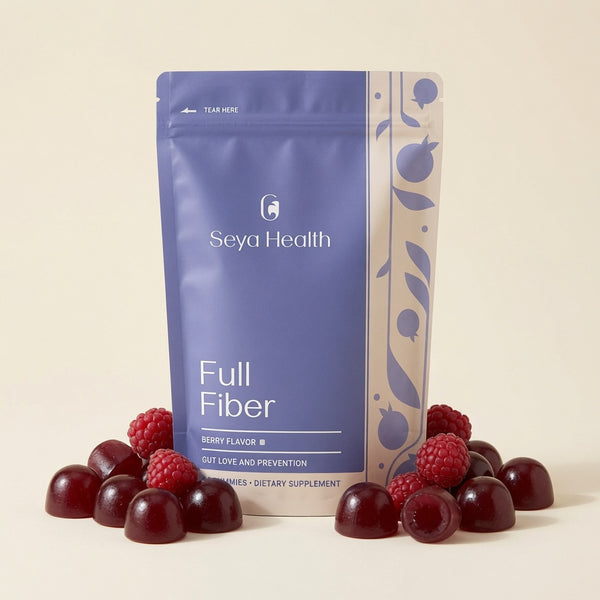
Seya Full Fiber
تفتقر معظم النساء إلى كمية كافية من الألياف. يمنحك Seya Full Fiber 6 غرامات من ثلاثة أنواع من الألياف في ثلاث حلويات نباتية صغيرة. قائم على النباتات، خالٍ من الجيلاتين، ومن دون كحوليات السكر.
تسوّق Full Fiber