Home/ The Journal/ creatine
creatine
Creatine before or after a workout: does timing actually matter?

Short version: Taking creatine before or after a workout matters far less than taking it every day. In a 2014 trial, older adults who took creatine before or after lifting for 12 weeks gained the same muscle and strength. One small study hints that after may edge out before, but the proof is weak.
- Dose: 3 to 5 g a day, every day, including rest days.
- Timing: any time you will remember. After a workout, with a meal, is a fine default.
- Food: a meal with carbs and protein may help your body hold on to a bit more.
Last updated October 2026.
You finally bought creatine. Now the internet is arguing about the clock.
Some people swear by a scoop before the gym. Others say after is the only way. A few say first thing in the morning.
Here is what the trials actually found, and why the boring answer is the right one.
Does it matter if you take creatine before or after a workout?
Not much. What matters is that you take it daily, so your muscles stay topped up.
Creatine does not work like caffeine. It does not kick in an hour later. It builds up in your muscles over weeks. The 2021 expert review from the International Society of Sports Nutrition (ISSN) notes that 3 g a day for 28 days raised muscle creatine about as much as 20 g a day for 6 days. See Antonio et al. (JISSN, 2021).
So the scoop you take today is filling a tank, not powering today's set. That is why the hour you pick is a small detail.
| Study | Who | What they compared | What they found |
|---|---|---|---|
| Antonio and Ciccone, 2013 | 19 young men who lift | 5 g right before vs right after, 4 weeks | No clear difference by standard stats. After looked "possibly" better. |
| Candow et al., 2014 | 22 older adults | 0.1 g per kg before vs after, 12 weeks | Same gains in muscle and strength in both groups. |
| Ribeiro et al., 2021 (review) | Summary of the research | Before, during, and after exercise | After may help a bit, but the studies are too weak to be sure. |
What do randomized trials say about creatine timing?
There are only a few, and they are small.
The first well-known one put 19 young men who lift on 5 g of creatine. Half took it right before training. Half took it right after. After 4 weeks, the after group gained about 2.0 kg of lean mass. The before group gained about 0.9 kg. See Antonio and Ciccone (JISSN, 2013).
That gap sounds big. But by standard statistics, the two groups were not different. The authors used a looser method to call after "possibly" better. And no women were in the study.
A second trial ran longer. Older adults lifted 3 days a week for 12 weeks. One group took creatine before training, the other after. Both groups gained muscle and strength, with no difference between them. Kidney function did not change. See Candow et al. (Res Sports Med, 2014).

Why might after a workout be slightly better?
There are a few ideas, but none is proven.
One is blood flow. After you train, more blood moves through the muscles you just used. Another is that a meal often follows a workout, and food may help muscles take in creatine.
A 2021 review weighed all of this. It said early evidence leans toward after, but weak study design means no solid conclusion yet. It also said the body data behind the timing claims is missing. See Ribeiro et al. (Nutrients, 2021). Two authors disclose ties to a creatine maker.
So if you like a rule, "after, with food" is a fair one. Just do not stress if you take it at lunch instead.
Should you take creatine with food?
It can help a little, and it is easy to do.
In a lab study, 12 men took creatine with either a little sugar or a real meal's worth of carbs and protein. With about 50 g of protein plus 47 g of carbs, their bodies held on to about 25% more creatine. See Steenge et al. (J Appl Physiol, 2000).
An earlier study found carbs raised creatine retention too. But cycling for an hour before the dose did not add any extra. See Green et al. (Acta Physiol Scand, 1996).
Both studies used large doses in men, so treat this as a nudge, not a rule. Taking creatine with a normal meal is also kinder to some stomachs.
Should you take creatine in the morning or at night?
Either one. We found no trial that compares morning and night doses.
Pick the time you will not forget. Many people tie it to breakfast or to the meal after training.
Some people ask about sleep. Creatine is not a stimulant like a pre-workout drink. If you notice sleep changes, try an earlier time. Our post on creatine side effects in women covers what is real and what is myth.
Is consistency more important than timing?
Yes. This is the part the research agrees on.
The 2021 ISSN review recommends about 3 to 5 g a day for at least 4 weeks. It says a high-dose "loading" week is not required. It also warns that single servings over 10 g may upset the gut. See Antonio et al. (JISSN, 2021).
That means rest days count. Take your dose on days you do not train, too, so your stores stay full.
Missed a day? Just take your normal dose the next day. No need to double up.
When should women take creatine gummies?
The same way as powder: one daily dose, at a time you can stick to.
Most timing trials studied men, so there is no women-only answer. The bigger question for gummies is the label. Check how many grams of creatine each serving gives you. You may need several gummies to reach 3 g.
Should you eat creatine gummies before or after a workout? Either. Pick the slot you will keep. Our guide on whether creatine gummies work walks through the label math, and best creatine for women covers form and testing.
Does timing matter if you are trying to lose weight?
No study shows that the clock changes fat loss.
In the 2013 trial, fat mass changes between the before and after groups were not statistically different. Creatine also tends to add some water to muscle early on, so the scale can move up a little first.
If you are cutting calories, what helps keep muscle is lifting and enough protein. Creatine is a small extra on top. It is not a fat burner, and no supplement can promise a result on the scale.
What does the ISSN position stand recommend?
The ISSN's 2017 position stand calls creatine one of the most popular sports supplements. It says studies up to 30 g a day for 5 years found it safe and well tolerated in healthy people. See Kreider et al. (JISSN, 2017).
The group's 2021 follow-up sets 3 to 5 g a day as the usual dose. Neither paper makes timing a must. Several ISSN authors disclose ties to creatine companies, which is worth knowing.
Is creatine regulated by the FDA?
Creatine is sold as a dietary supplement. The FDA does not approve supplements before they are sold, and the company is responsible for what is in the tub. See the FDA supplement questions and answers.
That is why outside lab testing matters more than timing. A perfect schedule does not help if the product is short on creatine.
If you have kidney disease, are pregnant, or take several medicines, talk to your doctor before you start.
Where Seya fits, honestly
Seya sells one product today: a fiber gummy that supports regularity.
Our creatine gummy is coming January 2027. It is not on sale yet. We will not share a dose or a price until the formula is final. Watch our site for launch news.
Until then, any well-tested creatine monohydrate, taken daily, follows the research. This is education, not medical advice.
These statements have not been evaluated by the Food and Drug Administration. This product is not intended to diagnose, treat, cure, or prevent any disease.
Frequently asked questions
Does it matter whether you take creatine before or after a workout?
Not much. A 12-week trial in older adults found the same muscle and strength gains either way. One small 2013 study hinted that after may be a bit better, but the difference was not statistically clear.
How long after a workout should you take creatine?
No study sets a window. The trials that tested "after" gave it right after training. Taking it with your next meal is a simple habit.
Should you take creatine in the morning or at night?
Either. No trial has compared the two. Choose the time you will remember every day.
Is consistency more important than timing?
Yes. Creatine builds up in muscle over weeks. The ISSN suggests 3 to 5 g a day for at least 4 weeks, including rest days.
Should you take creatine with food?
It may help. In one study, taking creatine with about 50 g of protein and 47 g of carbs raised the amount the body kept by about 25%.
Should you eat creatine gummies before or after a workout?
Either. Timing works the same for gummies and powder. Check the label for grams of creatine per serving. Seya's creatine gummy is coming January 2027 and is not on sale yet.
Does creatine timing help you lose weight?
No study shows that. Creatine may add a little water weight at first. Lifting and enough protein matter far more for keeping muscle while you cut calories.
Is creatine regulated by the FDA?
It is sold as a dietary supplement. The FDA does not approve supplements before sale, so look for outside lab testing.
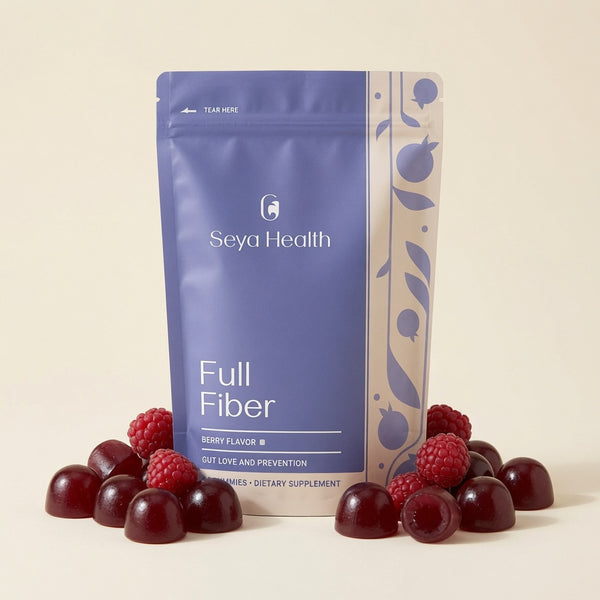
Seya Full Fiber
Most women fall short on fiber. Seya Full Fiber gives you 6 grams from three fibers in three small vegan gummies. Plant based, no gelatin, no sugar alcohols.
Shop Full Fiber