Home/ The Journal/ brain health
brain health
Can creatine gummies support brain health? Evidence vs label claims

Short version: Can you count on creatine gummies for brain health? Not yet. Creatine itself has some memory evidence, with a small effect in a 2024 review of 16 trials. But we found no published trial of a creatine gummy and the brain. And in 2024, EU food safety reviewers looked at the same field and said a cause-and-effect link "has not been established."
- The evidence: small and mixed, from creatine monohydrate, mostly not gummies.
- The label: brain wording does not need FDA approval first.
- Your move: treat "boosts cognition" as marketing until the dose and the study line up.
Last updated October 2026.
You read "boosts cognition" on a bag of gummies. You take them for a month. You feel about the same.
It is easy to think your brain is the problem.
It isn't. The label is simply allowed to say more than the research can show. Here is how to tell the two apart.
Do creatine gummies help brain health?
No one has tested that yet. We searched PubMed for creatine gummy trials and found one. It tracked jump height and body build in 32 female volleyball players, not thinking. See Pereira et al. (2026).
So any brain claim on a gummy is borrowed. It comes from studies of creatine monohydrate, usually powder or capsules.
That borrowing can be fair, since creatine is creatine. But it only holds if your gummy delivers the amount it lists, at a dose the studies used. Our guide to whether creatine gummies work covers the lab tests.
Is there evidence creatine improves cognition?
Some, and it is small. The strongest signal is for memory.
- 16 trials, 492 adults: memory improved with an effect size of 0.31. The authors rated that moderate certainty. Attention and processing speed were low certainty. See Xu et al. (Front Nutr, 2024).
- 8 pooled trials in healthy people: a 0.88 effect in adults aged 66 to 76, and just 0.03 in people aged 11 to 31. See Prokopidis et al. (Nutr Rev, 2023).
- 123 adults, 5 g a day for 6 weeks: the data supported "a small beneficial effect," but the main tests missed statistical significance. See Sandkühler et al. (BMC Med, 2023).
Want the study-by-study tour? Read creatine for brain health. The rest of this post is about the label.

Why did EU reviewers reject the creatine brain claim?
Because the studies did not agree enough. In November 2024, a European Food Safety Authority panel reviewed a request from the company Alzchem Trostberg to back a cognition claim.
Its verdict: "a cause-and-effect relationship has not been established between creatine supplementation and an improvement in cognitive function in one or more of its domains." See the EFSA opinion (EFSA Journal, 2024).
The panel weighed 3 things:
- Working memory gains showed up in 2 studies at 20 g a day for 5 to 7 days, but not at 2.2 to 14 g a day.
- 10 studies in healthy people did "not show a consistent effect."
- 3 studies in people with disease did not support an effect either.
Does that cancel the memory reviews? No. Pooled analyses can find a small average effect. EFSA asked a tougher question, which is whether the pattern is consistent enough to back a claim. Both can be true at once.
What can creatine supplements legally claim?
In the US, they can describe how an ingredient affects normal body function. They cannot claim to deal with a disease.
| Type of wording | Example | US rule |
|---|---|---|
| Structure/function | "Supports memory" | Allowed with a disclaimer and FDA notice, no pre-approval |
| Disease claim | "Helps with Alzheimer's" | Makes the product subject to regulation as a drug |
| Symptom of a disease | "Eases dementia memory loss" | Also a disease claim |
These examples are ours, for illustration. The rule itself says a statement is a disease claim if it says a product has "an effect on a specific disease or class of diseases." See 21 CFR 101.93.
Does FDA check brain claims on a supplement label?
Not before they appear. The FDA says these claims "are not pre-approved." The maker must have proof that the claim is truthful and not misleading. Then it tells the FDA "no later than 30 days after marketing."
The label must also say that the FDA has not evaluated the claim. See the FDA's page on structure/function claims.
That is why the fine print exists. It is not a formality. It tells you nobody at the FDA reviewed that sentence before you read it.
And proof does get tested, sometimes years later. In December 2024, a New York court issued an order barring Prevagen's maker from advertising that the supplement improves memory, per NutraIngredients. That case had nothing to do with creatine. It does show that memory claims can be challenged.
What do creatine gummy labels actually say about the brain?
Here is the wording on 2 brands' own product pages, as we read them in October 2026.
| Brand page | Brain wording | Creatine per serving |
|---|---|---|
| Create | "Boosts cognition," "sharper focus," "improved mental acuity" | 4.5 g in 3 gummies |
| Force Factor | "Cognitive benefits with consistent use" | 5 g per dose |
Both pages carry an FDA disclaimer. We are not saying either brand broke a rule. Copy like this names no disease, and these doses are close to the 5 g used in the 123-person trial.
The gap is simpler. Neither phrase tells you how small the effect was, who it showed up in, or that the gummy itself was not the thing tested.
For side-by-side numbers, see our creatine gummy brands compared.
How to read a brain claim on a creatine gummy
Ask 4 questions before you pay for the promise.
- Which words? "Supports" and "boosts" tell you nothing about effect size.
- What dose? Count the gummies. At 1.5 g each, 5 g takes about 3, and 20 g takes about 14.
- Who was studied? The biggest memory effect in healthy people was in adults aged 66 to 76. Are you in that group?
- Is the amount checked? Look for a seal such as NSF Certified for Sport.
If a page cites a study, open it. See if it tested the same form, the same dose, and people like you.
What to expect from creatine gummies for brain health
A small change at most, and maybe nothing you notice. That is the honest read.
Across a group, a 0.3 effect shows up on a memory test. It may not show up in your day. Feeling no different does not mean you did it wrong.
Creatine has a stronger case in muscle than in the brain. See the position paper by Kreider et al. (JISSN, 2017). If memory is your main worry, or it has changed quickly, a supplement is not the first step. Talk to your doctor. Ask first, too, if you have kidney disease or are pregnant or nursing.
Where Seya fits, honestly
Right now, the only Seya product you can buy is our fiber gummy, which supports regularity.
A Seya creatine gummy is coming January 2027. Until it launches, we will not share its dose, price, or ingredients. No creatine gummy, ours included, has a published brain trial that we could find.
Choosing a form instead? Read best creatine for cognitive benefits. This is education, not medical advice.
These statements have not been evaluated by the Food and Drug Administration. This product is not intended to diagnose, treat, cure, or prevent any disease.
Frequently asked questions
Do creatine gummies help brain health?
That has not been tested. We found no published trial of creatine gummies and the brain. Small memory benefits come from studies of creatine monohydrate in other forms.
What can creatine supplements legally claim?
In the US, they can describe effects on normal body function, like supporting memory, with an FDA disclaimer. They cannot claim to affect a specific disease without being regulated as a drug.
Is there evidence creatine improves cognition?
Some. A 2024 review of 16 trials found a small memory benefit with moderate certainty. Evidence for attention and processing speed was low certainty.
Did Europe reject the creatine brain claim?
EFSA, the EU food safety agency, concluded in 2024 that a cause-and-effect link between creatine and better cognitive function has not been established.
Does the FDA approve brain claims on supplements?
No. Makers need proof that the claim is truthful and must notify the FDA within 30 days of marketing, but the FDA does not pre-approve the wording.
Can creatine gummies help with Alzheimer's or dementia?
No supplement can legally claim that without being regulated as a drug, and no gummy has been tested for it. Talk to your doctor about memory changes.
How many creatine gummies match the brain studies?
It depends on the gummy. At 1.5 g each, a 5 g dose takes about 3 gummies. A 20 g loading dose takes about 14.
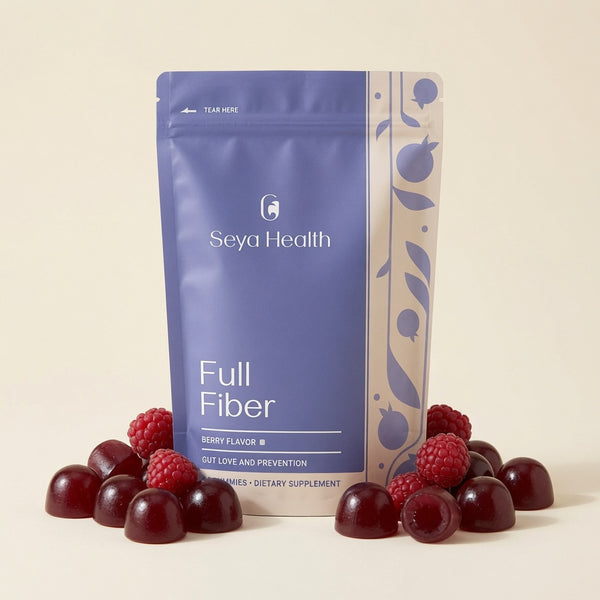
Seya Full Fiber
Most women fall short on fiber. Seya Full Fiber gives you 6 grams from three fibers in three small vegan gummies. Plant based, no gelatin, no sugar alcohols.
Shop Full Fiber