Short version: Creatine purity varies more than most labels let on. When researchers tested 33 creatine products, 44% held creatinine, a breakdown product, above 100 mg per kg, and about 1 in 7 carried traces of factory byproducts. A clean supplement is plain creatine monohydrate with an outside seal that tests each batch.
- Form: creatine monohydrate has the most safety data by far.
- Proof: look for a batch-tested seal such as NSF Certified for Sport.
- HCl: no study shows it is safer than monohydrate.
Last updated October 2026.
Creatine is one of the best-studied supplements you can buy. That part is settled.
What is not settled is what sits inside the tub you pick up. Two jars can both say "creatine" and come from very different factories.
Here is what can go wrong, how to spot it, and which seals actually check.
How do you know if a creatine supplement is pure?
You cannot tell by look, taste, or price. Pure creatine and slightly dirty creatine are both a white, plain powder.
The only real proof is a lab test. Since you cannot run one at home, you rely on someone who did. That means an outside seal tied to the batch you hold, not a word like "pure" on the front.
The research gives three clues that raise the odds:
- The label lists one ingredient: creatine monohydrate.
- The brand names where its creatine is made.
- An outside group tests each batch for contaminants and label accuracy.
What can contaminate creatine?
Most creatine is made in a factory, not pulled from meat. Makers mix two starting chemicals, sarcosine and cyanamide, then filter and dry the crystals. A 2022 review describes the process and its weak spots. See Kreider et al. (Nutrients, 2022).
That review lists what poorly run plants have been reported to leave behind:
| Contaminant | What it is | Why it shows up |
|---|---|---|
| Creatinine | The waste product creatine breaks down into | Heat, moisture, or age |
| Dicyandiamide | A leftover from the cyanamide step | Side reaction during making |
| Dihydrotriazine | Another byproduct of the reaction | Poorly controlled synthesis |
| Thiourea, dimethyl sulphate | Chemicals from other recipes | Different starting materials |
| Mercury, lead | Heavy metals | Weak filtering or dirty inputs |
The same review says one German plant that uses water as its solvent reports 99.9% pure creatine. It says other sources, "particularly from China," have been reported to carry the byproducts above. Note that the lead author chairs a creatine advisory board for that German maker, a tie the paper discloses.
How common are impurities in creatine?
Only a few labs have checked shelves, and the best-known test is older. Still, it is the clearest look we have.
One research team bought 33 creatine products and ran each through two lab tests. Here is what they found. See Moret et al. (Food Chemistry, 2011).
- Creatinine was the most common extra. 44% of samples had more than 100 mg per kg.
- About 15% had dihydrotriazine above the test's detection limit and dicyandiamide above 50 mg per kg.
- None had thiourea.
- Of four heavy metals tested, only mercury showed up, and below 1 mg per kg.
Those are small amounts. The study did not test whether they harm people. But it shows a "creatine" label does not tell you the whole story.

Can a supplement contain things not on the label?
Yes, and this matters most if you compete in a tested sport.
A study from the German Sport University bought 634 supplements that were not sold as hormones. They came from 13 countries. 94 of them, or 14.8%, contained anabolic steroids that were not on the label. See Geyer et al. (Int J Sports Med, 2004).
That study is two decades old and covered many product types, not only creatine. The lesson still holds. Mix-ups happen when a plant makes several products on shared lines.
What third-party certifications matter for creatine?
Look for a seal that tests what is in the product, not one that only checks paperwork.
NSF says its Certified for Sport program checks that products "do not contain unsafe levels of contaminants, prohibited substances or masking agents." It also checks that the label matches what is inside. See NSF's description of the mark.
Other seals you may see include USP Verified and Informed Sport. Each has its own rules, so read what a seal covers before you trust it. A few quick checks:
- Search the listing. Look the product up on the certifier's own site. A logo on a tub is easy to copy.
- Match the product. A seal on one flavor or size does not cover the whole line.
- Be wary of vague words. "Lab tested" or "pharmaceutical grade" with no named lab tells you little.
Gummies need extra care. Recent paid lab tests found some creatine gummies held far less than the label said. Our guide on whether creatine gummies work walks through those results.
Is creatine monohydrate or HCl safer?
Monohydrate has far more safety data. No study shows creatine HCl is safer.
Creatine monohydrate has been sold in the US since 1993, per the 2022 review. The 2017 position stand from the International Society of Sports Nutrition says studies of up to 30 g a day for 5 years found it safe in healthy people. See Kreider et al. (JISSN, 2017).
The 2022 review adds that, as of its writing, monohydrate was the only form of creatine on the FDA's list of GRAS notices. GRAS means "generally recognized as safe." On HCl, it says claims that it is more bioavailable, more effective, or safer than monohydrate "are not supported." It does rate HCl as having some evidence of working compared with a placebo.
Two 2026 trials add to the picture:
- In 36 women in perimenopause or after menopause, 1.5 g a day of creatine HCl for 8 weeks was well tolerated, with no serious side effects. See Korovljev et al. (J Am Nutr Assoc, 2026).
- In 40 young male soccer players, the HCl and ethyl ester groups beat the monohydrate group on some sprint and jump tests after 4 weeks. See Duan et al. (JISSN, 2026).
Both are small. Neither compared safety head to head with monohydrate over a long time. An older review reached the same bottom line: newer forms have "little to no evidence" of being safer or better. See Jäger et al. (Amino Acids, 2011).
Does HCl give you less creatine per gram?
Yes, a little. Creatine monohydrate is about 87.9% creatine by weight. Creatine HCl is about 78.2%, per the 2022 review.
So 3 g of HCl gives you less creatine than 3 g of monohydrate. HCl products often suggest smaller servings because it mixes into water more easily. Mixing well is not the same as reaching your muscles. Check the grams of actual creatine, not just the scoop size.
Who checks creatine before it is sold?
No one approves it first. The FDA says it does not have the authority to approve dietary supplements before they go on sale. See the FDA supplement questions and answers.
Makers must follow good manufacturing rules for identity, purity, and labeling. Those rules are set out in 21 CFR Part 111. But the FDA mostly steps in after a problem, not before. That gap is why outside testing carries so much weight.
A creatine purity checklist
- One ingredient. Creatine monohydrate, with no blend hiding the dose.
- A real seal. Batch-tested, and listed on the certifier's site under this exact product.
- A named source. The brand says where its creatine is made.
- Grams, not scoops. 3 to 5 g of creatine a day is the usual dose. See Antonio et al. (JISSN, 2021).
- Fresh and dry. Keep the lid shut. Moisture and heat help creatine turn into creatinine.
Want the side-by-side on forms and seals for women? Read best creatine for women. Worried about what creatine does in the body? Our post on creatine side effects in women covers what is real and what is myth.
If you have kidney disease, are pregnant, or take several medicines, talk to your doctor before you start.
Where Seya fits, honestly
Seya sells one product today: a fiber gummy that supports regularity.
Our creatine gummy is coming January 2027. It is not on sale yet. We will not share a dose, price, or testing details until the formula is final. When we do, we will tell you what lab checked it and what they tested for.
Until then, use the checklist above on any brand. This is education, not medical advice.
These statements have not been evaluated by the Food and Drug Administration. This product is not intended to diagnose, treat, cure, or prevent any disease.
Frequently asked questions
How do you know if a creatine supplement is pure?
You need a lab result. Look for a batch-tested seal, such as NSF Certified for Sport, and confirm the product on the certifier's own site.
What third-party certifications matter for creatine?
Seals that test the product itself. NSF Certified for Sport checks for contaminants, banned substances, and label accuracy. USP Verified and Informed Sport are other common seals.
Is creatine monohydrate or HCl safer?
Monohydrate has far more safety data, including studies of up to 30 g a day for 5 years in healthy people. No study shows HCl is safer.
What contaminants can be found in creatine?
Creatinine, dicyandiamide, dihydrotriazine, and traces of heavy metals have been reported. In one test of 33 products, 44% had creatinine above 100 mg per kg.
Is "pharmaceutical grade" creatine better?
Not by itself. Without a named lab and a batch test, the phrase tells you little. An outside seal tells you more.
Is creatine approved by the FDA?
No supplement is approved before sale. As of a 2022 review, creatine monohydrate was the only form of creatine on the FDA's list of GRAS notices.
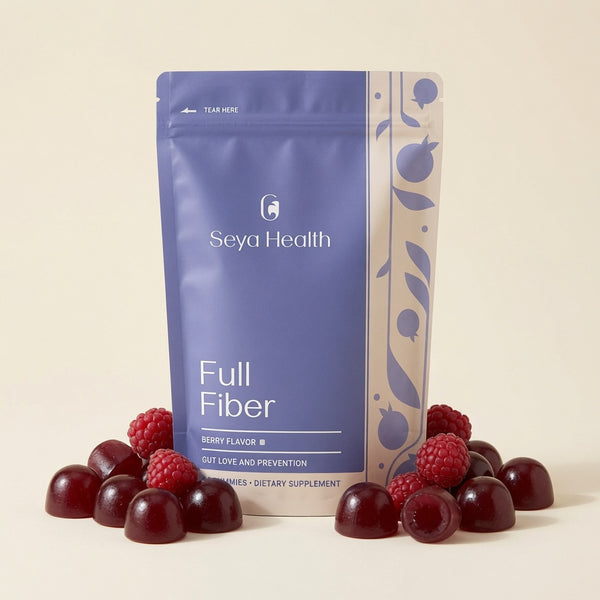
Seya Full Fiber
Most women fall short on fiber. Seya Full Fiber gives you 6 grams from three fibers in three small vegan gummies. Plant based, no gelatin, no sugar alcohols.
Shop Full Fiber