Home/ The Journal/ creatine
creatine
Third-party tested creatine: what the seals mean and which certifications matter

Short version: Third-party tested creatine has been checked by an outside lab, not just the brand. But seals differ a lot. The strongest ones test every batch. Informed Sport screens each batch for more than 285 banned substances before it ships. Weaker labels like "made in a GMP facility" only describe the legal minimum.
- Top tier: every batch tested, with a public lot search.
- Middle tier: random checks a few times a year.
- Ingredient marks: Creapure tells you the raw creatine source, not how the finished product tested.
- Red flags: "lab tested" with no named lab, or "WADA approved."
Last updated November 2026.
You flip a tub of creatine over and find three logos and a line that says "lab tested." Which one counts?
Most of us assume a seal is a seal. It is not. Some test every batch before it ships. Some buy a product off the shelf a dozen times a year. Some only tell you where the raw powder came from.
This guide sorts the seals you will see on creatine into four tiers. Then it shows you how to check any of them in about two minutes.
What does third-party tested creatine mean?
It means a lab that the brand does not own has tested the product. That matters because nobody else has to check it first. The FDA says that under DSHEA it "does not have the authority to approve dietary supplements before they are marketed." See the FDA's supplement questions and answers.
Without outside testing, you are taking the label on trust. And labels do slip. When German researchers bought 634 supplements, 94 of them (14.8%) held steroids that were not on the label. See Geyer et al. (Int J Sports Med, 2004).
Creatine itself can carry leftovers from how it is made. In a test of 33 creatine products, 44% held creatinine, a breakdown product, above 100 mg per kg. See Moret et al. (Food Chemistry, 2011). Our creatine purity guide covers those byproducts.
Which certifications should a creatine supplement have?
Look for one seal from the top tier below. If you are drug tested for sport, that is a must. If you are not, it is still the clearest proof that what is in the tub matches the label.
Here is how the common seals and label phrases stack up.
| Seal or phrase | Who runs it | How often it tests | Tier |
|---|---|---|---|
| Informed Sport | LGC | Every batch before release | 1 |
| BSCG Certified Drug Free | Banned Substances Control Group | Every finished lot | 1 |
| NSF Certified for Sport | NSF | Product lots, plus factory audits | 1 |
| Informed Choice | LGC | At least 12 random lots a year | 2 |
| NSF Contents Certified | NSF | Label and contaminants, no banned-substance screen | 2 |
| Creapure | Alzchem, the maker | Raw creatine only | 3 |
| "Made in a GMP facility" | No one outside | None required | 4 |
| "Lab tested" with no named lab | Unknown | Unknown | 4 |
Tier 1: seals that test every batch
These are the seals built for athletes who get drug tested. Each one screens for hundreds of banned substances.
- Informed Sport. It says it tests "every single" batch before it reaches stores, for more than 285 banned substances, using ISO 17025 accredited lab methods. It also buys products in stores and tests them again. See Informed Sport vs Informed Choice.
- BSCG Certified Drug Free. It says it tests every finished lot for more than 450 banned substances. Testing also covers label claims, heavy metals, pesticides, and germs. See BSCG.
- NSF Certified for Sport. It screens for 290 banned substances, checks the label, tests for contaminants, and audits the factory once or twice a year. See NSF's page on its mark. Our NSF Certified for Sport creatine guide goes deeper.
USADA, the U.S. anti-doping agency, names five programs it recommends: BSCG, Eurofins Clean Sport, Informed Sport, NSF Certified for Sport, and TruShield. See USADA Supplement Connect.
Is NSF Certified for Sport creatine better?
Not better, just one of the three strongest. NSF, Informed Sport, and BSCG all sit in the top tier and all are on USADA's list.
The differences are small. They screen for different numbers of substances. Their lot searches look different. And each brand tends to pick one program, so you will rarely see two of these logos on one tub.
The practical rule: any one of the three is enough. What matters more is that your exact product and lot show up on that program's own site.

Tier 2: seals that test some batches
These still involve a real outside lab. They just do not promise to test every batch.
- Informed Choice. It runs the same lab methods as Informed Sport. But it works by buying products from stores. It tests at least 12 lots a year at random, and it says "it is not guaranteed that every batch has been tested." It is built for active people who are not drug tested.
- NSF Contents Certified. It checks that the label is true and that contaminants are low. It does not add the banned-substance screen. That is the key gap if you compete.
For most people who just want real creatine in the tub, tier 2 is a good sign. For a tested athlete, it is not enough.
Tier 3: what does Creapure mean on a label?
Creapure is a brand of creatine monohydrate, not a test of the finished product. It is made by Alzchem in Trostberg, Germany, and the maker calls it "tested and traceable." See Creapure.
So a Creapure logo tells you where the raw powder came from. It does not tell you what happened after a brand mixed it, flavored it, or poured it into gummies.
That gap matters most for gummies, where dose can drift. The best case is Creapure plus a tier 1 seal. Our guide to creatine gummies for women covers gummy dose checks.
Tier 4: label words that prove little
Some phrases sound like testing but have nothing to look up.
- "Made in a GMP facility." Every supplement maker is already required to follow current good manufacturing practices. The FDA says so in its supplement Q and A. This is the floor, not a bonus.
- "Lab tested" or "third-party tested" with no name. Which lab? Testing for what? If you cannot find out, it tells you nothing.
- "Pharmaceutical grade." This is not a certification you can look up.
- "WADA approved." Informed Sport calls this "meaningless," because WADA and national anti-doping groups do not approve supplements. See Informed Sport.
Some brands will email a certificate of analysis if you ask. It helps, but it is the brand's own paperwork. Treat it as tier 4 unless an outside lab's name is on it.
Is creatine tested for contaminants?
Only if a brand pays for it. No law makes a lab check each tub before sale.
Tier 1 and tier 2 seals cover contaminants. NSF says certified products have no unsafe levels of contaminants. BSCG lists heavy metals, pesticides, and germs in its testing. Informed Sport adds a reason this matters for athletes. It cites an Anti-Doping Knowledge Centre study finding that product contamination caused 8% of all anti-doping violations from 2005 to 2022.
A seal does not check whether creatine is right for you. Creatine monohydrate has the deepest safety record. The ISSN found up to 30 g a day for 5 years safe in healthy people. See Kreider et al. (JISSN, 2017). For daily amounts, read is creatine safe?
How to check a seal in two minutes
- Find the logo. Note which program it names.
- Go to that program's own site. Do not trust a link on the brand's page.
- Search the exact product. Match the flavor and size. One certified flavor does not cover the line.
- Match the lot. Informed Sport, BSCG, and NSF all let you search by lot number. The lot is usually printed near the expiry date.
- No listing? Treat it as tier 4. A logo is easy to copy.
Want brand names that pass? Our best creatine monohydrate brands scorecard lists which ones hold a top-tier seal. New to creatine? Start with what is creatine?
Where Seya fits, honestly
Right now, the only Seya product you can buy is our fiber gummy, which supports regularity.
A Seya creatine gummy is coming January 2027. Until it launches, we will not share its dose, price, ingredients, or any testing seal. When it ships, use the checks above on it too. You can join the waitlist on our site.
This is education, not medical advice.
These statements have not been evaluated by the Food and Drug Administration. This product is not intended to diagnose, treat, cure, or prevent any disease.
Frequently asked questions
What does third-party tested creatine mean?
An outside lab, not the brand, tested the product. The best programs test every batch and let you look up your lot online. The FDA does not approve supplements before they are sold.
Which certifications should a creatine supplement have?
One every-batch seal: Informed Sport, BSCG Certified Drug Free, or NSF Certified for Sport. All three are on USADA's recommended list. Informed Choice is a weaker, random-check option.
Is creatine tested for contaminants?
Only when a brand pays for outside testing. Top seals cover contaminants. BSCG, for example, tests label claims, heavy metals, pesticides, and germs. No law requires a check before sale.
Is NSF Certified for Sport creatine better?
It is one of the three strongest seals, not the only one. Informed Sport and BSCG Certified Drug Free are just as strict. Pick any one, then confirm your lot on its site.
Is Creapure the same as third-party testing?
No. Creapure is a German brand of raw creatine monohydrate. It tells you the source of the powder, not how the finished tub or gummy tested.
Does "made in a GMP facility" mean the creatine was tested?
No. The FDA already requires every supplement maker to follow good manufacturing practices. It is the legal floor, not an outside test.
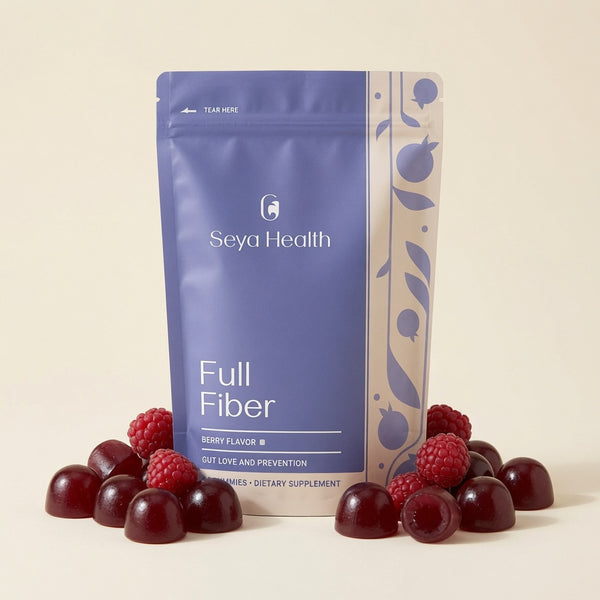
Seya Full Fiber
대부분의 여성은 식이섬유 섭취가 부족합니다. Seya Full Fiber는 세 가지 식이섬유 6그램을 작은 비건 구미 세 개에 담았습니다. 식물성, 젤라틴 무첨가, 당알코올 무첨가.
Full Fiber 쇼핑하기