Short version: Is creatine safe? For healthy adults, yes. The International Society of Sports Nutrition says up to 30 g a day for 5 years was safe and well tolerated. Most people take 3 to 5 g a day, which is far below that.
- Everyday dose: 3 to 5 g a day keeps muscle full.
- More is not better: muscle holds a fixed amount. The extra leaves in your urine.
- Normal: a pound or two of water weight early on.
- Call a doctor: if you have swelling in your legs or face, or you pee much less.
Last updated November 2026.
You see a scoop on the label and wonder how much is too much. Or a friend says it wrecks your kidneys.
The answer depends on the dose. So this guide starts there. We cover what each daily amount has been tested at, what happens above the point your muscles are full, and what is normal versus a sign to call a doctor.
Is creatine safe at every dose?
For healthy people, it has been tested safe across a wide range. The 2017 position stand of the International Society of Sports Nutrition (ISSN) says there is no compelling evidence of harm from creatine monohydrate, even at up to 30 g a day for 5 years. See Kreider et al. (JISSN, 2017).
That 30 g figure is a research ceiling, not a target. It came from long studies in healthy people and in patient groups, from infants to older adults. Most people never need it.
We could not retrieve the daily limits set by EFSA or Health Canada, so we do not quote them here. Check those agencies directly if you need a regulator number.
How many grams of creatine a day is safe?
Here is a dose ladder. Each row shows what the amount is used for and the longest safety data we found for it.
| Daily amount | What it is used for | Longest safety data |
|---|---|---|
| 3 g | A slow build-up, or upkeep once muscle is full | 3 g a day for 28 days raises stores more slowly than loading |
| 3 to 5 g | The standard daily dose | Recommended by the 2021 expert review |
| 5 to 10 g | Larger athletes who train hard | 21 months in college football players, with no clinically significant differences in blood or urine markers |
| Up to 10 g | Long-term users in a kidney study | 10 months to 5 years, with normal kidney function |
| About 20 g | A loading phase of 5 to 7 days | Short bursts, split into 4 doses of 5 g |
| 10 to 30 g | Clinical research in disease groups | Up to 30 g a day for 5 years |
The sources are the ISSN position stand, Antonio et al. (JISSN, 2021), and Poortmans and Francaux (Med Sci Sports Exerc, 1999).
What happens if you take more than you need?
Your muscles have a ceiling. The ISSN says storage tops out near 160 mmol per kg of dry muscle in most people. Once you hit it, extra creatine has nowhere to go.
It leaves in your urine. In one study, 21 sprinters took 10, 25, or 35 g a day for 4 days. Their urine creatine rose 7.4-fold at 10 g and 36-fold at 25 g. See Havenetidis and Bourdas (J Sports Med Phys Fitness, 2003).
The 2021 expert review says urine creatine can pass 10 g a day on supplements. It adds that these rises alone are unlikely to mean kidney damage. A bigger dose mostly means a pricier trip to the toilet, plus a higher chance of stomach upset.
Does your body weight change the dose?
A little. Researchers often use grams per kg of body weight. Here is what that looks like for a 70 kg (154 lb) person:
- 0.03 g per kg: about 2 g a day. Football players used this for 115 days after a 5-day load. See Greenwood et al. (J Athl Train, 2003).
- 0.1 g per kg: about 7 g a day. The 2021 review gives this as the recommended dose, alongside 3 to 5 g a day.
- 0.3 g per kg: about 21 g a day. That is the loading dose, used for 5 to 7 days.
For most adults, a flat 3 to 5 g is simpler. Our post on whether you need a loading phase covers the 20 g option.

Is it safe to take creatine every day?
Yes. Daily use is how creatine works, because muscle fills slowly. A 1999 study checked long-term users, from 10 months to 5 years. Their kidney filtering and related markers matched non-users. See Poortmans and Francaux (1999).
A 2011 review reached the same view for liver and kidney tests in healthy people over several months. See Kim et al. (Amino Acids, 2011).
For women, older adults, and long-term use, see is creatine safe for women?
Does creatine make you gain weight, and is it fat or water?
Mostly water, and mostly early. The ISSN says loading brings about 0.5 to 1.0 liters of fluid retention. That is roughly 1 to 2 pounds on the scale.
In a trial of 16 men and 16 women, body mass and total body water both went up. The way water was spread in the body did not change. See Powers et al. (J Athl Train, 2003).
Weight gain is the only side effect the ISSN calls consistent. The full week-by-week story is in our creatine weight gain timeline. The water mechanism is in creatine water retention.
What is normal, and what is not?
Most changes are small and harmless. A few are a signal to stop and get care.
| Normal on creatine | Stop and call a doctor |
|---|---|
| A pound or two of water weight in the first weeks | Swelling in your legs, ankles, or face |
| Mild stomach upset at big single doses | Peeing much less than normal, or dark urine |
| A slightly higher creatinine number on a blood test | Severe belly pain, or vomiting that does not stop |
| Feeling a bit full or puffy while loading | Diarrhea that lasts for days |
The creatinine point trips people up. Your muscles turn creatine into creatinine, so supplements can raise it. A review of studies found no rise in 12, a rise within the normal range in 8, and a rise above normal in 2. See Antonio et al. (2021). Tell your doctor you take creatine before any blood test. Our post on creatine vs creatinine explains more.
The right column is a list of reasons to call a doctor, not a way to diagnose yourself. For the symptom-by-symptom list, read creatine side effects and loading side effects.
Who should ask a doctor first?
A 2011 review advises that people with kidney disease, or a higher kidney risk, should not use doses above 3 to 5 g a day. Higher risk includes diabetes, high blood pressure, and low kidney filtering. See Kim et al. (2011).
The same review says a kidney check before starting is not needed for healthy people.
Also ask first if you are pregnant or breastfeeding, or if you take daily medicines. Our guide to creatine and medications covers the common ones. Parents can read is creatine safe for teenagers?
Product quality matters too. See our creatine purity guide.
Where Seya fits, honestly
Right now, the only Seya product you can buy is our fiber gummy, which supports regularity.
A Seya creatine gummy is coming January 2027. Until it launches, we will not share its dose, price, or ingredients. You can join the waitlist on our site.
This is education, not medical advice.
These statements have not been evaluated by the Food and Drug Administration. This product is not intended to diagnose, treat, cure, or prevent any disease.
Frequently asked questions
Is creatine safe to take every day?
Yes, for healthy adults. Long-term users from 10 months to 5 years had normal kidney function in a 1999 study. Daily use is how creatine fills muscle.
How many grams of creatine a day is safe?
Most people use 3 to 5 g a day. Studies have gone up to 10 g a day for years and up to 30 g a day for 5 years in research settings, but muscle holds only so much, so more adds little.
Does creatine make you gain weight?
Yes, a little, mostly in the first weeks. The ISSN puts loading water gain at about 0.5 to 1.0 liters. See our weight gain timeline for the full picture.
Is the weight from creatine fat or water?
Mostly water held in the body. In a 2003 trial, body mass and total body water rose together, and the water was not spread differently. Weight gain was the only consistent side effect named by the ISSN.
What happens if you take too much creatine?
Muscle fills up near 160 mmol per kg of dry muscle. The extra leaves in your urine, and you may get stomach upset. In one study, urine creatine rose 36-fold at 25 g a day.
When should you stop creatine and call a doctor?
Stop and call if you notice swelling in your legs or face, much less urine, dark urine, severe belly pain, or diarrhea that lasts for days.
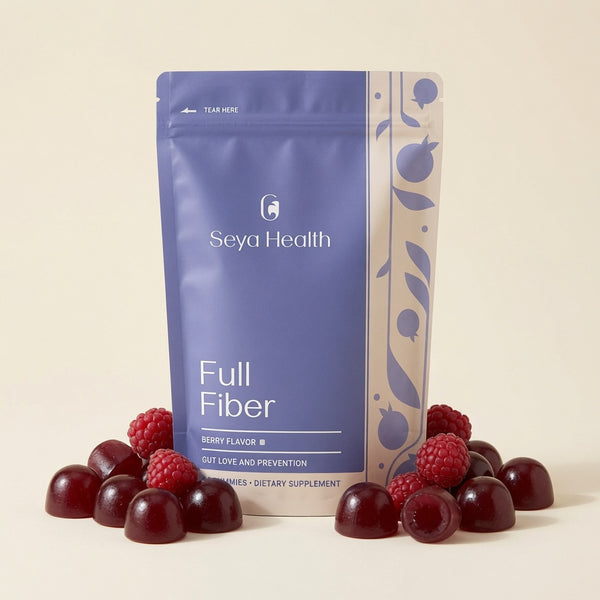
Seya Full Fiber
대부분의 여성은 식이섬유 섭취가 부족합니다. Seya Full Fiber는 세 가지 식이섬유 6그램을 작은 비건 구미 세 개에 담았습니다. 식물성, 젤라틴 무첨가, 당알코올 무첨가.
Full Fiber 쇼핑하기