Home/ The Journal/ bone health
bone health
Creatine for women over 60: muscle, bone, and brain benefits

Short version: Creatine for women over 60 can help you keep muscle and strength, but only if you lift. A review of 22 trials in 721 older adults found creatine plus resistance training added about 1.37 kg more lean mass than training alone. Bone did not change. Brain results are early.
- Muscle: real but modest gains, mostly in the legs, with 2 to 3 strength sessions a week.
- Bone: no bone density benefit in trials up to 2 years.
- Brain: small studies hint at better memory in older adults. Not proven.
- Before you start: check with your doctor if you have kidney disease or take daily medicine.
Last updated October 2026.
After 60, the reason most women think about strength starts to change.
It is less about looking fit. It is more about getting out of a chair, carrying the groceries, and climbing stairs without a second thought.
That is where creatine has a real, if modest, story. Here is what the published trials in older adults found for muscle, bone, and the brain.
Does creatine for women over 60 actually work?
Yes, for muscle and strength, when it is paired with lifting. Not much on its own.
The biggest summary pooled 22 randomized trials with 721 older men and women. Their average age ran from 57 to 70. Everyone did resistance training 2 to 3 days a week, for 7 weeks up to a year. See Chilibeck et al. (Open Access J Sports Med, 2017).
Compared with training plus a placebo, training plus creatine gave:
- Lean mass: about 1.37 kg more.
- Upper body strength: a bigger gain on the chest press.
- Lower body strength: a bigger gain on the leg press.
The authors reported no conflicts of interest for this review.
A newer 2025 review of 8 trials and 482 older adults found a similar picture, but smaller. Leg strength and lean mass went up. Arm strength did not change much. Gains were clearest in programs of 32 weeks or less. See Liu et al. (Eur Rev Aging Phys Act, 2025).
Why muscle matters more after 60
Doctors have a name for the slow loss of muscle and strength with age: sarcopenia.
It is not just about muscle. A 2024 review notes that sarcopenia often travels with weaker bones and changes in brain health. See Candow and Moriarty (Curr Osteoporos Rep, 2024).
That review sums up the creatine research with a neat phrase. For muscle, it is "hope." For bone, it is mostly "hype." For the brain, it is a "ray of hope."
We think that is a fair way to read the evidence, and the rest of this post follows the same order.

What did trials in older women find?
Most trials mix men and women. One Brazilian trial looked only at older women, a group the researchers described as vulnerable. See Gualano et al. (Exp Gerontol, 2014).
It split 60 women into 4 groups for 24 weeks: placebo, creatine, placebo plus lifting, and creatine plus lifting.
- Leg press: up 19.9% with creatine plus lifting, and 15% with lifting alone. That gap was not big enough to count as a real difference.
- Bench press: up 10% with creatine plus lifting. That beat every other group.
- Arm and leg muscle: up 1.31% with creatine plus lifting, versus a small dip with lifting alone.
- Bone: no difference between any of the groups.
So lifting did most of the work in this trial. Creatine added a little on top, mostly in the amount of muscle the researchers could measure.
For trials in women past menopause, including the dose findings, see our deep dive on creatine for menopause.
Does creatine work without exercise?
Not in the long trials.
A 2-year Brazilian trial gave 200 women past menopause 3 g of creatine a day, with no exercise program. Creatine did not help muscle, function, or bone. See Sales et al. (J Gerontol A, 2020).
The good news is that you do not need a gym. The trials used simple strength work: leg press, chest press, squats, and similar moves, 2 to 3 times a week.
Resistance bands, light dumbbells, and your own body weight all count. If you are new to strength training, a physical therapist can build a routine that fits your joints and your balance.
How much creatine do older adults take in trials?
Doses varied, and there is no single magic number.
A 2021 meta-analysis compared dosing plans in older adults who lifted. See Forbes et al. (Nutrients, 2021). Its main points:
- Any dose plus lifting beat placebo for lean mass and strength.
- More than 5 g a day gave bigger leg press gains.
- Taking it only on training days still helped.
Worth knowing: several of those authors have worked with creatine makers. That does not make the data wrong. It is a reason to read it with care.
Your doctor can help you pick a dose that fits your health and your medicines.
Does creatine help bone density after 60?
No, based on the trials so far.
The largest bone trial ran 2 years in 237 women past menopause who lifted and walked. Creatine did not change bone density at the hip or spine. See Chilibeck et al. (Med Sci Sports Exerc, 2023).
The Gualano trial above also found no bone change.
If bone is your main worry, ask your doctor about a bone scan, calcium, vitamin D, and a strength plan. Creatine is not the tool for that job.
Does creatine help memory in older adults?
Maybe. The early signs are interesting, but the studies are small.
- Memory: a 2023 review of 10 trials found creatine helped memory a little overall. The effect looked larger in adults aged 66 to 76. See Prokopidis et al. (Nutr Rev, 2023).
- Healthy aging: a 2026 review found 6 studies in adults 55 and up. Only 2 were supplement trials, and 3 of the 6 were rated poor quality. See Marshall et al. (Nutr Rev, 2026).
- Alzheimer's disease: a pilot gave 20 patients 20 g a day for 8 weeks. Brain creatine rose 11%. There was no placebo group. See Smith et al. (Alzheimers Dement, 2025).
None of this shows that creatine can stop memory loss. If you notice changes in your memory, the right first step is a visit with your doctor.
For the full brain research, read creatine for brain health.
Is creatine safe for women over 60?
For healthy adults, the trials have found it well tolerated.
One thing to know before blood work. A 2026 review of 19 trials found creatine raised blood creatinine by about 0.13 mg/dL. eGFR, the estimate of how well your kidneys filter, did not change. See Tsiaras et al. (J Ren Nutr, 2026).
That small bump can look like a kidney problem on a lab report, even when your kidneys are working normally. Tell your doctor you take creatine before any blood test.
Ask first if you have kidney disease, diabetes, or take daily medicine. For the full list of real and made-up side effects, see creatine side effects in women.
A simple checklist if you are over 60
- Talk to your doctor first. Bring your medicine list.
- Lift 2 to 3 days a week. Every benefit in the trials came with strength training.
- Pick creatine monohydrate. It is the form used in nearly all the trials.
- Choose a tested product. Our guide to whether creatine gummies work shows how to check a label.
- Track what matters. Chair stands, stairs, and grip, not just the scale.
- Give it time. Trials ran 7 weeks to a year.
Losing weight on a GLP-1 medicine? Muscle is even more at stake. See creatine on a GLP-1.
Where Seya fits, honestly
Seya sells one product today: a fiber gummy that supports regularity.
Our creatine gummy is coming January 2027. It is not on sale yet. We will not quote a dose or price until the formula is final.
We wrote this so you can see what the research in older adults actually shows, before you buy creatine from anyone. For the bigger picture, see creatine for women: strength, bone, and brain.
This is education, not medical advice. Talk to a qualified clinician before adding any supplement.
These statements have not been evaluated by the Food and Drug Administration. This product is not intended to diagnose, treat, cure, or prevent any disease.
Frequently asked questions
Should a woman over 60 take creatine?
It can make sense if you do strength training 2 to 3 days a week. A review of 22 trials in older adults found creatine plus lifting added about 1.37 kg more lean mass than lifting alone. Without exercise, a 2-year trial found no benefit. Ask your doctor first.
Does creatine help with sarcopenia?
It may help slow the muscle side of it when paired with lifting. Trials in older adults found modest gains in lean mass and leg strength. A 2024 review called creatine "hope" for aging muscle. It is not a treatment for any disease.
Does creatine help bone density in women over 60?
Not in the trials so far. A 2-year trial of 237 women past menopause found no change in hip or spine bone density. A 24-week trial in older women also found no bone change.
Can creatine help memory in older women?
The evidence is early. A 2023 review found a small memory benefit that looked larger in adults aged 66 to 76. A 2026 review of 6 studies called the evidence limited. No trial shows creatine prevents memory loss.
How much creatine do older adults take?
Trials used a range of doses. A 2021 review found any dose plus lifting beat placebo, and doses above 5 g a day gave bigger leg strength gains. Ask your doctor what fits you.
Is creatine safe for seniors' kidneys?
For healthy adults, trials say yes. Creatine can raise blood creatinine by about 0.13 mg/dL without changing kidney filtering. Tell your doctor before blood work, and ask first if you have kidney disease.
Is Seya's creatine gummy available?
Not yet. Seya's creatine gummy is coming January 2027. Seya's fiber gummy is the product on sale today.
Written and reviewed by the Seya Health Editorial Team. Every health claim on this page is sourced to primary research, as of October 2026. This article is educational and not a substitute for medical advice.
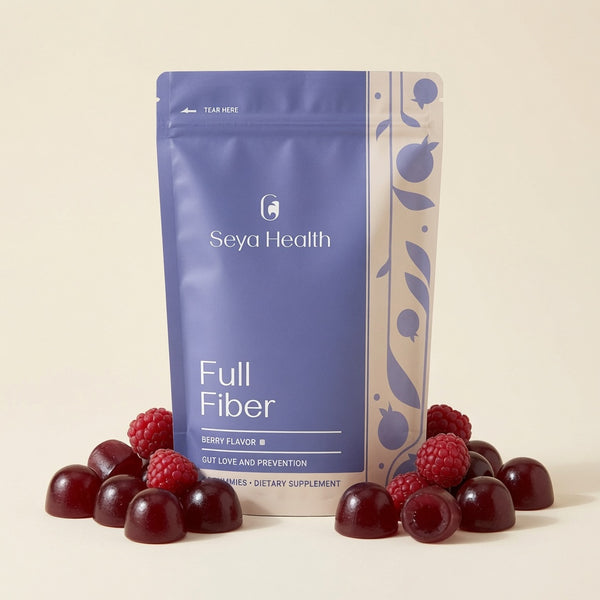
Seya Full Fiber
Most women fall short on fiber. Seya Full Fiber gives you 6 grams from three fibers in three small vegan gummies. Plant based, no gelatin, no sugar alcohols.
Shop Full Fiber