
Home/ The Journal/ digestive health
digestive health
The Fiber Gap in Women: Why Most Fall Short
Most women get about half the fiber they need. The shortfall shows up in your gut, your blood sugar, and your hormones.

Short version: The fiber gap in women is the space between how much fiber you need and how little you actually get. Most women eat about 15 grams a day. The target is about 25. That 10-gram gap hits women harder than men, and it shows up in your gut first.
- The average woman gets about 15 grams of fiber a day. Her target is closer to 25.
- More than 90% of U.S. women fall short. You are not the exception.
- Women's food moves slower, about 42 hours through the colon versus 30 for men, so the same gap lands harder.
Last updated July 2026.
You eat what looks like a healthy day. A salad at lunch. Fruit in the afternoon. And you still come up short on fiber.
Most women do. The average woman in the U.S. gets about 15 grams of fiber a day. Her target is about 25. That is a 10-gram gap, every single day.
This is the fiber gap in women, and it is one of the most consistent shortfalls in the modern diet.
Here is the part that gets skipped. The gap is not only about willpower or eating more salad. Women's bodies move food slower than men's, so the same shortfall lands harder on you. You are not failing at fiber. The odds were stacked against you.
What is the fiber gap in women?
The fiber gap is the distance between the fiber women need and the fiber women eat. The target sits near 25 grams a day for most adult women. Real intake sits near 15. So the typical woman runs about 10 grams short, day after day.
It is not a rare miss. It is the norm. More than 90% of U.S. women do not reach the recommended fiber intake, and only about 5% of the whole population does. A peer-reviewed analysis in Nutrients put it plainly:
"In the U.S. more than 90% of women and 97% of men do not meet the recommended intakes for dietary fiber." — Dietary fiber and chronic disease analysis, Nutrients (2021)
Fiber lives in the foods modern eating squeezes out: beans, whole grains, vegetables, and fruit with the skin on. Processed convenience food is built for taste and shelf life, and fiber is the first thing lost. You can hit a full day of calories and barely touch a third of your fiber target without noticing. The Dietary Guidelines for Americans name fiber a "dietary component of public health concern," one of the few nutrients Americans underconsume across the board.
Want the exact number for your age? See how much fiber women need per day. This page is about why the gap exists and why it matters.
Why does the fiber gap hit women harder?
Because your gut is not a smaller version of a man's gut. It runs slower.
Food takes longer to move through a woman's colon. In one study of 164 healthy adults, colon transit time averaged about 42 hours in women and 30 in men. That is a 40% difference in how long things sit. You can read it in the colonic transit study by Meier and colleagues (1995).
Slower transit means the same missing fiber leaves a bigger mark. That is part of why constipation is far more common in women. Across North American surveys, women report constipation about twice as often as men, roughly 19.7% versus 10.6%. The pattern holds in the review of gender differences in constipation across North America.
This is the whole Seya thesis in one table. Women aren't smaller men. Yet fiber targets, like most nutrition guidance, get built off male-heavy data and handed to everyone the same way.
| Measure | Women | Men |
|---|---|---|
| Daily fiber target (19–50) | ~25 g | ~38 g |
| Average daily intake | ~15 g | ~18 g |
| Reach the target | under 10% | about 3% |
| Colon transit time | ~42 hours | ~30 hours |
| Report constipation | 19.7% | 10.6% |
Read the middle rows. Nearly everyone falls short, but the slower gut and higher constipation rate mean the shortfall costs women more. Same gap, heavier price. If you want the deeper story on why one-size dosing fails women, see why medicine is not one-size-fits-all for men and women.

What does the fiber shortfall actually touch?
More than you would guess. Fiber is not just about staying regular, though that is the clearest effect.
- Your gut. Fiber is the main food for your gut bacteria and the biggest driver of regularity. Too little, and things slow down and back up. The NIH MedlinePlus dietary fiber guide lists better regularity as a core effect.
- Your blood sugar. Soluble fiber slows how fast glucose from a meal reaches your blood, which softens the spike-and-crash after eating.
- Your fullness. Fiber stretches and slows the stomach, so a high-fiber meal keeps you satisfied longer.
- Your hormones. The gut is a key exit route for used estrogen, and emerging research on the "estrobolome" ties gut bacteria to how much estrogen gets recycled back into circulation. This one is still being worked out, so hold it loosely. The current science is summarized in the estrogen and gut microbiome review (Maturitas, 2017).
The gut effect is the settled one. The rest are real but lighter. We flag the difference on purpose, because a lot of fiber marketing does not.
The shortfall also shifts with your life stage. Constipation and bloating tend to climb during hormonal transitions. See luteal phase bloating for the monthly version and the early signs of menopause for the longer one.
How do you close the fiber gap without bloating?
Slowly. That is the whole trick.
A sudden jump from 15 to 30 grams ferments hard and leaves you gassy and bloated. So climb in small steps. Add a few grams every few days, and drink more water as you go. Give your gut a week to adjust before the next bump.
The food swaps are boring, which is usually a good sign:
- Swap one refined grain for a whole one. White rice to brown, white bread to whole grain.
- Add one serving of legumes a day. Beans, lentils, or chickpeas.
- Keep the skin on your fruit and vegetables. Most of the fiber is there.
- Add water every time you add fiber. Fiber needs it to move.
If you already struggle with a slow, backed-up gut, go even gentler. Our guides on why constipation happens and why bloating happens and how to deflate walk through the mechanics.
Here is the reframe worth keeping. That sluggish, backed-up feeling is not a character flaw or proof you ate wrong. Often it is a signal that the fiber is simply missing, and it tends to ease as your intake climbs back toward the target.
Seya's job is to stay specific, not loud. The evidence that fiber supports regularity earns a grade of C at about 5 grams, roughly half the dose used in the bigger trials, so that is exactly what we claim and nothing beyond it. 3 vegan gummies with resistant tapioca fiber, ingredients you can actually name, are an honest daily fiber habit. They are not a fix for a medical condition, and they will not do the work of a whole-food diet.
These statements have not been evaluated by the Food and Drug Administration. This product is not intended to diagnose, treat, cure, or prevent any disease.
Related reading: our daily fiber gummy for women, fiber and GLP-1 support for women, and more from the Seya journal.
Frequently asked questions
What is the fiber gap in women?
The fiber gap is the difference between the fiber women need and the fiber they eat. Most adult women should aim for about 25 grams a day but average closer to 15, leaving a roughly 10-gram daily shortfall. More than 90% of U.S. women fall short of the recommended intake.
Why do women get less fiber than they need?
Fiber lives in beans, whole grains, vegetables, and fruit with the skin on, and processed convenience foods that crowd those out are low in fiber. On top of that, women's guts move food more slowly than men's, so the same shortfall causes more constipation and discomfort. It is a diet-and-physiology problem, not a willpower failure.
Does the fiber gap affect women differently than men?
Yes. Food moves through a woman's colon more slowly, about 42 hours on average versus 30 for men, and women report constipation roughly twice as often, about 19.7% versus 10.6%. So even though both sexes fall short of the fiber target, the shortfall tends to hit women harder.
Related reading
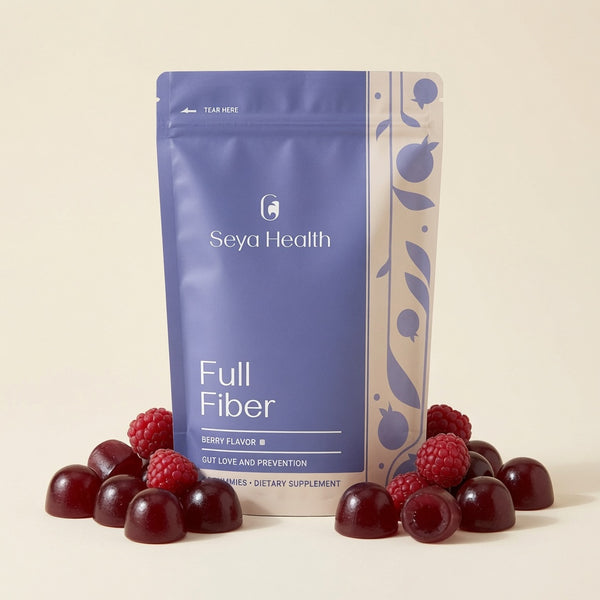
Seya Full Fiber
Getting enough fiber from food every day is hard. Seya Full Fiber is 6 grams from three fibers in one, in three small gummies, so you have a reliable daily floor. Plant based, no gelatin, no sugar alcohols, 60 gummies per pouch.
Shop Full FiberKeep reading

fiber
Can a Multivitamin Replace Vegetables? What Supplements Can't Do for Your Gut

constipation
The Best Way to Beat Constipation in Your 30s (and Where Fiber Gummies Fit)
fiber
The Gut-Skin Axis: Does Your Gut Health Affect Your Skin?
The gut-skin axis, explained: how your gut bacteria and blood sugar affect your skin, w...