

The short version: Here is how GLP-1 works. It is a hormone your gut makes after you eat. It tells your pancreas to release insulin, and it tells your brain you are full. Incretin messengers like it drive an estimated 50 to 70% of the insulin you release after a meal.
- It only pushes insulin when your blood sugar is already up, so it rarely sends glucose too low on its own.
- It also reaches your brain. That is why appetite and intrusive food thoughts quiet down on the medications.
- Fiber is not one of these drugs and cannot replace one. But your body makes its own version, and fiber is part of that story.
Last updated July 2026.
You eat. Blood sugar climbs. Within minutes, a messenger in your gut goes to work.
That messenger is GLP-1. You have heard the brand names built on it: Ozempic, Wegovy, Zepbound. Every one of them copies a signal your own body already sends. Once you see the real mechanism, the hype quiets and the biology gets clear.
How GLP-1 works: what it is and where it comes from
GLP-1 stands for glucagon-like peptide-1. Scientists call it an "incretin," which just means a gut cue that boosts insulin after food. Cells in your intestinal lining, named L-cells, secrete it the moment nutrients arrive.
"Glucagon-like peptide 1 (GLP-1) [is] an incretin hormone secreted by intestinal L-cells in response to glucose and other ingested nutrients." — Doyle and Egan, National Institutes of Health (PMC)
None of this is recent. Researchers first identified the hormone in the 1980s. Turning that discovery into medicine took nearly two decades. The first receptor agonist, exenatide, won FDA approval on April 28, 2005. Every product since refines that single idea.
How does GLP-1 affect blood sugar and insulin?
It prompts your pancreas to release insulin, but only while glucose is already high. That timing is the entire trick, and it is why the hormone rarely drops your sugar too far by itself.
"The ability of GLP-1 and GLP-1R agonists to promote insulin secretion depends upon elevated blood glucose levels." — Doyle and Egan, National Institutes of Health (PMC)
The hormone handles three jobs at once. It tells the pancreas to make insulin. It silences glucagon, the counterpart that shoves sugar upward. And it slows how quickly your stomach empties, so a meal arrives as a gentle tide instead of a spike.
Together the effect is huge. Incretin messengers account for roughly 50 to 70% of the insulin your body puts out after eating, per a review in Physiological Reviews. Most of your post-meal insulin runs on a quiet gut signal you never notice.
Why does GLP-1 quiet hunger and food noise?
Because the signal does not stop at your pancreas. It also reaches your brain, landing in the hypothalamus and brainstem, the regions that manage hunger and fullness. Loud signal, you feel done. Faint signal, you do not.
You already ate. You are not hungry. You are circling the kitchen anyway.
You have probably blamed willpower. Most people do. But that pull is not a character flaw. It is a signal, and "food noise" is its name: the constant, intrusive chatter about your next snack. GLP-1 turns the volume down.
The medications lean hard on this brain effect. In trials, the strongest doses trimmed how much people ate at a sitting by up to a third. That is an appetite brake, not discipline. You can trace the gut-brain reward loop in this NIH review on the hormone and food reward.
GLP-1 medications vs. the version your body already makes
Same signal, wildly different volume. One comes by prescription. The other you brew yourself at every meal. Here is the honest comparison.
| Feature | What your gut makes | The medications |
|---|---|---|
| Source | Your own L-cells, after food | An injection or pill |
| How long it lasts | Minutes; it degrades fast | Days; built to resist breakdown |
| Signal strength | Gentle, meal-sized | Strong and steady |
| Effect on appetite | A normal fullness nudge | A large, lasting drop in hunger |
| Prescription needed | No, it is built in | Yes |
Notice the gap. Food and fiber shift your own supply a little. The drugs push an engineered copy a lot. Anything marketing a supplement as equal to the shot is selling a story.

Where does fiber fit as a companion?
Fiber is not one of these medicines, and it will not stand in for one. Say that plainly first. But your gut brews its own GLP-1, and fiber is one lever that nudges the amount upward.
The pathway is tidy. When bacteria ferment fiber, they produce short-chain fatty acids. Those bind receptors on your L-cells and coax out more of the hormone.
"SCFAs activate the free fatty acid receptors FFAR2 and FFAR3 on the intestinal L-cells, thereby stimulating endogenous GLP-1 secretion, with propionate acting as the most potent agonist of these receptors." — Frontiers in Endocrinology, 2026 scoping review
The human evidence is real but modest. In a randomized crossover study of 20 volunteers, piping fiber's fermentation product straight into the colon raised the hormone and cut intake at the next meal by 13.8%. A 2026 review pooling 52 studies and 1,085 people found fiber can lift both your own supply and satiety, though results hinge on the fiber type and dose.
Now the honest scope. Those trials use diet-level fiber, often far above what any gummy delivers. Seya sells a fiber gummy, never a GLP-1 drug. The proof that fiber supports regularity is graded C at about 5 grams, roughly half the dose used in the larger studies.
So that is exactly what we claim, and nothing more. 3 vegan gummies with resistant tapioca fiber, ingredients you can name, are an honest daily habit. They support regularity. They will not silence food noise like a prescription, drain hunger on command, or substitute for medicine.
This statement has not been evaluated by the Food and Drug Administration. This product is not intended to diagnose, treat, cure, or prevent any disease.
Related reading: our daily fiber gummy for women and more from the Seya journal.
Frequently asked questions
What is GLP-1, and how does it work?
It is a hormone your gut releases after you eat. The signal prompts your pancreas to make insulin when glucose is high, quiets the counterpart that raises sugar, and slows how fast your stomach empties. It also tells your brain you are full. Incretin messengers like it drive an estimated 50 to 70% of the insulin you release after a meal.
Why do people feel less hungry on GLP-1 medications?
Because the hormone acts on the hypothalamus and brainstem, the brain regions that govern appetite. The drugs copy your own version but last far longer and hit harder, so the fullness cue stays switched on. In trials, the strongest doses trimmed intake at a meal by up to a third, which is why cravings and food noise fade.
What are the benefits of GLP-1?
Your natural supply steadies glucose after meals, curbs the hormone that pushes sugar up, slows digestion, and signals fullness. As a medicine, a longer-lasting copy is prescribed for type 2 diabetes and appetite control under a doctor's care. It is not a supplement, and no fiber gummy equals the drug.
Related reading
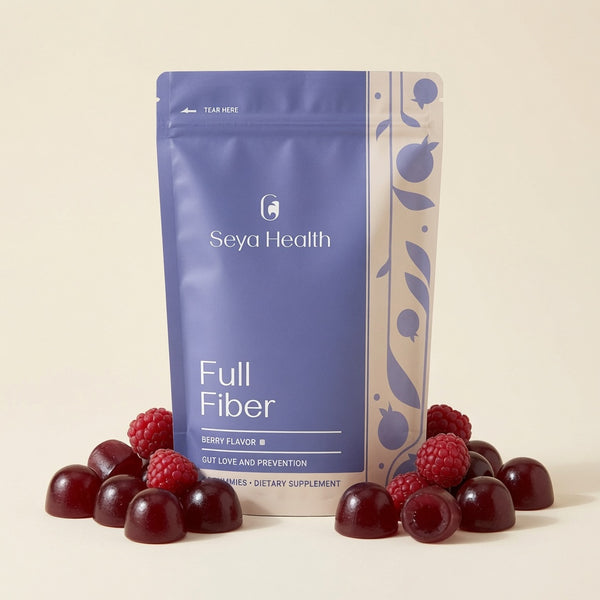
Seya Full Fiber
More than 90% of women fall short on fiber. Seya Full Fiber gives you 6 grams from three fibers in one, in three small gummies that feed the beneficial bacteria in your gut. Plant based, no gelatin, no sugar alcohols.
Shop Full FiberKeep reading
fiber
Can a Multivitamin Replace Vegetables? What Supplements Can't Do for Your Gut

constipation
The Best Way to Beat Constipation in Your 30s (and Where Fiber Gummies Fit)
fiber
The Gut-Skin Axis: Does Your Gut Health Affect Your Skin?
The gut-skin axis, explained: how your gut bacteria and blood sugar affect your skin, w...