
Home/ The Journal/ cortisol
cortisol
The real reason you can't wind down at night
When your nervous system stays switched on, sleep gets shallow. The magnesium-cortisol connection, explained.

Short version: If you can't wind down at night, that is arousal, not a discipline problem. Your stress axis is still running, and it shows up on a blood test.
- People with chronic insomnia ran higher cortisol across 24 hours, and the gap was widest in the evening and the first half of the night.
- In 3,045 women aged 42 to 52, 30.8% reported at least one sleep difficulty, and the rate climbed as they moved through the menopause transition.
- 400 mg of caffeine taken 6 hours before bed cut measured sleep by more than an hour. The people drinking it did not notice.
Last updated August 2026.
You are exhausted. You got into bed on time. Your brain is running tomorrow's meeting anyway.
That state has a name in the sleep literature, and it is not laziness. It is arousal.
The short version: your body never got the signal to change modes. Not because you failed to relax hard enough.
What if you can't wind down at night, even when you're exhausted?
Then the problem is upstream of your bedtime routine.
Researchers measured hormones around the clock in people with chronic insomnia and in healthy sleepers. The insomnia group secreted more ACTH and more cortisol over 24 hours, at 218.0 versus 190.4 nm for cortisol. The difference was largest in the evening and the first half of the night.
The worse the sleep, the higher the cortisol. People sleeping less than 70% of their time in bed put out more than those with mild disruption.
The authors' own conclusion is the useful part. They wrote that treatment should aim at "decreasing the overall level of physiologic and emotional arousal, and not just to improve the nighttime sleep." That is Vgontzas et al., Journal of Clinical Endocrinology and Metabolism, 2001.
It was a small study, 11 people with insomnia against 13 controls. Small, and measured directly rather than asked about.
What is the cortisol curve, and why does it matter at night?
Cortisol is supposed to move on a schedule.
High in the morning, to get you upright. Falling through the day. Lowest around the time you are meant to be asleep.
When evening cortisol stays up, your body keeps running the daytime program. Alert. Scanning. Ready. Sleep still arrives, but shallower, and easier to break.
This is the part worth relocating. You have probably read the wired-but-tired feeling as a personal failure of self-control at 11pm. It is a signal from a system that never downshifted, and you cannot out-schedule a hormone.
Why does this get louder in your 40s?
Because the hormonal ground is moving, and the data on that is not subtle.
The Study of Women's Health Across the Nation followed 3,045 women aged 42 to 52. At baseline, 30.8% reported at least one sleep difficulty. Waking repeatedly during the night was the most common, at 25.9%. Trouble falling asleep affected 10.1%.
Those rates rose as women moved deeper into the transition. Difficulty sleeping went from about 30% before the transition to roughly 40 to 45% in the perimenopausal years. See Sleep disturbance during the menopausal transition (SWAN).
So if your sleep changed around 45 and you assumed you had simply gotten worse at it, roughly 4 in 10 women around you had the same year.
More on what else shifts in that window is in the early signs of menopause.
Is caffeine still in your system at bedtime?
Probably, and this is the cheapest thing on the list to test.
In a controlled trial, people took 400 mg of caffeine, roughly 2 to 3 cups of coffee, at bedtime, 3 hours before bed, or 6 hours before bed. Even the 6-hour dose cut objectively measured sleep by more than an hour.
The finding that matters most: the participants did not report feeling that their sleep was worse. The disruption was real and invisible at the same time. See Drake et al., Journal of Clinical Sleep Medicine, 2013.
A 3pm coffee is a 9pm dose. You will not feel it. Your sleep architecture will.
Does what you eat change how deeply you sleep?
There is a signal here, and we are going to be careful about how big we say it is.
In a randomized crossover study, 26 adults aged 30 to 45 were fed a controlled diet, then allowed to choose their own food for a day, with sleep measured in a lab throughout.
Greater fiber intake predicted more time in slow-wave sleep, the deepest stage. More energy from saturated fat predicted less of it. More sugar predicted more arousals from sleep. That is St-Onge et al., Journal of Clinical Sleep Medicine, 2016.
Now the honest framing. Twenty-six people. One day of self-selected eating. These are associations inside a small trial, not proof that adding fiber will fix your sleep.
What it does suggest is that a day built almost entirely on refined food is not a neutral input to the night that follows. Most women are running well short on fiber anyway, which we covered in the fiber gap.
What actually builds an off-ramp?
Boring, repeatable inputs. The kind that lower arousal rather than schedule sleep.
Keep one wake time. The same one, weekends included. It anchors the whole rhythm, and it is the single lever with the widest reach.
Move your caffeine cutoff earlier. Given the 6-hour finding, an 11pm bedtime argues for nothing after about 3pm.
Drop the light in the last hour. Bright evening light tells the same system it is still daytime.
Get the room cool. Body temperature has to fall for sleep to start.
Park tomorrow on paper. A written list stops the rehearsal loop from running in your head at midnight.
Eat a day with actual plants in it. Not as a sleep aid. As one of the inputs the research keeps finding attached to deeper sleep. Where to start is in high-fiber foods for women.
If this has run for weeks, or you snore heavily, wake gasping, or feel unrefreshed no matter the hours, that is a conversation for a clinician. Sleep apnea is common in women and routinely missed.
Where Seya fits, honestly
Seya sells one product. A fiber gummy. It supports regularity.
We are not going to tell you it is a sleep product, because the evidence does not support that claim and we would rather keep your trust than make it.
What is true is narrower. Fiber intake shows up in the diet-and-sleep research as one associated input among several, and almost every woman is short on it. Closing that gap is worth doing on its own terms, for regularity, for the gut, for the reasons we already have evidence for.
If your gut has also slowed down in this same stretch of life, that overlap is real and we wrote it up in perimenopause and constipation.
This is education, not medical advice. Talk to a qualified clinician about persistent sleep problems, especially before starting or stopping anything.
These statements have not been evaluated by the Food and Drug Administration. This product is not intended to diagnose, treat, cure, or prevent any disease.
Frequently asked questions
Why can't I wind down at night even when I'm tired?
Because tiredness and arousal are separate systems, and arousal can stay switched on. Researchers measuring hormones around the clock found that people with chronic insomnia secreted more cortisol over 24 hours than healthy sleepers, 218.0 versus 190.4 nm, with the widest gap in the evening and the first half of the night. The authors concluded that the target should be lowering overall physiological arousal, not just the hours of sleep. Feeling wired while exhausted is that state, measured.
What is the cortisol curve and how does stress affect it?
Cortisol normally peaks in the morning and falls to its lowest point at night. When evening cortisol stays elevated, the body keeps running an alert daytime pattern into the hours when sleep should deepen, which produces lighter sleep and more awakenings. In the insomnia research, people with the most disturbed sleep, under 70% of time in bed spent asleep, secreted the most cortisol.
Is sleep trouble normal in your 40s?
It is extremely common. In the Study of Women's Health Across the Nation, 30.8% of 3,045 women aged 42 to 52 reported at least one sleep difficulty at baseline, most often waking repeatedly during the night at 25.9%. Reported difficulty rose from about 30% before the menopause transition to roughly 40 to 45% during the perimenopausal years, independent of several other factors.
How late is too late for caffeine?
Later than most people assume. In a controlled trial, 400 mg of caffeine taken 6 hours before bedtime reduced objectively measured total sleep time by more than an hour, and participants did not perceive the disruption. For an 11pm bedtime that argues for a caffeine cutoff around 3pm. Individual sensitivity varies, so the practical test is moving your cutoff earlier for two weeks and comparing.
Does fiber help you sleep?
The evidence is suggestive, not conclusive, and it should not be sold as a sleep aid. In a randomized crossover study of 26 adults, higher fiber intake predicted more slow-wave sleep, while more saturated fat predicted less and more sugar predicted more arousals. That is a small study measuring associations across a single day of self-selected eating. Fiber has solid evidence for regularity. Treating it as a sleep intervention goes beyond what the data supports.
When should you see a doctor about sleep?
When the problem has lasted weeks, when you snore heavily or wake gasping, or when you feel unrefreshed regardless of how long you were in bed. Sleep apnea is frequently missed in women, and insomnia that persists is itself linked to chronic activation of the stress axis, which the researchers flagged as a reason to take it seriously rather than wait it out.
Related reading
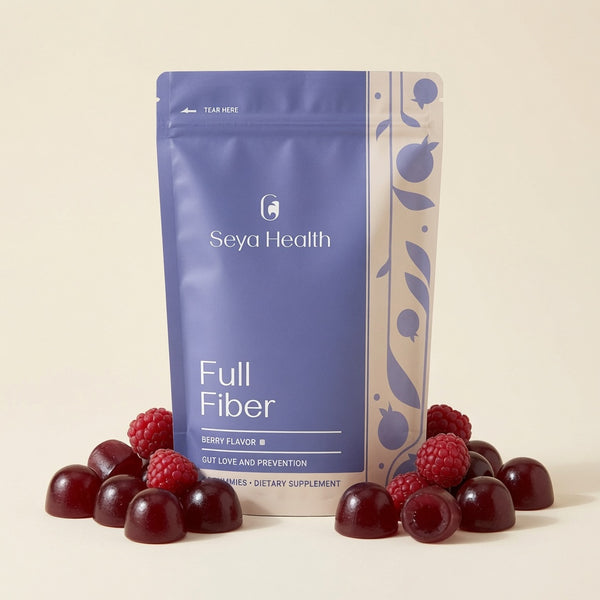
Seya Full Fiber
More than 90% of women fall short on fiber. Seya Full Fiber gives you 6 grams from three fibers in one, in three small gummies that feed the beneficial bacteria in your gut. Plant based, no gelatin, no sugar alcohols.
Shop Full FiberKeep reading

fiber
Can a Multivitamin Replace Vegetables? What Supplements Can't Do for Your Gut

constipation
The Best Way to Beat Constipation in Your 30s (and Where Fiber Gummies Fit)

fiber
The Gut-Skin Axis: Does Your Gut Health Affect Your Skin?
The gut-skin axis, explained: how your gut bacteria and blood sugar affect your skin, w...