Short version: What is sarcopenia? It is the slow loss of muscle strength and muscle mass that comes with age. Doctors now call it a muscle disease. Large studies put it at 10% to 27% of adults over 60. The early signs are easy to miss: a weaker grip, slower walking, and needing your arms to get out of a chair.
- Strength comes first: doctors look at strength before they measure muscle size.
- Menopause matters: falling hormones may speed up muscle loss in women.
- The main fix is lifting: guidelines strongly recommend strength training, plus enough protein.
- Simple tests: a grip test, a chair test, and a walking test.
Last updated October 2026.
You may not notice muscle loss until a jar lid will not budge.
Or the stairs feel steeper than they used to. Or you push off the arms of a chair to stand up without thinking about it.
Those small moments can be early signs of sarcopenia. Here is what it is, how to spot it, and what the research says helps.
What is sarcopenia, in plain words?
Sarcopenia is the loss of muscle strength and muscle mass over time. The word comes from Greek for "poverty of flesh."
In 2019, a European expert group updated how doctors define it. They called it a muscle disease, or "muscle failure," that builds up across a lifetime. It is most common in older adults, but it can start earlier. See Cruz-Jentoft et al. (Age Ageing, 2019).
The big change: low strength is now the key sign, not just small muscles. Muscle size is checked second, to confirm it.
Sarcopenia also has its own medical code in the US, M62.84, since 2016. That lets doctors record it as a real diagnosis. See Anker et al. (J Cachexia Sarcopenia Muscle, 2016).
How common is sarcopenia?
More common than most people think.
A 2022 review pooled 151 studies and close to 700,000 people. In adults 60 and older, between 10% and 27% had sarcopenia. The range depends on which definition the study used. See Petermann-Rocha et al. (J Cachexia Sarcopenia Muscle, 2022).
International guidelines give a similar range, about 6% to 22% of older adults. See Dent et al. (J Nutr Health Aging, 2018).
The loss starts long before it shows. One review notes that muscle mass drops by about 3% to 8% each decade from age 30. The pace picks up after 60. See Buckinx and Aubertin-Leheudre (Int J Womens Health, 2022).
Signs of muscle loss women should know
Sarcopenia rarely hurts. It shows up as everyday tasks getting harder. Watch for these signs:
- A weaker grip. Jars, heavy pans, and grocery bags feel harder to hold.
- Trouble rising from a chair. You need your arms, or a few tries, to stand up.
- Slower walking. Friends pull ahead, or you cannot cross the street before the light changes.
- Stairs feel harder. You reach for the rail more, or stop to rest.
- More falls or near-falls. Weak legs and poor balance often go together.
- Feeling weak or tired. Carrying a bag across the parking lot wears you out.
- Losing weight without trying. Some of that may be muscle.
These line up with a short 5-question screen called SARC-F. It asks about strength, walking, rising from a chair, climbing stairs, and falls. See Malmstrom and Morley (J Am Med Dir Assoc, 2013).
One sign alone does not mean you have sarcopenia. Several together are worth raising with your doctor.

How do doctors test for sarcopenia?
The tests are quick, and most need no special scan. The 2019 European guide lists these cut-offs for women. See Cruz-Jentoft et al. (Age Ageing, 2019).
- Grip strength: under 16 kg on a hand dynamometer points to low strength. The cut-off for men is 27 kg.
- Chair stand: taking more than 15 seconds to stand up 5 times, arms crossed, points to low strength.
- Muscle amount: if strength is low, a body scan such as DXA checks how much muscle you have.
- Walking speed: 0.8 meters per second or slower marks severe sarcopenia.
Guidelines also suggest a quick screen with walking speed or the SARC-F questions. See Dent et al. (J Nutr Health Aging, 2018).
Ask for these tests at your yearly checkup if any of the signs above sound familiar. They take a few minutes.
Why menopause can speed up muscle loss
Menopause brings big hormone shifts, especially a drop in estrogen. A 2022 review says these changes could speed up sarcopenia, or help start it. See Buckinx and Aubertin-Leheudre (Int J Womens Health, 2022).
The same review lists other risk factors that are not about sex:
- Moving less: long stretches of sitting or bed rest.
- Too little protein: muscle needs it to repair and rebuild.
- Low vitamin D intake: listed as a risk factor in the review.
Women also start with less muscle than men, on average. So the same loss can cross the line into weakness sooner.
Midlife is a good time to start protecting muscle, well before signs appear. For the bigger hormone picture, see how to support your hormones after 40.
What helps with sarcopenia?
Strength training comes first. International guidelines strongly recommend resistance exercise for sarcopenia. They make a weaker, conditional recommendation for protein. They make no recommendation for vitamin D pills. See Dent et al. (J Nutr Health Aging, 2018).
Here is what that looks like in real life:
- Lift 2 to 3 times a week. The menopause review suggests strength work 3 times a week, plus 150 minutes of moderate cardio. Bands, light weights, and body weight all count.
- Eat enough protein. An expert group advises adults over 65 to get at least 1.0 to 1.2 g of protein per kg of body weight each day. That is 60 to 72 g for a 60 kg (132 lb) woman. More if you are active. See Bauer et al. (J Am Med Dir Assoc, 2013).
- Check with your doctor about kidneys. That same group says people with severe kidney disease may need less protein, not more.
- Practice balance. Fewer falls protect the muscle you have.
If you are new to lifting, a physical therapist can build a safe plan around your joints and balance.
Does creatine help sarcopenia?
It may add a little on top of strength training. It does not work alone.
A review of 22 trials in older adults found creatine plus lifting added about 1.37 kg more lean mass than lifting alone. See Chilibeck et al. (Open Access J Sports Med, 2017).
But a 2-year trial in women past menopause found that creatine with no exercise did not help muscle or function. See Sales et al. (J Gerontol A, 2020).
So creatine is a possible helper, not a treatment. For the trial details, read creatine for women over 60 and creatine for menopause.
Losing weight on a GLP-1 medicine? Muscle is even more at stake. See creatine on a GLP-1.
When to talk to your doctor
- You have fallen, or nearly fallen, in the past year.
- You struggle to stand from a chair without your arms.
- You are losing weight without trying.
- Your walking has slowed, or stairs feel much harder.
Weakness and weight loss can have other causes too. A doctor can sort out what is going on.
Where Seya fits, honestly
Seya sells one product today: a fiber gummy that supports regularity. It does not build muscle.
Our creatine gummy is coming January 2027. It is not on sale yet. We will not quote a dose or price until the formula is final.
We wrote this so you can spot muscle loss early and know what the research backs first: strength training and protein. For the wider creatine picture, see creatine for women: strength, bone, and brain.
This is education, not medical advice. Talk to a qualified clinician before adding any supplement.
These statements have not been evaluated by the Food and Drug Administration. This product is not intended to diagnose, treat, cure, or prevent any disease.
Frequently asked questions
What is sarcopenia?
Sarcopenia is the loss of muscle strength and muscle mass that builds up with age. A 2019 European expert group calls it a muscle disease. Low strength is the main sign, and muscle size is checked to confirm it.
What are the symptoms of sarcopenia?
Common signs are a weaker grip, trouble standing up from a chair, slower walking, harder stairs, more falls, and losing weight without trying. It usually does not hurt, so it is easy to miss.
What causes sarcopenia?
Aging is the main driver. Moving less, too little protein, low vitamin D, and hormone changes add to it. In women, the drop in estrogen at menopause may speed it up.
How is sarcopenia diagnosed?
Doctors start with strength. For women, a grip under 16 kg or taking more than 15 seconds to stand up 5 times points to low strength. A scan such as DXA then checks muscle amount. Walking 0.8 meters per second or slower marks severe sarcopenia.
How common is sarcopenia in women after menopause?
A 2022 review of 151 studies found sarcopenia in 10% to 27% of adults over 60, depending on the definition. A 2022 review focused on menopausal women says hormone changes may raise the risk.
Can you reverse muscle loss?
You can often rebuild strength. Guidelines strongly recommend resistance training, and suggest enough protein, about 1.0 to 1.2 g per kg of body weight a day for adults over 65. Talk to your doctor first.
Is Seya's creatine gummy available?
Not yet. Seya's creatine gummy is coming January 2027. Seya's fiber gummy is the product on sale today.
Written and reviewed by the Seya Health Editorial Team. Every health claim on this page is sourced to primary research, as of October 2026. This article is educational and not a substitute for medical advice.
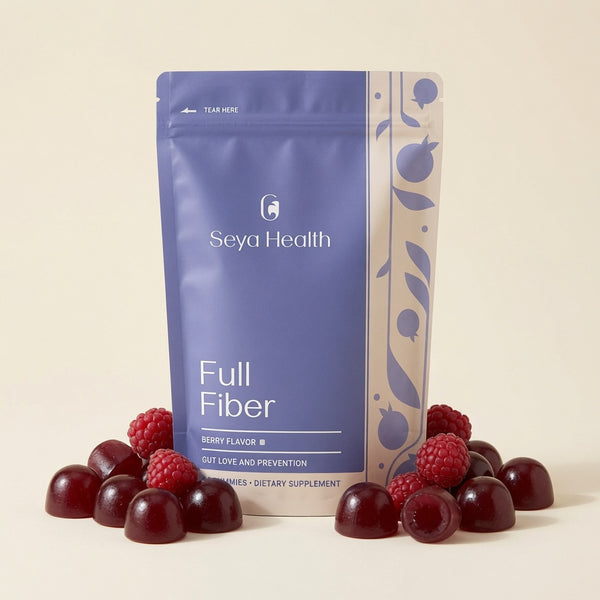
Seya Full Fiber
Most women fall short on fiber. Seya Full Fiber gives you 6 grams from three fibers in three small vegan gummies. Plant based, no gelatin, no sugar alcohols.
Shop Full Fiber