Home/ The Journal/ Asian American women
Asian American women
Best Fiber Gummies for Asian Women: Dairy and Gut Guide

Short version: The best fiber gummies for Asian women are the same good gummies as for any woman, with one extra filter: check for milk ingredients. NIDDK lists Asian Americans among the groups more likely to have lactose malabsorption. And the American Diabetes Association (ADA) says to consider diabetes testing at a BMI of 23, not 25, for people of Asian ancestry.
- "Asian American" covers many different groups, and risk data differs between them.
- Lactose malabsorption is not the same as lactose intolerance.
- Plant fiber foods and plant based gummies carry no lactose to begin with.
Last updated October 2026.
Most fiber gummy guides ignore who is reading them. This one doesn't, but it stays careful. Asian American women are not one group, and a population average says nothing certain about you.
For the basics, such as how much fiber to aim for and how to compare labels, our best fiber gummies for women roundup has you covered. This page sticks to two things that come up for this group: dairy and diabetes screening.
What are the best fiber gummies for Asian women?
The same ones that suit any woman: a named fiber, a clear dose, and an ingredient list you can read. Nothing we found says Asian American women need a different amount of fiber.
What differs is health context. The American Heart Association notes that risk varies a lot between Asian American subgroups, and that most studies fail to look at those subgroups one by one. So treat every number below as a rough average. It is a reason to ask your own questions, not a label for you.
Why does milk bother so many Asian American women?
Often because of lactose malabsorption. That means your gut makes less of the enzyme that breaks down milk sugar. The NIDDK says Asian Americans are among the groups more likely to have lactose malabsorption, along with African Americans, American Indians, and Hispanics and Latinos.
But malabsorption is not the same as intolerance. The NIDDK says not everyone with malabsorption has symptoms. An NIH consensus panel agreed. It found that most people with malabsorption do not have clinical lactose intolerance, and that the true prevalence of intolerance is not known.
Dose matters too. In a breath-test study in Hangzhou, China, 60 healthy adults took 10, 20, and 40 grams of lactose. Symptoms rose with the dose, from 3% of people at 10 grams to 22% at 20 grams. That is one small study, not every Asian American group.
Can you get fiber without dairy?
Yes. Lactose is in all milk and milk products. Plant foods like beans, lentils, and vegetables are not milk products. For ideas, see high-fiber foods for women.
The catch is hidden milk. The NIDDK says milk can be added to baked goods, cereals, soups, snack foods, and protein powders. It also says a small amount of lactose may be in some medicines.
It is not always the dairy, either. Gas and bloat have many causes. Our guide to why you feel bloated walks through them, including fiber added too fast.

Should you get checked for diabetes at a lower weight?
Ask your doctor. The ADA's 2026 Standards of Care say testing should be considered for adults with overweight or obesity, defined as a BMI of 25 or higher, or 23 or higher for people of Asian ancestry, who have at least one other risk factor.
That is a lower line than for other adults. A BMI of 23 is not a diagnosis. It is a prompt to talk to your clinician about a simple blood test.
What to look for in a fiber gummy if you avoid dairy
Read the full ingredient list, not just the front of the jar. The NIDDK says these words mean a product contains lactose: milk, lactose, whey, curds, milk by-products, dry milk solids, and nonfat dry milk powder.
Seya Full Fiber is plant based, with no gelatin. One serving of three gummies gives 6 g of fiber, and a pouch lasts 20 days. Still read the label on any product, ours included. Formulas change.
If you have symptoms after small amounts of lactose, ask your doctor or dietitian about the medicines and supplements you take.
These statements have not been evaluated by the Food and Drug Administration. This product is not intended to diagnose, treat, cure, or prevent any disease.
Frequently asked questions
Do Asian American women need more or less fiber?
Nothing we found says so. Asian American is a broad label, and the AHA notes that risk differs by subgroup. What differs in population data is health context, such as lactose malabsorption and the lower BMI line for diabetes testing, not the fiber you need.
Can I take a fiber gummy if I am lactose intolerant?
Often yes, if it has no milk ingredients. Check the label for milk, lactose, whey, and dry milk solids, which the NIDDK lists as signs a product contains lactose. Seya Full Fiber is plant based. If you have symptoms, ask your doctor first.
Is lactose malabsorption the same as lactose intolerance?
No. Malabsorption means you digest less lactose. Intolerance means it gives you symptoms. The NIDDK says not everyone with malabsorption has intolerance, and many people can handle about 12 grams of lactose, the amount in about 1 cup of milk, with no or mild symptoms.
At what BMI should I ask about diabetes testing?
The ADA says testing should be considered at a BMI of 23 or higher for people of Asian ancestry who have one or more other risk factors, such as a relative with diabetes. Ask your clinician what applies to you.
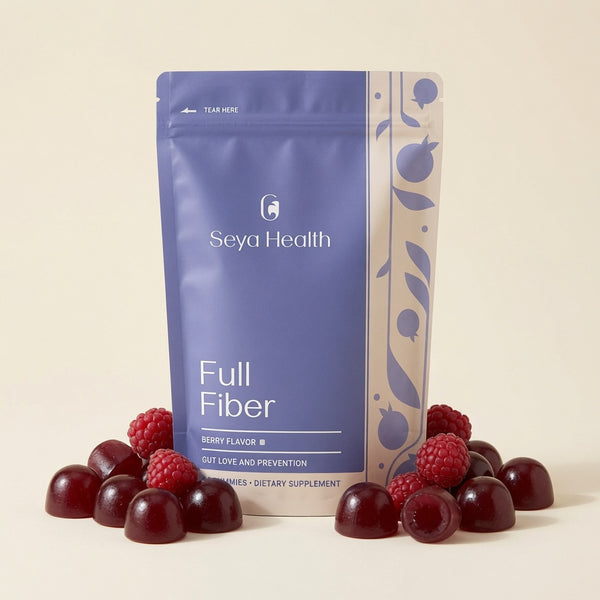
Seya Full Fiber
Most women fall short on fiber. Seya Full Fiber gives you 6 grams from three fibers in three small vegan gummies. Plant based, no gelatin, no sugar alcohols.
Shop Full Fiber