Short version: In the creatine monohydrate vs HCl matchup, both forms work, and monohydrate is the safer bet. In 3 of 4 human trials that compared them, HCl did no better, per a 2022 review in Nutrients and a 2024 trial in 40 adults. Monohydrate also packs more creatine per gram and costs about half as much.
- Monohydrate: the form most studies use, 87.9% creatine, about $0.12 a gram.
- HCl: dissolves better in water. That has not been shown to mean better results.
- Smaller HCl doses: less creatine is less creatine. No trial shows a tiny dose matches 3 to 5 g of monohydrate.
Last updated October 2026.
Creatine HCl comes with a big promise. Take less, skip the loading, skip the bloat.
Monohydrate comes with something else: decades of data.
So which one should you buy? We read every human trial we could find that tested the two side by side. Here is what they found, and where the HCl pitch comes from.
What's the difference between creatine HCl and creatine monohydrate?
Both deliver the same creatine molecule. The difference is what rides along with it.
- Creatine monohydrate is creatine bound to one water molecule. By weight it is 87.9% creatine.
- Creatine HCl is creatine bound to hydrochloric acid, a salt. By weight it is 78.2% creatine.
Both figures come from Kreider et al. (Nutrients, 2022). Once either form breaks apart in your gut, your body sees plain creatine. Your muscles store it as fuel for short, hard efforts like a heavy lift or a sprint up the stairs.
New to how that works? Start with how creatine powers strength training.

Is creatine HCl better than monohydrate?
Not on the evidence so far. Here are the head-to-head human trials, smallest claim first.
| Trial | Who | Doses | Result |
|---|---|---|---|
| Tayebi and Arazi, 2020 | 36 trained men, 7 days | 3 g HCl vs 3 g or 20 g monohydrate | HCl no better |
| Eghbali et al., 2024 | 40 adults, 8 weeks of lifting | Same dose by body weight | Both beat placebo; HCl no better |
| Londoño-Velásquez et al., 2025 | 31 elite athletes, men and women, 8 weeks | 5 g a day of each | No difference between forms |
| Duan et al., 2026 | 40 male soccer players, 4 weeks | 5 g a day of each | HCl beat monohydrate on jump, sprint, and peak power |
Sources: the 2020 trial is summarized in the 2022 Nutrients review. See also Eghbali et al. (Physiol Res, 2024), Londoño-Velásquez et al. (JISSN, 2025), and Duan et al. (JISSN, 2026).
How to read the one win for HCl
The 2026 soccer trial is the best case for HCl. It is real, and its authors reported no conflicts. Still, three things keep it in proportion.
- Each group had 10 players, and the trial ran 4 weeks.
- The authors flag their own limit: 5 g of each form does not deliver the same amount of creatine.
- The other three trials did not see an edge.
In fairness the other way, some authors of the 2025 trial advise a monohydrate maker's science board. They disclose it. That is one reason to weigh all four trials, not just one.
Is creatine HCl absorbed better than monohydrate?
That has not been shown in people. The claim traces back to a lab test of how well each form dissolves.
In that test, HCl dissolved 37.9 times better in water. But the HCl was measured in a strongly acidic solution, at pH 0.3. Monohydrate was measured at pH 8.6. That detail is laid out in the 2022 Nutrients review.
Your stomach is already very acidic. So the dissolving gap in a glass of water may shrink once creatine reaches your gut.
The other study often cited is a rat study. It found monohydrate was 53% absorbed at a low dose and 16% at a high one. Any HCl advantage came from a computer model, not from feeding HCl. See Alraddadi et al. (Pharmaceutics, 2018).
The review's bottom line: claims that HCl is more bioavailable, more effective, or safer than monohydrate are not supported.
Does creatine HCl work with a smaller dose?
Many HCl labels suggest 750 mg to 2 g a day. Here is the math behind that.
| Daily scoop | Creatine you actually get |
|---|---|
| 5 g monohydrate | About 4.4 g |
| 5 g HCl | About 3.9 g |
| 1.5 g HCl | About 1.2 g |
| 750 mg HCl | About 0.6 g |
Your muscles care about grams of creatine, not grams of powder. The common daily dose in the research is 3 to 5 g, per Antonio et al. (JISSN, 2021).
No published trial shows that about 1 g of creatine a day, from HCl, fills muscle as well as 3 to 5 g. The 2022 review says the same: there is no evidence that low HCl doses match standard monohydrate doses.
One small 2026 brain trial did see results from 1,500 mg of HCl in women. That was about reaction time, not muscle. We cover it in the best creatine for cognitive benefits.
Does creatine HCl cause less water retention?
Probably only because it gives you less creatine.
Creatine pulls water into muscle. That is part of how it works. In one 30-day study of elite gymnasts, total body water rose 1.81 liters on monohydrate and 0.24 liters on HCl.
Sounds like a win for HCl. But the monohydrate group took in about 132 g of creatine over the month. The HCl group took about 35 g. Less creatine, less water. The 2022 review walks through it.
If the scale jump worries you, our guide to whether creatine causes bloating explains what that water is and how long it lasts.
Do you need a loading phase with monohydrate or HCl?
No. Loading is optional with either form.
A classic 1996 study found 20 g a day for 6 days raised muscle creatine by about 20%. Taking 3 g a day got to the same 20% rise in 28 days. See Hultman et al. (J Appl Physiol, 1996).
So "no loading needed" is not unique to HCl. It is true of monohydrate too. You just wait about a month instead of a week. For what loading can feel like, see creatine loading side effects.
Which costs more?
HCl, usually by about double. A 2022 study priced 175 creatine products on Amazon. Plain monohydrate averaged $0.12 a gram. Products using only other forms averaged $0.26 a gram. See Escalante et al. (Heliyon, 2022).
At 5 g a day, that is roughly $18 a month versus $39. The same study found only 8% of products carried a third-party test seal.
Is creatine monohydrate or HCl better for women?
The research on women mostly uses monohydrate. A 2021 review found creatine helps strength and exercise performance in women before menopause. After menopause, it may help muscle and bone when paired with lifting. See Smith-Ryan et al. (Nutrients, 2021).
The 2025 head-to-head trial included women and found no gap between forms. So for most women, monohydrate is the form with the proof. More in what creatine does for women.
Creatine monohydrate vs HCl: the verdict
| Question | Monohydrate | HCl |
|---|---|---|
| Human research | Most creatine studies | A handful |
| Creatine per gram | 87.9% | 78.2% |
| Beats the other head to head? | Tied in 3 of 4 trials | Won 1 small trial |
| Mixes in water | Gritty | Dissolves well |
| Typical price | About $0.12 a gram | About double |
Pick monohydrate if you want the most proof per dollar. Pick HCl if monohydrate upsets your stomach or you hate the grit, and dose it so you still get 3 to 5 g of creatine.
Either way, look for a third-party seal. Our guide to the best creatine for women lists what to check, and creatine purity and safety covers what can go wrong.
A safety note for both forms: creatine can raise a blood marker called creatinine without harming the kidneys, per a 2025 review in BMC Nephrology. Tell your doctor you take it before blood work. If you have kidney disease, ask first.
Where Seya fits, honestly
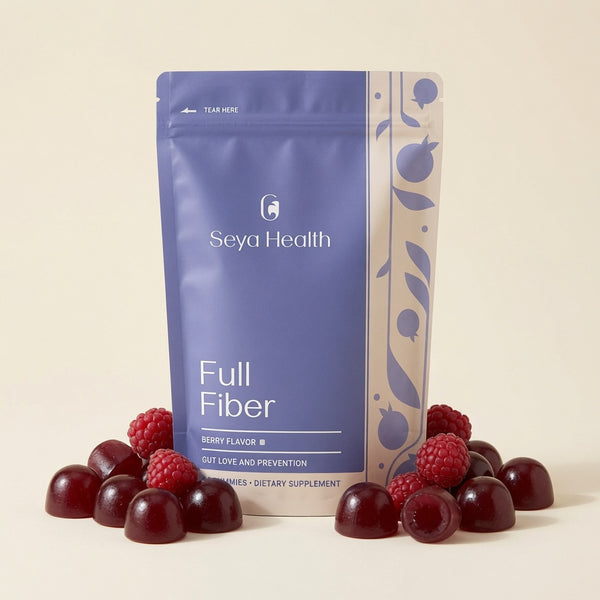
Today, the only Seya product for sale is our fiber gummy, which supports regularity.
A Seya creatine gummy is coming January 2027. We will share its form, dose, and price when it launches, not before. Wondering how gummies stack up against powder in the meantime? See creatine gummies vs powder vs capsules.
This is education, not medical advice. Talk to a qualified clinician before adding any supplement.
These statements have not been evaluated by the Food and Drug Administration. This product is not intended to diagnose, treat, cure, or prevent any disease.
Frequently asked questions
What's the difference between creatine HCl and creatine monohydrate?
Monohydrate is creatine bound to water and is 87.9% creatine by weight. HCl is creatine bound to hydrochloric acid and is 78.2% creatine. HCl dissolves better in water. Both release the same creatine in your body.
Is creatine HCl better than monohydrate?
Not on current evidence. In 3 of 4 human trials that compared them, HCl did no better. One 4-week trial in 40 soccer players found HCl did better on jump and sprint tests.
Does creatine HCl work with a smaller dose?
Not proven. 1.5 g of HCl holds about 1.2 g of creatine. No trial shows that matches the 3 to 5 g a day used in most research.
Does creatine HCl cause less water retention?
In one study, body water rose less on HCl, but that group took in about a quarter as much creatine. Less creatine means less water pulled into muscle.
Do you need a loading phase with either form?
No. A 1996 study found 3 g a day reached the same muscle creatine levels as loading, in about 28 days instead of 6.
Which is more effective for muscle growth?
Both helped muscle and strength versus placebo in a 2024 trial, with no extra benefit from HCl. Monohydrate has far more research behind it.
Why is monohydrate the most studied form of creatine?
It is cheap, it is stable as a powder, and it reliably raises muscle creatine. Researchers keep using it, so the evidence keeps piling up behind it.
Does creatine actually work?
Yes, for short, hard efforts. Studies consistently show creatine raises muscle creatine and supports high-intensity exercise performance, per the ISSN position stand (JISSN, 2017).
Seya Full Fiber
Most women fall short on fiber. Seya Full Fiber gives you 6 grams from three fibers in three small vegan gummies. Plant based, no gelatin, no sugar alcohols.
Shop Full Fiber