
Home/ The Journal/ digestive health
digestive health
Best Fiber Gummies for Women (2026): Sugar-Free, Prebiotic, and GLP-1-Friendly Picks

Short version: The best fiber gummies for women give you a real dose, keep added sugar low, and name the prebiotic or soluble fiber right on the label. Most women get about 15 g of fiber a day against a 28 g target, so the chew's job is to help close a real gap, not to taste like candy.
- Judge any gummy on 3 things: the fiber grams per serving, the added sugar, and whether it names a real fiber like resistant tapioca, inulin, or psyllium.
- The FDA sets the fiber Daily Value at 28 g a day. The average American woman gets about 15 g, and fewer than 5% of Americans hit the target at all.
- A gummy is a convenience format, not a full day of fiber. The honest claim for a ~5 g soluble-fiber dose is that it supports regularity.
Last updated August 2026.
The picks worth your money give you a real dose of fiber, keep added sugar low, and name a prebiotic or soluble fiber you can actually read on the label. That is the whole test.
Here is the number that frames it. The FDA sets the fiber Daily Value at 28 g a day in the FDA labeling rule, 21 CFR 101.9. The average American woman gets about 15 g, per a fiber-intake review in the American Journal of Lifestyle Medicine. You are already short. A gummy's whole job is to help close that gap.
You have probably filed low fiber under willpower. It is not that. It is a food supply built on refined grains, and a target most women were never set up to hit. The right gummy is one small, boring lever you can actually name.
What are the best fiber gummies for women?
The strongest picks are honest about dose and low on sugar. Skip the marketing and read three lines on the panel.
| What to check | Good sign | Red flag |
|---|---|---|
| Fiber per serving | Grams listed, ~4 to 6 g | Under 2 g, or "fiber blend" with no number |
| Added sugar | 0 to 2 g, sweetener named | 4 g or more of added sugar per serving |
| Fiber source | Named: resistant tapioca, inulin, psyllium | "proprietary blend," no source named |
Most gummies fail on grams. Many give you 1 to 2 g per serving and lean on the flavor. That is a snack with a supplement label. A good one gives real fiber and does not hide the source.
Are sugar-free fiber gummies worth it?
Often yes, if the trade is a clean one. Low added sugar is the point of a daily gummy.
A gummy you take every morning should not hand you 4 g of added sugar with it. Look for 0 to 2 g. Some "sugar-free" gummies swap in sugar alcohols like maltitol, which can be hard on a sensitive gut for some people. Neither extreme is what you want. You want a named fiber, a small amount of a named sweetener, and grams you can count. Read the panel, not the front of the jar.
What are the best prebiotic fiber gummies?
The best prebiotic gummies name the fiber and give enough of it to matter. "Prebiotic" is a real term with a real bar.
The scientific definition, set by the International Scientific Association for Probiotics and Prebiotics, is "a substrate that is selectively utilized by host microorganisms conferring a health benefit," from the ISAPP consensus statement in Nature Reviews Gastroenterology and Hepatology.
Two things follow. Every prebiotic is a fiber, but not every fiber earns the label. A chew qualifies only when it names an ingredient that feeds your gut bacteria, like inulin or resistant tapioca, at a dose that counts. If the jar says "prebiotic blend" with no grams, read it as marketing.
Psyllium husk vs gummies: which format is better?
Different jobs. Psyllium is the heavier tool, a gummy is the daily habit.
Psyllium husk is a gel-forming soluble fiber with strong evidence for regularity. In a review of fiber and chronic constipation in the American Journal of Gastroenterology, psyllium outperformed wheat bran for softening stool and easing bowel movements. The catch is format. Psyllium is a powder you mix and drink, and the studied doses often run near 10 g a day, which is a lot of gritty water.
A fiber gummy trades some dose for a habit you will actually keep. If your main aim is regularity and you want something you take without thinking, the gummy wins on adherence. If you need a heavier push, psyllium powder is the stronger single tool. We compare the two more in flaxseed vs psyllium for perimenopause constipation.
Best fiber gummies for GLP-1 users
Look for gentle, soluble, prebiotic fiber. Constipation is one of the most common complaints on these medicines.
These drugs slow how fast your stomach empties, and backed-up digestion is a frequent complaint. Dietary guidance for GI symptoms on GLP-1 receptor agonists, published in Nutrients, points to raising fiber toward about 14 g per 1,000 calories, plus 2 to 3 liters of fluid a day, as a first move for regularity.
A soluble chew fits that plan and stays down when appetite is low. Start small and add water. We walk through the whole routine in how to relieve GLP-1 constipation.
Best fiber gummies for women over 50
Prioritize regularity and an easy daily dose. Digestion and hormones both shift in this window.
Through perimenopause and after, bloat and slower regularity are common, and the fiber gap does not go away. A soluble, prebiotic gummy you take every morning is a low-effort way to add grams without changing your whole plate. It will not fix everything on its own. Pair it with food-first fiber, and check the target first in how much fiber women need per day.
Where does Seya fit, honestly?
Seya makes one product. A fiber gummy.
Three vegan gummies give you about 5 g of resistant tapioca fiber, a soluble, prebiotic-type fiber, with low added sugar and the source named on the label. That is real fiber toward your 28 g day. We grade its evidence a C, since 5 g is about half the 10 g dose many fiber studies leaned on, so we make one plain claim. It supports regularity.
It is not a full day of fiber, and it is not a substitute for food. It is one lever, honestly scoped. If you want the food-first version and the reason the gap exists, start with the fiber gap and why most women fall short.
This is education, not medical advice. Talk to your clinician before adding a supplement, especially if you have a gut condition or take daily medication.
These statements have not been evaluated by the Food and Drug Administration. This product is not intended to diagnose, treat, cure, or prevent any disease.
Frequently asked questions
What are the best fiber gummies for women?
Look for three things: about 4 to 6 g of fiber per serving, 0 to 2 g of added sugar, and a named ingredient like resistant tapioca, inulin, or psyllium rather than a "proprietary blend." Many products give only 1 to 2 g and lean on flavor, which sits closer to candy. A chew is a daily habit toward the 28 g target, not a whole day of fiber on its own. The right pick for you keeps sugar low and tells you exactly what is inside.
What are the best prebiotic fiber supplements?
The strongest ones name an ingredient that feeds your gut bacteria and give enough of it to matter. Under the ISAPP consensus, a prebiotic is "a substrate that is selectively utilized by host microorganisms conferring a health benefit." Every prebiotic is a fiber, yet not every fiber clears that bar, so a product qualifies only when it lists something like inulin or resistant tapioca at a stated dose. Skip anything that hides behind "prebiotic blend" with no grams shown.
Are fiber gummies actually healthy, or basically candy?
It comes down to the panel. A chew with 4 to 6 g of a named fiber and barely any sugar is a real, small step toward your daily target. One with 1 to 2 g of fiber and 4 g or more of sugar is dessert with a supplement label. The two can look identical on a shelf. Check the grams, the sugar, and the ingredient, and the gap becomes obvious.
Which fiber gummies are best for GLP-1 users and women over 50?
For both groups, choose a gentle, soluble, prebiotic ingredient at a modest daily dose, with plenty of water. Backed-up digestion is common on GLP-1 medicines and through perimenopause, and clinical guidance points to more soluble fiber and fluid as a first response. A daily chew is easy to stay consistent with, which beats a heavy dose you quit. Begin low, drink water, and lean on food-first sources too rather than asking one product to carry the load.
Related reading
- Is Resistant Tapioca Starch Keto-Friendly? Fiber Without the Blood-Sugar Spike
- Do Fiber Gummies Help Blood Sugar? What Women Should Know About Fiber and Glucose
- What's Actually in a Fiber Gummy? Sweeteners, Prebiotics, and Label Red Flags
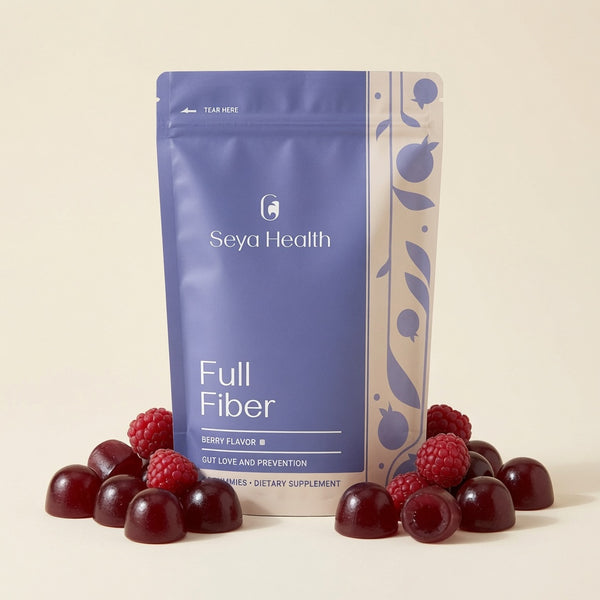
Seya Full Fiber
More than 90% of women fall short on fiber. Seya Full Fiber gives you 6 grams from three fibers in one, in three small gummies that feed the beneficial bacteria in your gut. Plant based, no gelatin, no sugar alcohols.
Shop Full FiberKeep reading
fiber
Can a Multivitamin Replace Vegetables? What Supplements Can't Do for Your Gut

constipation
The Best Way to Beat Constipation in Your 30s (and Where Fiber Gummies Fit)
fiber
The Gut-Skin Axis: Does Your Gut Health Affect Your Skin?
The gut-skin axis, explained: how your gut bacteria and blood sugar affect your skin, w...