Home/ The Journal/ blood pressure
blood pressure
Best fiber gummies for Black women: what the data says

Short version: The best fiber gummies for Black women are the same ones that work for any woman, because fiber needs don't change by race. What differs is health context. In 2019 to 2023, SEER counted 37.1 colorectal cancer cases per 100,000 Black women vs 33.6 for White women. High blood pressure is also more common in Black adults.
- Fiber trials found small blood pressure drops, mostly after 8 weeks or more.
- Colorectal screening starts at 45 for average-risk adults, per the USPSTF.
Last updated October 2026. Population averages, not predictions for any one woman.
The fiber itself is the same for everyone. What changes is the risk picture in public health data. That data describes groups, not you. It can still shape what you ask your doctor and what you check on a label. Start with the label checklist in our hub on the best fiber gummies for women.
Do Black women need a different amount of fiber?
No. The Dietary Guidelines for Americans list fiber goals by age and sex. Race is not a column in that table.
The Guidelines also call dietary fiber a nutrient of public health concern for the general U.S. population, because most people eat too little. The goal is the same as for any adult woman. Eat more fiber, and build up slowly.
Why does blood pressure come up in a fiber conversation?
Because high blood pressure is more common in Black adults. The National Heart, Lung, and Blood Institute says Black people tend to have higher average blood pressure numbers and get high blood pressure earlier in life.
That is a group pattern, not a trait you carry. It is a reason to check your numbers, and to keep up habits that support healthy blood pressure. Fiber is one. For the heart side of fiber, read fiber and heart health for women. For warning signs, read heart attack symptoms in women.
Can fiber help support healthy blood pressure?
A little, and it takes time. Two 2005 meta-analyses of randomized trials looked at this question.
One pooled 25 trials. Fiber lowered diastolic pressure by 1.65 mmHg on average. In trials of people who had high blood pressure, systolic fell 5.95 mmHg and diastolic fell 4.20 mmHg. Trials of 8 weeks or longer did better, per the J Hypertens analysis.
The other pooled 24 trials, with fiber at an average of 11.5 g a day. Diastolic fell 1.26 mmHg. The systolic change was not statistically clear, per the Arch Intern Med analysis.
These are modest numbers. Fiber supports a healthy pattern. It does not replace blood pressure medicine. If you take medicine, keep taking it.

Why does colorectal screening at 45 matter?
Because the numbers are higher, and screening finds problems early. The SEER program reports colorectal cancer in women at 37.1 new cases per 100,000 for non-Hispanic Black women, vs 33.6 for non-Hispanic White women. Deaths run 13.2 vs 10.9 per 100,000. Both are age-adjusted, per SEER Cancer Stat Facts.
The U.S. Preventive Services Task Force recommends screening for adults 45 to 49 at average risk, and for everyone 50 to 75, per its 2021 statement. Fiber is a daily habit. Screening is a test. One does not stand in for the other.
Tell your clinician about blood in your stool, new bowel changes that last, or a family history of colorectal cancer. Do not wait for 45 if you have those.
What to look for in the best fiber gummies for Black women
- The dose. The pooled trials used about 11.5 g a day. A gummy gives you 5 to 6 g. Count it as a boost on top of food fiber, not the whole plan.
- The habit. The better trial results came at 8 weeks or longer. Pick a gummy you will take daily.
- A label you can read. Named fibers, sugar listed plainly, and no sugar alcohols if they upset your gut.
One serving of Seya Full Fiber is three gummies with 6 g of fiber, drawn from three different fiber sources. The recipe has no gelatin and no sugar alcohols, and one pouch covers 20 days. It supports regularity, and it fits as one part of a fiber habit.
Frequently asked questions
Do Black women need more fiber than other women?
No. The Dietary Guidelines set fiber goals by age and sex. What differs between groups is health risk context, such as blood pressure and colorectal cancer rates. Your fiber target depends on your age.
Should Black women start colorectal screening before 45?
The USPSTF recommends starting at 45 for average-risk adults, the same for all groups. SEER data show higher rates in Black women. If you have symptoms or a family history, talk to your clinician about starting sooner.
Can a fiber gummy replace blood pressure medicine?
No. In trials, fiber lowered blood pressure by small amounts, and the larger drops were in people with diagnosed high blood pressure. Fiber can support a healthy pattern. Keep taking prescribed medicine, and ask your clinician before you change it.
How long does fiber take to affect blood pressure?
The trial data point to at least 8 weeks of steady intake. Check your blood pressure on the schedule your clinician suggests, not by feel.
This is education, not medical advice. Talk to your clinician about blood pressure, screening, and any new supplement.
These statements have not been evaluated by the Food and Drug Administration. This product is not intended to diagnose, treat, cure, or prevent any disease.
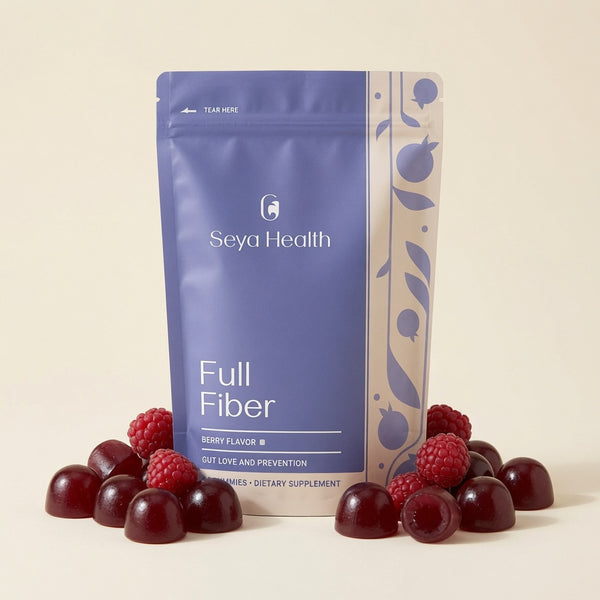
Seya Full Fiber
Most women fall short on fiber. Seya Full Fiber gives you 6 grams from three fibers in three small vegan gummies. Plant based, no gelatin, no sugar alcohols.
Shop Full Fiber