
Home/ The Journal/ brain fog
brain fog
Creatine for perimenopause: muscle, mood, sleep, and brain fog

Short version: Creatine for perimenopause has early, limited evidence. In a 2026 trial of 51 perimenopausal women, creatine plus lifting gave steadier sleep than placebo plus lifting, by 7.4 points. Thinking test scores improved no more than on placebo.
- Muscle: the strongest case, and it comes mostly from older women who lift.
- Sleep: one early signal for consistency. Not proof you will sleep longer.
- Brain fog and mood: promising ideas, weak proof so far.
- Dose: about 5 g a day, with lifting if you can.
Last updated November 2026.
You walk into a room. You forget why.
You wake at 3am, again. The same workout feels harder than it did last year.
You may blame yourself. Too busy. Too tired. Not trying hard enough.
It is not a character flaw. Your hormones are swinging, and your muscle, sleep, and thinking can all feel it.
So does creatine help? We went through it one symptom at a time, using the few studies that include women like you.
Is creatine for perimenopause worth trying?
It may help some, but the proof is early. Until recently, there was almost nothing to go on. A 2025 review said there was no research directly testing creatine in perimenopausal women. See Smith-Ryan et al. (JISSN, 2025).
That changed in October 2026. The same lab tested 51 women, average age 46. See Baker et al. (Eur J Appl Physiol, 2026).
- 18 women took creatine monohydrate and lifted twice a week.
- 20 women took a placebo and lifted twice a week.
- 13 women did neither.
Creatine started at 20 g a day for 5 days, then about 4.5 g a day for 6 weeks. The authors called their analysis "exploratory."
Two more facts belong here. The senior author advises creatine makers and holds equity in Create Wellness. A coauthor who works at WHOOP ran the sleep and symptom analyses, blinded to the groups, using WHOOP wristbands.
| Symptom | Best evidence in midlife women | Our read |
|---|---|---|
| Muscle and strength | 7 trials, 608 women past menopause | Strongest, with lifting at 5 g or more |
| Sleep | 1 trial, 51 perimenopausal women | Early signal for consistency |
| Temperature sensitivity | 1 trial, self-reported | Early signal, not a hot flash study |
| Brain fog and thinking | 2 small trials, mixed results | Unproven |
| Mood | 1 trial in diagnosed depression, not perimenopause | Not a stand-alone option |
| Anxiety | No trial found | Unknown |
Does creatine help muscle in perimenopause?
Probably, if you lift. This is the best case for creatine, though most of it comes from women a bit further along.
The timing matters. In the long-running SWAN study, lean mass began to fall at the start of the menopause transition. Fat gain doubled at the same point. Both trends ran until about 2 years after the final period. See Greendale et al. (JCI Insight, 2019).
A 2026 review put the gap at about 2.5% less lean or muscle mass in perimenopausal women than in premenopausal women. See Menzies et al. (J Cachexia Sarcopenia Muscle, 2026).
So if the same weights feel heavier, you are not imagining it.
What the muscle trials found
A 2026 meta-analysis of 608 women past menopause found creatine added 0.37 kg of lean mass and 7.5 kg on the leg press. Benefits showed at 5 g or more with lifting. Trials at 3 g or less without lifting showed none. See Naddafha et al. (JISSN, 2026).
Closer to your age, a 12-week trial studied 64 adults aged 45 to 65, 40 of them women, at 10 g a day. Lean mass and strength rose, even in the group that did not exercise. That group was small, men were included, and a creatine maker supplied the product. See Chun et al. (JISSN, 2026).
Not every review agrees. A 2026 analysis of 14 trials and 763 women found supplements plus exercise added strength but not muscle mass. Only 3 of those trials used creatine, so it is not a clean test. See Chen et al. (Int J Med Sci, 2026).
The older-women trials are in creatine for menopause.
Does creatine help perimenopause brain fog?
Not shown yet. The fog is real, but the creatine fix is still a theory.
First, the fog. In SWAN, 2,362 women took thinking tests for 4 years. Normally, scores climb with practice. During perimenopause, some of that climb stalled. After menopause, it came back. See Greendale et al. (Neurology, 2009).
That matters. It suggests the slump may be time-limited.
What the creatine studies found
A 2026 scan study of 12 perimenopausal women found lower brain creatine than reference values for younger adults. Lower levels in some areas went with more trouble concentrating. It is a small snapshot, and it cannot show cause. See Ostojic and Ostojic (Neurosci Lett, 2026).
The new trial is the real test. Reaction time on a focus test improved over time, but with no difference between groups. So lifting, practice, or both may explain it. Creatine did go with more oxygen in the front of the brain during the test, up 0.32% against a 1.62% drop on placebo. That is a body signal, not a sharper mind.
The trial also tracked brain fog daily. Its published summary reports no benefit for it. We could not read the full paper, so we can't say more.
A smaller 2026 trial points the other way. 36 perimenopausal and menopausal women took low doses of creatine HCl or a placebo for 8 weeks. At 1,500 mg a day, reaction time improved more than placebo and frontal brain creatine rose 16.4%, against 0.9%. See Korovljev et al. (J Am Nutr Assoc, 2026).
That is 36 women split across 4 groups. Treat it as a lead. For the wider brain research, see creatine for brain health.

Does creatine help you sleep in perimenopause?
There is one early signal. It is about consistency, not more hours.
Poor sleep at this stage has clear causes. Estrogen and progesterone shift, and hot flashes can wake you. See Troìa et al. (J Clin Med, 2025).
In the Baker trial, sleep consistency, a wristband score, was 7.4 points higher on creatine than on placebo at week 6. The creatine group also reported fewer days of temperature sensitivity.
Keep it in proportion. This is one 6-week trial, with 38 women across the 2 lifting groups. Self-reported heat days are not a hot flash study. The summary does not report that creatine helped women sleep longer.
You may also see headlines about creatine and sleep loss. Those studies test something else. In one, 29 healthy people stayed awake for 21 hours and took one large dose, 0.2 g per kg of body weight. That is about 14 g for a 70 kg person. Creatine eased the drop in test scores, by up to 12%. See Gordji-Nejad et al. (Nutrients, 2026). It says nothing about a daily 5 g after a broken night.
Does creatine help mood or anxiety in perimenopause?
Possibly for mood, but no one has shown it in perimenopause. We found no trial on anxiety in this group.
Low days at this stage are common and not a personal failing. A review of 11 studies found the odds of depressive symptoms about 2 times higher in perimenopause than before it. See de Kruif et al. (J Affect Disord, 2016).
The trial people quote gave 52 women with diagnosed depression a prescription antidepressant, plus 5 g of creatine or a placebo. The creatine group improved faster, starting at week 2. See Lyoo et al. (Am J Psychiatry, 2012).
That was an add-on, under a doctor's care. It was not a perimenopause trial, and it does not mean creatine can stand in for treatment.
In the Korovljev trial, mood swings trended lower at 1,500 mg, but the result was not statistically significant.
If your mood has dropped for more than 2 weeks, tell your doctor. If you take medicine for mood, ask before you add anything.
Will creatine cause weight gain or bloating in perimenopause?
It may add some water, not fat. Creatine pulls water into your muscle. See Antonio et al. (JISSN, 2021).
A high dose shows this fastest. In 30 women taking 20 g a day for 5 days, body water rose 0.83 L in the second half of the cycle, while it fell 0.62 L on placebo. Body weight did not change much in that study, so the water may not show on your scale. See Moore et al. (Nutrients, 2023).
That timing is worth a thought, because your cycle and your gut are already unpredictable. If you start creatine during a bad bloating week, it is hard to tell the cause. Start on a calmer week, and skip loading if you want fewer variables.
More here: creatine water retention, creatine that doesn't bloat, and perimenopause bloating.
How much creatine should you take in perimenopause?
About 5 g of creatine monohydrate a day. Pair it with lifting 2 or more days a week if you can. The perimenopause trial used about 4.5 g a day after loading.
You do not need to load. In one older study, 3 g a day for 28 days raised muscle creatine as much as a high-dose start. It just takes longer. See Hultman et al. (J Appl Physiol, 1996).
Choosing a product? See the best creatine for menopause and women over 40.
What are the side effects of creatine in perimenopause?
For healthy adults, they tend to be mild. Stomach upset is the main one, and it is more likely at high doses. See Longobardi et al. (Front Nutr, 2025).
Creatine can also raise a kidney lab number, creatinine, by about 0.13 mg/dL, while kidney filtering stays the same. See Tsiaras et al. (J Ren Nutr, 2026) and creatine vs creatinine. Tell your doctor before blood work.
Ask first if you have kidney disease or could be pregnant. That review says the safety data is lacking for both.
And see your doctor about the symptoms themselves. Creatine is not hormone therapy. Very heavy bleeding, bad sleep that lingers, or memory changes that worry you all deserve a real workup. Not sure this is perimenopause? Read how doctors actually tell.
Where Seya fits
Seya sells a vegan fiber gummy today that supports regularity. Our creatine gummy is coming January 2027. It is not on sale, so we are not sharing a dose or price.
The research skipped this stage of your life for a long time. It is finally starting to catch up. We would rather tell you what it found than what would sell.
This guide is education, not medical advice. No supplement can promise results.
These statements have not been evaluated by the Food and Drug Administration. This product is not intended to diagnose, treat, cure, or prevent any disease.
Frequently asked questions
Does creatine help perimenopause symptoms?
It may help a few, but the evidence is thin. In a 2026 trial of 51 perimenopausal women, creatine plus lifting went with steadier sleep and fewer self-reported temperature sensitivity days than placebo plus lifting. The authors called the analysis exploratory.
Does creatine help perimenopause brain fog?
It is not shown yet. In the 2026 trial, thinking test scores improved just as much on placebo. Brain fog was tracked, but the published summary reports no benefit for it. We could not read the full paper.
How does creatine help women in perimenopause?
Creatine helps your muscles and brain store quick energy. Its best evidence in midlife women is for muscle and strength when paired with lifting. It does not change the hormone shifts behind perimenopause.
Should you take creatine in your 40s?
It is a reasonable choice if you lift, or plan to, and you are healthy. Your 40s are when lean mass often starts to slip. Ask your doctor first if you have kidney disease, take prescription medicine, or could be pregnant.
Is perimenopause too early to take creatine?
No. Women in the 2026 perimenopause trial averaged 46 years old. Lean mass starts to fall at the start of the transition, so this is a sensible time to think about muscle.
Are there risks of creatine during perimenopause?
For healthy adults, the main ones are mild. Stomach upset gets more likely at high doses, and you may hold some water early on. Creatine can also raise a kidney lab number called creatinine, so tell your doctor before blood work.
What changes can you expect from creatine in perimenopause?
Expect slow, small changes. You may hold a little extra water in the first weeks. Any strength gain comes with training, over weeks to months. Do not expect hot flashes or irregular periods to stop.
How much creatine should you take in perimenopause?
About 5 g a day is the best supported dose. The perimenopause trial used about 4.5 g a day after a 5-day loading phase. Loading is optional. A lower daily dose fills muscle more slowly.
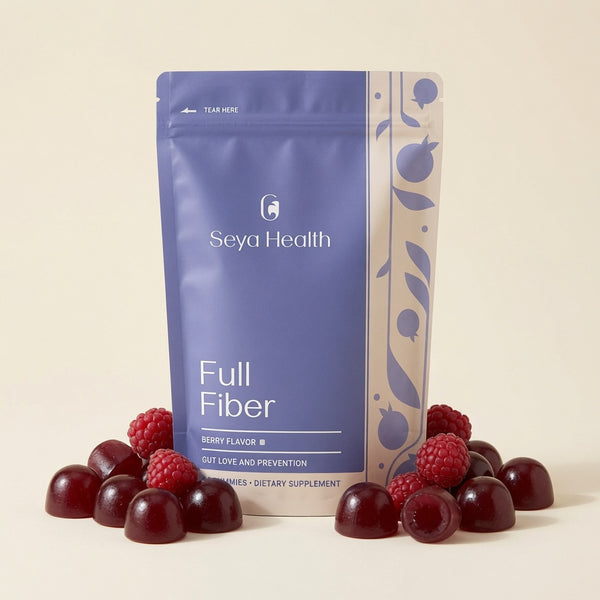
Seya Full Fiber
Most women fall short on fiber. Seya Full Fiber gives you 6 grams from three fibers in three small vegan gummies. Plant based, no gelatin, no sugar alcohols.
Shop Full FiberKeep reading

bone health
Best supplements for women over 40: what the evidence supports for heart, bones and muscles (and what's hype)

creatine
How long does creatine take to work? A realistic timeline for women

constipation