
Home/ The Journal/ constipation
constipation
The best constipation relief for women: fiber, stool softeners, and laxatives ranked by speed and gentleness

Short version: The best constipation relief for women depends on what you need. For fast, one-time relief, a bisacodyl suppository works in 15 minutes to 1 hour. For gentle, daily relief, fiber works in 12 to 72 hours. For ongoing relief with the strongest evidence, polyethylene glycol (MiraLAX) gets a strong rating from US gut experts.
- Fastest: suppository, then the magnesium citrate bottle, then senna or bisacodyl pills.
- Gentlest: fiber, then polyethylene glycol. Stimulants are for when those fail.
- Stool softeners are gentle but weak. Psyllium beat docusate in a 170-person trial.
- Women are about twice as likely as men to have long-term constipation.
Last updated November 2026.
The laxative aisle is a wall of boxes. Some promise "overnight." Some say "gentle." Most don't tell you what is actually different.
There are only a few real types. Each one trades speed for gentleness. Once you see the trade, picking gets easy.
Here is every common option, ranked both ways, with the time each one takes from its own label.
What is the best constipation relief for women?
There is no single best. There is a best for your situation. Ask yourself one question first: do I need to go today, or do I need to stop this from coming back?
- Need relief today: a stimulant (senna or bisacodyl) or the magnesium citrate bottle. Short-term only.
- Want something gentle to take daily: fiber, like psyllium, plus water.
- Fiber is not enough: polyethylene glycol 3350, sold as MiraLAX and store brands.
That order matches the NIDDK, part of the National Institutes of Health. It lists fiber, osmotic agents, stool softeners, and stimulants, and says: "You should only use stimulants if your constipation is severe or other treatments have not worked."
Why do women get constipated more often?
Women are about twice as likely to have long-term constipation. A review of 45 studies with 261,040 people found an odds ratio of 2.22 for women versus men, per Suares and Ford in the American Journal of Gastroenterology. About 14% of adults overall had it.
Some reasons are specific to women. The NIDDK lists pelvic floor problems, "especially in women," as a cause. Iron pills, common in pregnancy and heavy periods, can also slow things down. Midlife hormone shifts can matter too. Our guide to perimenopause constipation relief covers the midlife side.
Not sure if you are constipated or just less regular? Start with how often you should poop.
Constipation relief ranked by speed
These times come from FDA labels and MedlinePlus, the National Library of Medicine's drug guide. Your result may be faster or slower.
| Rank | Option | Type | Usual time to work |
|---|---|---|---|
| 1 | Bisacodyl suppository (Dulcolax and store brands) | Stimulant, rectal | 15 minutes to 1 hour |
| 2 | Magnesium citrate liquid | Saline osmotic | 30 minutes to 6 hours |
| 3 | Senna or bisacodyl pills | Stimulant, oral | 6 to 12 hours |
| 4 | Psyllium fiber (Metamucil and others) | Bulk-forming fiber | 12 to 72 hours |
| 5 | Docusate stool softener (Colace) | Stool softener | 1 to 3 days of regular use |
| 6 | Polyethylene glycol 3350 (MiraLAX) | Osmotic | 2 to 4 days |
Sources: a bisacodyl suppository label ("1/4 to 1 hour"), MedlinePlus pages for magnesium citrate, senna, bisacodyl, stool softeners, and polyethylene glycol 3350, and a Metamucil label ("12 to 72 hours").
Notice the pattern. The fastest options are the harshest. The slowest ones are the ones you can live with.
Constipation relief ranked by gentleness
Gentle here means fewer cramps, less urgency, and safe to use for longer. This order follows the labels and the 2023 guideline below.
- Fiber. Works with your body. Gas and bloating are the usual side effects, and they fade if you start low.
- Polyethylene glycol 3350. Pulls water into the stool. Little cramping. Slow to start.
- Docusate stool softener. Very mild, but also very weak. MedlinePlus says not to use it for more than 1 week unless your doctor says so.
- Magnesium oxide. A daily osmotic used widely in Japan. Loose stools if you take too much.
- Senna or bisacodyl pills. They make your gut muscles squeeze. Cramps are common. 1 week at most without a doctor.
- Magnesium citrate bottle or a suppository. Fast and strong. Rescue use only.

What do gut experts recommend?
In 2023, the American Gastroenterological Association and the American College of Gastroenterology published a joint guideline on long-term constipation in adults, per Chang and colleagues in Gastroenterology.
- Strong recommendation: polyethylene glycol and sodium picosulfate (a stimulant).
- Conditional recommendation: fiber, senna, magnesium oxide, and lactulose.
- Not rated: stool softeners were not among the drugs the panel reviewed.
Conditional means the evidence is weaker or results vary by person. It does not mean the option does not work. For many people, fiber is still the first step because it is cheap, gentle, and good for the rest of your gut.
Is fiber or a stool softener better?
Fiber, in the best head-to-head trial. In a 2-week study of 170 adults with long-term constipation, psyllium raised stool water content by 2.33%. Docusate raised it by 0.01%, per McRorie and colleagues in Alimentary Pharmacology and Therapeutics.
By week 2, the psyllium group had 3.5 bowel movements a week. The docusate group had 2.9. So the product sold as a "softener" softened stool less than fiber did.
Fiber has broader support too. A 2022 review of 16 trials with 1,251 adults found 66% responded to fiber versus 41% on a control, per van der Schoot and colleagues. Psyllium had the clearest effect. Doses above 10 g a day for at least 4 weeks worked best.
Our best fiber supplement for constipation guide compares psyllium, powders, and gummies.
Are stimulant laxatives safe for women?
Yes, for short-term use as labeled. A 28-day trial gave 90 adults senna, magnesium oxide, or a placebo. 93% of them were women. Overall symptoms improved in 69.2% on senna and 68.3% on magnesium oxide, versus 11.7% on placebo, per Morishita and colleagues in the American Journal of Gastroenterology. No serious side effects were reported.
The catch is the time limit on the box. MedlinePlus says not to take senna or bisacodyl for more than 1 week without talking to your doctor. If you keep needing them, that is a sign to find the cause, not to keep refilling.
Check your other pills too. Our guide to medications that cause constipation lists the usual suspects.
What is the fastest constipation relief?
A bisacodyl suppository is the fastest common option, at 15 minutes to 1 hour. Magnesium citrate liquid is next, at 30 minutes to 6 hours. Read our guide on how to take magnesium citrate for constipation before you open the bottle.
Fast options fix today. They do not fix next week. If you reach for one more than once in a while, build a daily routine instead.
What is the gentlest daily option?
Fiber, taken every day with water. Start with a small dose and add more over 1 to 2 weeks. That gives your gut bacteria time to adjust and keeps gas down.
The NIDDK says adults should get 22 to 34 grams of fiber a day, depending on age and sex. Most women fall short, as our look at the fiber gap shows. Food comes first: beans, oats, berries, and prunes. In one trial of 40 adults, 37 of them women, prunes beat psyllium on complete bowel movements per week, per Attaluri and colleagues.
If fiber alone is not enough after a few weeks, polyethylene glycol is the next gentle step. If you are on a GLP-1, see fiber vs laxatives for GLP-1 constipation.
Who should ask a doctor first?
Laxative labels ask you to check with a health professional first if you are pregnant or breastfeeding. Ask first, too, if you have kidney disease, take other daily medicines, or have had a change in bowel habits for more than 2 weeks.
The NIDDK says to see a doctor right away if constipation comes with any of these:
- Bleeding from your rectum or blood in your stool
- Constant belly pain, or you cannot pass gas
- Vomiting or fever
- Lower back pain
- Losing weight without trying
See a doctor, too, if self-care is not working, or if you have a family history of colon or rectal cancer.
Where Seya fits
Seya is a daily fiber gummy, not a laxative. 3 vegan gummies give you 6 g of fiber from resistant tapioca fiber, prebiotic soluble fiber, and cellulose, plus 80 mg of magnesium and 100 mg of ginger root, per our product page.
It belongs in the gentle, every-day lane. It supports regularity as part of a fiber-rich diet.* It will not work in an hour, and it is not meant to. Learn more in how fiber supplements work.
Frequently asked questions
What is the fastest constipation relief?
A bisacodyl suppository usually works in 15 minutes to 1 hour, per its FDA label. Magnesium citrate liquid usually works in 30 minutes to 6 hours. Both are for occasional use only.
What is the gentlest daily option for constipation?
Fiber, such as psyllium, taken daily with water. Start low and build up over 1 to 2 weeks. If fiber is not enough, polyethylene glycol 3350 is the next gentle step.
Is fiber or a stool softener better?
Fiber. In a trial of 170 adults, psyllium softened stool more than docusate and led to more bowel movements by week 2. Stool softeners were not rated in the 2023 AGA-ACG guideline.
What is the best constipation relief for adults?
For ongoing constipation, polyethylene glycol has a strong recommendation from US gut experts, and fiber is a gentle first step. For a one-time fix, a stimulant or magnesium citrate works within hours.
Can I take a laxative every day?
Fiber and polyethylene glycol are the options most often used daily. Labels for senna, bisacodyl, stool softeners, and magnesium citrate say not to use them for more than 1 week without a doctor.
Why are women more constipated than men?
Women are about twice as likely to have long-term constipation. The NIDDK lists pelvic floor problems, especially in women, as one cause. Iron supplements can also make it worse.
*These statements have not been evaluated by the Food and Drug Administration. This product is not intended to diagnose, treat, cure, or prevent any disease. This article is educational and is not medical advice. Talk to your clinician or pharmacist about your own health and medications.
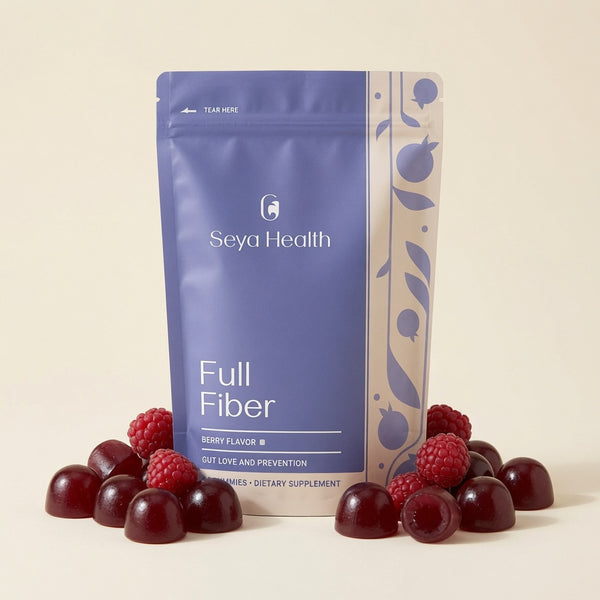
Seya Full Fiber
Most women fall short on fiber. Seya Full Fiber gives you 6 grams from three fibers in three small vegan gummies. Plant based, no gelatin, no sugar alcohols.
Shop Full Fiber

