
Home/ The Journal/ bone health
bone health
Best supplements for women over 40: what the evidence supports for heart, bones and muscles (and what's hype)

What are the best supplements for women over 40? Only the ones that fill a real gap. For most women that means fiber if you eat under 25 g a day, calcium and vitamin D if your diet falls short, and enough protein. A review of 28 trials found about 10 g of psyllium fiber a day cut LDL cholesterol by about 13 mg/dL (Jovanovski, 2018).
- Heart: fiber has the best data. Fish oil pills did not cut heart events in a 25,871-person trial.
- Bones: calcium and vitamin D fill a gap. Extra does not add strength on top of enough.
- Muscles: protein and strength training come first. Creatine adds a little, with training.
- Hype: multivitamins for heart health, collagen for skin, and anything that "balances hormones."
Last updated November 2026.
Walk down any supplement aisle and you will see a shelf just for women over 40. Bottles promise energy, glow, hormone balance, and a younger heart.
The research tells a quieter story. A few supplements have strong data for one clear job. Most have none for the job on the label.
About half of US adults take at least one supplement, according to the US Preventive Services Task Force. So this guide sorts them by the three things that change most after 40: your heart, your bones, and your muscles. Then it names the hype.

The best supplements for women over 40: the scorecard
Here is how the common picks stack up for women in their 40s and 50s. "Gap" means it helps if you are low, not on top of enough.
| Supplement | Main job | Strength of evidence | Our take |
|---|---|---|---|
| Psyllium or other soluble fiber | LDL cholesterol, regularity | Strong (28 trials) | Worth it if you eat under 25 g of fiber a day |
| Calcium | Bone | Strong for a gap | Food first. Supplement only to reach 1,000 to 1,200 mg |
| Vitamin D | Bone | Strong for a gap | 600 IU covers most. Test before high doses |
| Protein (food or powder) | Muscle | Strong with training | Most women can eat more of it |
| Creatine | Muscle, with lifting | Moderate | Small extra gain if you train |
| Fish oil (omega-3) | Heart | Weak for prevention | Eat fish. Pills did not cut heart events |
| Multivitamin | Heart, cancer | Not enough evidence | Fine as insurance, not as prevention |
| Collagen | Skin, joints | Weak once you check funding | Skip for skin claims |
The pattern is simple. The winners fix a shortfall you can measure. The losers promise to make a healthy body healthier.
Which supplements support heart health in women over 40?
Fiber leads the list. It is the one supplement with a large body of trials on a heart risk marker you can measure: LDL cholesterol.
Soluble fiber, like psyllium, forms a gel in your gut. That gel traps some bile, and your liver pulls LDL out of your blood to make more. In a pooled review of 28 trials with 1,924 people, about 10 g of psyllium a day lowered LDL by 0.33 mmol/L, or about 13 mg/dL (Jovanovski, 2018).
Fiber from food shows up in the bigger picture too. A large set of reviews for the World Health Organization linked high fiber intake to 15 to 30% lower death from heart disease than low intake. The best results came at 25 to 29 g a day. In trials, more fiber also lowered systolic blood pressure (Reynolds, 2019). Those death numbers come from observational studies, so they show a link, not proof.
Most women fall short of 25 g. Our guide to how much fiber women over 40 need shows how to close the gap, and fiber and blood sugar after 40 covers the glucose side.
Does fish oil protect your heart after 40?
Not in the best prevention trial. The VITAL trial gave 25,871 adults 1 g of omega-3 a day or a placebo for a median of 5.3 years. Women joined at 55 and up.
Major heart events happened to 386 people on fish oil and 419 on placebo. That gap was too small to rule out chance (Manson, 2019). Strokes and heart deaths did not drop.
One side result did look better: heart attacks were 28% lower on fish oil. But it was not the main test, so treat it as a lead, not an answer. Eating fatty fish twice a week is still a good habit. A pill is not a stand-in for it.
Do multivitamins prevent heart disease or cancer?
There is not enough evidence to say they do. In 2022, the US Preventive Services Task Force reviewed the trials and said the evidence for multivitamins was insufficient to judge, either way (USPSTF, 2022).
The same panel went further on two popular antioxidants. It recommended against beta carotene and vitamin E for heart disease or cancer prevention. For beta carotene, it found the harms outweigh the benefits.
A multivitamin can still be reasonable insurance if your diet is narrow. Just do not count on it to protect your heart. We dig into what a pill cannot replace in can a multivitamin replace vegetables.
Which supplements help your bones after 40?
Calcium and vitamin D, but only up to the amount you need. Bone loss speeds up in the years around your last period, so your 40s are the time to check your intake.
The Institute of Medicine sets calcium at 1,000 mg a day for women 31 to 50 and 1,200 mg for women 51 to 70. Vitamin D is 600 IU a day up to age 70 (Ross, 2011). Dairy, canned fish with bones, tofu made with calcium, and fortified foods count toward that total.
More is not better. In the VITAL trial, 2,000 IU of vitamin D a day did not lower fractures in adults who were not low to start (LeBoff, 2022). And the Task Force recommends against low-dose vitamin D (400 IU or less) plus calcium (1,000 mg or less) to prevent fractures in healthy women after menopause. It also found the combo raises the risk of kidney stones (USPSTF, 2018).
That advice does not cover women with osteoporosis, low vitamin D, or a past fracture. If that is you, follow your doctor's plan. Our perimenopause supplements guide covers how fast bone loss starts.
Which supplements help you keep muscle after 40?
Protein first, then maybe creatine, and both work best with strength training.
For adults over 65, an expert group suggests at least 1.0 to 1.2 g of protein per kilogram of body weight a day, plus regular exercise (Bauer, 2013). That is about 70 to 80 g a day for a 150-pound woman. Many women in their 40s eat less than that, so it is worth a look now.
Creatine has the next best data. A meta-analysis pooled 22 trials with 721 older adults, ages 57 to 70 on average. People who took creatine while lifting 2 to 3 days a week gained about 1.37 kg more lean mass than those on placebo (Chilibeck, 2017). Without the lifting, there is little to gain. See creatine for menopause for the research in older women.
Is collagen worth taking after 40?
Not for your skin, based on the most careful review so far. A 2025 meta-analysis looked at 23 trials with 1,474 people. Pooled together, collagen seemed to help skin hydration, elasticity, and wrinkles (Myung, 2025).
Then the authors split the trials by who paid for them. Trials funded by companies showed benefits. Trials without company funding showed none. High-quality trials also showed no effect. The authors concluded there is no clinical evidence to support collagen for aging skin.
Collagen is a protein, so it does add to your daily protein total. It is just a pricey and incomplete way to get it.
Do botanical supplements help with menopausal symptoms?
Mostly no. Black cohosh and fish oil did no better than placebo for hot flashes in trials. Soy isoflavones have modest data. We cover each one, symptom by symptom, in our perimenopause supplements guide.
Be wary of any bottle that claims to "balance hormones." No supplement has been shown to do that. If symptoms are hurting your sleep or work, ask your doctor about hormone therapy and other proven options.
Are dietary supplements safe?
Many are, at normal doses, but nobody checks them before they hit the shelf. The FDA does not approve supplements before they are sold. The company is responsible for safety and for what the label says.
Before you start one, run through four checks:
- Do you have a gap? A food log or a blood test beats a guess.
- Is the dose the one studied? Many products use a fraction of the trial dose.
- Is it third-party tested? Look for USP or NSF seals.
- Does it clash with your meds? Fiber can slow the uptake of some drugs, so take them a few hours apart. Ask your pharmacist.
Our guide to the best supplements for women's health walks through how to read a label. Some of these may also be paid for with an FSA or HSA, as we explain in are supplements FSA or HSA eligible.
What should women over 40 do before buying a supplement?
Start with the basics your doctor can check. Preventive care in your 40s usually includes blood pressure, cholesterol, and blood sugar tests, plus a talk about when to start bone density screening.
Those numbers tell you where a supplement might help. High LDL points to fiber. Low vitamin D on a blood test points to vitamin D. A low protein diet points to more protein at meals. Without a gap, most pills just add cost.
Where Seya fits, honestly
Seya sells one product today: a fiber gummy that supports regularity and adds to your daily fiber. It is one way to close a fiber gap, alongside beans, oats, fruit, and vegetables. If you want to compare formats, see our guide to fiber supplements for women over 40.
Our creatine gummy is coming January 2027. It is not on sale yet, and we will not share its dose, price, or ingredients until the formula is final.
This is education, not medical advice. Talk to a qualified clinician before you start any supplement, especially if you take medicines or are pregnant.
These statements have not been evaluated by the Food and Drug Administration. This product is not intended to diagnose, treat, cure, or prevent any disease.
Frequently asked questions
Which dietary supplements are worth taking after 40?
Ones that fill a real gap. For most women that means fiber if you eat under 25 g a day, calcium and vitamin D if your diet falls short, and enough protein. Creatine can add a little muscle if you lift.
What vitamins should a 40-year-old woman take daily?
None by default. Vitamin D (600 IU) and calcium (1,000 mg) are the daily targets, ideally from food. Supplement only what your diet misses, and test before taking high-dose vitamin D.
Do women over 40 need vitamin D, and how much?
The daily target is 600 IU up to age 70. In a large trial, 2,000 IU a day did not lower fractures in people who were not low to start, so more is not better.
Which supplements support heart health and blood pressure in women?
Soluble fiber has the strongest data. About 10 g of psyllium a day lowered LDL by about 13 mg/dL across 28 trials, and higher fiber intake lowered systolic blood pressure in trials. Fish oil pills did not cut major heart events in the VITAL trial.
Is collagen worth taking after 40?
Not for skin. A 2025 review of 23 trials found benefits only in company-funded or lower-quality studies. Independent, high-quality trials showed no effect.
Do botanical supplements help with menopausal symptoms?
Mostly no. Black cohosh did no better than placebo for hot flashes. Soy isoflavones have modest data. Hormone therapy remains the most effective option for many women.
Are dietary supplements safe?
Many are at normal doses, but the FDA does not approve them before sale. Choose third-party tested products and check with a pharmacist about drug interactions.
Which supplements help during perimenopause?
Calcium and vitamin D if you are low, fiber for regularity, and soy isoflavones for modest hot flash relief. Nothing in a bottle balances hormones.
What supplements should women over 40 take for energy?
No supplement adds energy unless you are low in something, like iron or vitamin B12. Ask for a blood test before you buy an "energy" blend.
How do nutritional needs change with ageing?
Calcium needs rise from 1,000 mg to 1,200 mg a day at 51. Protein needs likely rise too, to at least 1.0 to 1.2 g per kilogram a day for adults over 65.
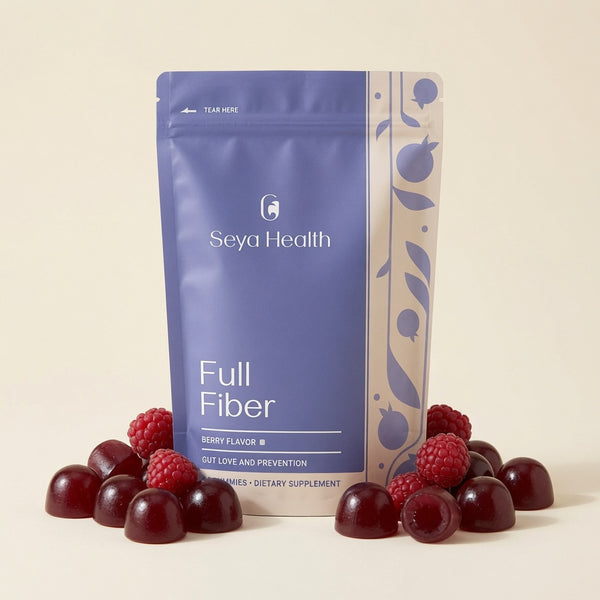
Seya Full Fiber
Most women fall short on fiber. Seya Full Fiber gives you 6 grams from three fibers in three small vegan gummies. Plant based, no gelatin, no sugar alcohols.
Shop Full Fiber

