

Short version: No creatine that doesn't bloat has been proven in a trial. We found no study that compared forms with bloating as a main result. Your safest bet is plain monohydrate, 3 to 5 g a day, with no loading and few add-ins.
- Monohydrate: the most data, and the first one to try.
- HCl and buffered: sold as gentler. The trials we found do not show it.
- Gummies: same creatine, plus sweeteners. Those can be the real problem.
- Women: report more bloating than men in a survey of 2,178 users.
Last updated November 2026.
You took creatine for a week. Your jeans felt tight. So you went looking for a better kind.
Now a tub on your screen says "no bloat" on the front, at twice the price.
Before you buy it, know this. You did not pick wrong because you missed a secret form. The form is rarely the thing that changed how you feel. The dose, the add-ins, and the timing of your cycle are far more likely.
Here is what the evidence says, form by form.
What is the best creatine that doesn't bloat?
Plain creatine monohydrate at 3 to 5 g a day is the best place to start. It is not proven bloat-free. Nothing is. It just has the most safety data and the fewest extras.
| Option | "Less bloat" claim | What we found | Our read |
|---|---|---|---|
| Monohydrate powder | Rarely made | Stomach trouble tied to big single doses | Try first |
| Micronized monohydrate | Mixes smoother | Same molecule, finer grind. No stomach trial found | Fine if powder feels gritty |
| Capsules | Sometimes | Often about 7 for 5 g. No stomach trial found | Fine, no sweeteners |
| HCl | Common | No trial built to test it | Unproven, costs more |
| Buffered | Common | No fewer side effects in a 28-day trial | Skip for this reason |
| Ethyl ester | Common | Breaks down in stomach acid | Skip |
| Gummies | Sometimes | No stomach trial found. Sweeteners vary a lot | Read the label |
Note the word "found." Few of these options have been tested for bloating at all. Most trials measured muscle, then wrote down any side effects people mentioned.
Why do women ask this so much?
Because women report more of it. That is not you being sensitive.
A 2026 survey asked 2,178 creatine users about side effects. Among women aged 30 to 39, 18.2% reported bloating. Among men in most age groups, it was 1.4% to 2.4%. In women new to creatine, 23.1% reported some side effect in the first month. See Burridge et al. (JISSN, 2026).
Now the limits. This was self-reported, with no placebo group. Two authors are tied to SuppCo, the app that ran it. And the authors say the gap is "unlikely to reflect a women-specific physiological adverse-event signal," since pooled trials do not show extra harm in women.
So what else could it be? One clue: the survey's 95.4% used monohydrate or micronized monohydrate. That means it cannot tell you which form bloats less.
Another clue is your cycle. Water retention already rises and falls across the month, so a new supplement can take the blame. We cover that overlap in does creatine make you puffy.
The advice you were given was built on studies of men. It is a gap in the research, not a flaw in you.
Is creatine monohydrate hard on the stomach?
Usually not at normal doses. Large single doses are a different story.
A major 2022 review found "no convincing evidence that CrM causes common anecdotal myths like bloating, gastrointestinal distress." CrM means creatine monohydrate. See Kreider et al. (Nutrients, 2022).
That line is stronger than the full picture. In a trial of 59 male soccer players, 55.6% reported diarrhea on one 10 g dose. On two 5 g doses, it was 28.6%, against 35.0% on placebo. See Ostojic and Ahmetovic (Res Sports Med, 2008).
And a small 2025 preprint gave 24 adults monohydrate with or without loading. 79.2% reported some stomach or fluid symptom. There was no placebo group, and it has not been peer reviewed, so the number may run high. See Wagner et al. (medRxiv, 2025).
What about the swollen feeling, even with no gas? That may be water going into muscle, and any form that works should do it. Read creatine water retention for that side of it.
Does creatine HCl cause less bloating than monohydrate?
Nobody has shown that. We found no trial built to test it.
The pitch sounds logical. HCl dissolves better, so less sits in your gut. But "dissolves better in a lab" is not the same as "bloats you less."
In one 28-day trial of 40 men and women, the 2022 review lists no side effects on HCl or on monohydrate. That means nobody reported any. It does not show that one beat the other.
Another study showed less water gain on HCl. But that group got far less creatine, which we break down in creatine monohydrate vs HCl.
The price gap is real, though. Across 175 Amazon products, monohydrate ran $0.12 per gram and other forms $0.26. See Escalante et al. (Heliyon, 2022).
You can try HCl if you want. Just know you are paying about twice as much for a promise no trial has backed.
Are buffered and other forms any gentler?
Buffered is the one form tested against this exact claim. It did not win.
One brand's marketing called it "an alternative to all the bloating, cramping, and other side effects." So researchers put 36 trained adults on monohydrate or buffered creatine for 28 days, some with a loading week. The verdict: "There was no evidence that supplementing the diet with a buffered form of creatine resulted in fewer side effects than CrM." See Jagim et al. (JISSN, 2012).
Creatine ethyl ester is sold the same way. The 2022 review notes it can break down to creatinine in stomach acid. So you may not be getting what you paid for.

Do creatine gummies cause bloating?
The creatine in most gummies is the same monohydrate. What differs is everything around it.
We found no trial that measured bloating on gummies. The one gummy trial we read, in 32 female volleyball athletes, does not report stomach symptoms at all. See Pereira et al. (2026).
So look at the sweetener next. It is the part most likely to change how your gut feels.
Which gummy sweeteners can bloat you?
Sugar alcohols are the first thing to check. Your gut absorbs them poorly, and bacteria ferment what is left.
| On the label | Example | What the research says |
|---|---|---|
| Sorbitol, maltitol | Bear Balanced, per BarBend | About 10 g of sorbitol a day is mild for most. 20 g can bring pain and diarrhea |
| Erythritol | Legion Sour Green Apple, per GarageGymReviews | Fewer gut symptoms than other sugar alcohols |
| Allulose | Create, per its product page | No severe symptoms up to 0.4 g per kg in one sitting, in a small trial |
| Inulin, chicory root | Check your label | A fermentable fiber that some gut diets restrict |
The sugar alcohol numbers come from Lenhart and Chey (Adv Nutr, 2017). They also report that symptoms track the dose, and that absorption gets worse when sugar alcohols are combined.
The allulose limit comes from Han et al. (Nutrients, 2018). For a 132 lb woman, that is about 24 g. A later trial at 24 to 36 g a day found mild, short-lived gut symptoms in 48.0% of adults. See Qi et al. (2026).
The inulin point comes from Ibrahim (2026).
A serving of creatine gummies likely holds far less sweetener than those trial doses. But the math changes with count. Some brands need 5 gummies for 5 g. And you may already get sugar alcohols from protein bars or gum. We rank specific products in creatine gummy brands compared.
Powder, capsules, or gummies: which is easiest on the stomach?
We found no trial that ranks them. Here is the honest way to choose.
- Pick powder if you want the fewest ingredients. Creatine dissolves slowly in cool water, at about 14 g per liter. By our math, 5 g needs about 12 oz (360 mL) to fully dissolve. See Jager et al. (Amino Acids, 2011).
- Pick capsules if you dislike the taste and do not mind swallowing about 7 pills.
- Pick gummies if they are the only thing you will take every day, and the sweetener suits you.
Whether gritty, undissolved powder bloats you has not been tested. It is a reasonable guess, and an easy thing to fix.
For absorption and cost by format, see creatine gummies vs powder vs capsules.
How do you find out what is bloating you?
Change one thing at a time. This is our practical suggestion, not a tested protocol.
- Drop the loading phase. In men, a slow 3 g daily reached the same muscle creatine after 28 days as 20 g daily did after 6. See Hultman et al. (J Appl Physiol, 1996).
- Split the dose. A 2021 review warns that more than 10 g at once "may potentially lead to gastrointestinal distress," so spread out any larger amount. See Antonio et al. (JISSN, 2021).
- Switch to plain monohydrate if your product has sugar alcohols or a long list of extras.
- Give each change 2 weeks. Try to span a full cycle before you judge, if you have one.
- Stop and call your doctor if you have severe pain, vomiting, blood in your stool, or swelling in your legs.
Still unsure if it is gas or water? Our guide to whether creatine causes bloating helps you tell them apart.
Where Seya fits, honestly
Today, the only Seya product for sale is our fiber gummy, which supports regularity.
A Seya creatine gummy is coming January 2027. We will share its form, dose, and ingredients when it launches, not before. When we do, hold it to the same label check above.
This is education, not medical advice. Talk to a qualified clinician before adding any supplement, above all if you are pregnant, have kidney disease, or take medication.
These statements have not been evaluated by the Food and Drug Administration. This product is not intended to diagnose, treat, cure, or prevent any disease.
Frequently asked questions
Which creatine makes you bloated?
No form has been shown to bloat you more than another at the same dose. Stomach trouble is tied most clearly to large single doses, such as 10 g at once. In gummies, sugar alcohols can also play a part.
Does creatine HCl cause less bloating than monohydrate?
That has not been shown. We found no trial designed to test it. HCl dissolves better in a lab, but it costs about twice as much per gram, and one study's lower water gain came with far less creatine.
Is creatine monohydrate hard on the stomach?
Usually not at 3 to 5 g a day. In one trial of 59 male athletes, 55.6% reported diarrhea on a single 10 g dose, against 28.6% on two 5 g doses and 35.0% on placebo.
Do creatine gummies cause bloating?
We found no trial that measured it. The creatine itself is usually monohydrate. Sweeteners vary, and sugar alcohols such as sorbitol and maltitol can cause gas or bloating depending on the dose. Check the label and count how many gummies you take.
What is the best creatine for no bloating?
Start with plain creatine monohydrate at 3 to 5 g a day, with no loading phase and few added ingredients. No product is proven bloat-free, so be wary of any label that promises it.
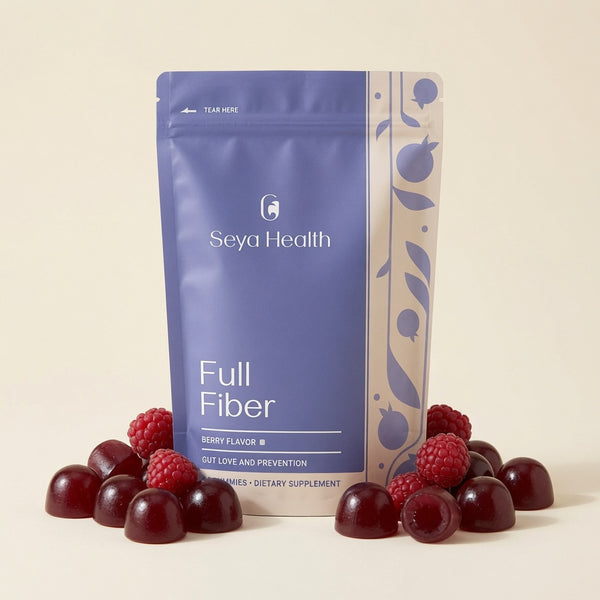
Seya Full Fiber
Most women fall short on fiber. Seya Full Fiber gives you 6 grams from three fibers in three small vegan gummies. Plant based, no gelatin, no sugar alcohols.
Shop Full FiberKeep reading

bone health
Best supplements for women over 40: what the evidence supports for heart, bones and muscles (and what's hype)

creatine
How long does creatine take to work? A realistic timeline for women

constipation