
Home/ The Journal/ creatine
creatine
Does creatine cause hair loss? What the DHT (rugby) study really found

Short version: Does creatine cause hair loss? No study has shown that it does. The fear traces back to one 2009 study of male rugby players, whose DHT rose 56% in a week. That study never measured hair. A 2025 trial did measure hair, for 12 weeks, and found no change. But it only tested men.
- The rugby study: a hormone result, not a hair result.
- The gap: no trial has checked hair in women.
- Your move: if you are shedding, check what changed 2 to 3 months ago.
Last updated November 2026.
You started creatine in the spring. By summer, there is more hair in the shower drain.
Then you search it. A forum says DHT. A video says stop now.
It is easy to blame the new scoop. It is the one thing you can point at.
But timing is not proof. Hair sheds on a delay, so the real trigger may be something else from months back. Here is what the famous study found, what it missed, and how to work out what is going on.
Where did the creatine and hair loss idea come from?
From one small study. Nearly all the worry traces back to it, says a 2021 expert review by Antonio et al.
In 2009, researchers in South Africa gave creatine to college rugby players during their season. They used a high dose: 25 g a day for 7 days, then 5 g a day for 14 days. The same men also took a placebo, with a 6-week break between the two.
Testosterone did not change. But DHT rose 56% after the first week. It was still 40% above the starting level at the end. See van der Merwe et al. (Clin J Sport Med, 2009).
The authors asked for more research. They never said anyone lost hair. They did not check.
What is DHT, and why does it matter for hair?
DHT is a hormone your body makes from testosterone. An enzyme does the conversion.
It matters because DHT is the main androgen involved in pattern hair loss. In people who are prone to it, hair follicles shrink over time and grow finer hairs. Your genes set up that sensitivity. See Iyengar and Li (Aust Prescr, 2025).
So the internet did some quick math. Creatine raises DHT. DHT shrinks follicles. So creatine causes baldness.
Each link sounds fair. But the chain was never tested, and the first link is shaky.
What did the rugby study really find?
A real rise, but a smaller story than the headline. The 2021 review pulled out details that the 56% figure hides:
- The starting points differed. DHT began 23% lower on creatine, at 0.98 nmol/L versus 1.26 on placebo.
- The change was small in real terms. Creatine added 0.55 nmol/L after a week. Placebo fell by 0.17.
- Levels stayed normal. DHT remained "well within normal clinical limits."
- Only 16 men finished, of the 20 who signed up.
- Hair was never measured. No photos, no counts, no scalp checks.
The result has also never been repeated. Across 12 other studies of testosterone, 10 found no change and 2 found small rises. The review's summary: the evidence "does not indicate that creatine supplementation increases total testosterone, free testosterone, DHT or causes hair loss/baldness."
One thing to keep in mind. Some of that review's authors have ties to creatine makers, which they disclose.

Has anyone actually tested creatine and hair?
Yes, once. It took until 2025. Lak et al. (JISSN, 2025) ran a randomized, double-blind trial in men who lift, aged 18 to 40. Half took 5 g of creatine a day for 12 weeks. Half took a placebo. Hair was checked with scalp imaging and a hair-root test.
38 men finished, 19 in each group. There was no difference between groups in DHT, in the DHT-to-testosterone ratio, or in any hair measure, including density and thickness. No side effects were reported.
Here is how the two studies compare:
| Rugby study (2009) | Hair trial (2025) | |
|---|---|---|
| Who | College rugby players, men | Men who lift, 18 to 40 |
| Dose | 25 g a day, then 5 g a day | 5 g a day, no loading |
| Length | 3 weeks | 12 weeks |
| DHT | Up 56%, then 40% | No difference from placebo |
| Hair measured? | No | Yes, no change |
That is good news, but it has limits. This is one small trial. It lasted 12 weeks, and pattern loss is slow. It did not record family history. And it skipped the 25 g loading week, so it did not retest the exact dose that raised DHT in 2009. At least 2 of its authors also advise creatine brands, which they disclose.
Does creatine cause hair loss in women?
No one knows for sure, because no one has tested it. Both studies above were in men.
The 2025 authors say so themselves: "future research may be needed in females."
That gap is the old problem. Women take it, and the research looks at men. In one 2026 survey of creatine users, 75% of women correctly marked "creatine causes hair loss" as false, against 87% of men. And 24% of women were simply unsure. See Burridge et al. (JISSN, 2026).
Being unsure is fair. You were never studied.
So the honest summary is this: no evidence of harm, but no direct proof of safety for women's hair. If you have PCOS or a family history of pattern hair loss, ask your doctor before you start. We found no hair study in those groups either. For the wider picture, read creatine side effects in women.
If it isn't creatine, why is my hair falling out?
It may be a signal from months ago. Not a verdict on your supplement.
One common shedding pattern is called telogen effluvium. A stress on the body pushes hair into its resting phase. The hair falls out about 2 to 3 months later. Past triggers include childbirth, surgery, high fevers, and fast weight loss. See Kang et al. (Ann Dermatol, 2024).
That delay is why creatine gets blamed. Look back further than your last purchase. Common suspects:
- Fast weight loss. In that same study of 140 people with this kind of shedding, 110 were women. Average weight loss was about 15%.
- A GLP-1 medicine. One pooled analysis tied these drugs to 40% higher odds of non-scarring hair loss, though it could not prove the drug itself was the cause. See Viquez Burboa et al. (Skin Appendage Disord, 2026). Taking both? Read creatine on a GLP-1. Don't stop your medicine without talking to your prescriber.
- Low iron or thyroid problems. Both can play a part, per Iyengar and Li, and a blood test can check them.
- Age and genes. Pattern hair loss affects about 12% of women in their 20s and up to 40% by age 50, per Iyengar and Li. A thinner ponytail is a common sign.
What should you do if you notice shedding on creatine?
Don't panic, and don't guess. Try these steps:
- Write down the last 6 months. Note any diet, illness, new medicine, or big stress, with dates.
- Look at the pattern. All-over shedding points toward telogen effluvium. Slow thinning in one pattern points toward pattern loss.
- Ask for labs. A 2026 review of hair loss on GLP-1 medicines says a blood count, ferritin, thyroid, and vitamin D may be considered. See Gupta et al. (Sci Prog, 2026).
- See a dermatologist if needed. That same review says to go if shedding lasts past 6 to 9 months, or if your scalp itches or looks inflamed. Sudden, heavy loss with no clear trigger should be seen quickly, per Iyengar and Li.
Want to pause creatine anyway? That is your call. Just know that hair sheds on a delay, so a quick change may not tell you much either way. And if you do take it, 3 to 5 g a day is the usual dose. A loading phase is optional, and it is the part the 2025 trial did not test.
Where Seya fits, honestly
You should know we have a stake here. A Seya creatine gummy is coming January 2027. Until it launches, we will not share its dose, price, or ingredients, and you can't buy it yet.
Today, the Seya product on sale is our fiber gummy, which supports regularity. It is not a hair product.
Still sorting creatine rumors from facts? Read is creatine a steroid. This is education, not medical advice.
These statements have not been evaluated by the Food and Drug Administration. This product is not intended to diagnose, treat, cure, or prevent any disease.
Frequently asked questions
Does creatine cause hair loss?
No study has shown that it does. The only trial to measure hair directly, in 38 men over 12 weeks, found no change in hair or DHT compared with placebo. It has not been tested in women.
Does creatine raise DHT?
One 2009 study in rugby players found a rise, and it stayed within normal limits. That result has not been repeated. A 2025 trial at 5 g a day found no difference from placebo.
Is creatine hair loss a concern for women?
There is no evidence of harm, but no trial has measured hair in women. If you have PCOS or a family history of pattern hair loss, talk to your doctor first.
What did the rugby player DHT study find?
DHT rose 56% after a week of 25 g a day and stayed 40% above the starting level after 2 more weeks at 5 g. Testosterone did not change. Hair was not measured.
Is hair loss a side effect of creatine?
It is not an established side effect. The 2025 trial reported no side effects in either group, though it was small and included only men.
Is hair loss from creatine permanent?
No evidence links creatine to hair loss, so no data answers this directly. The common shedding type, telogen effluvium, is usually temporary. Pattern hair loss tends to progress, so see a doctor.
Does hair grow back after shedding?
Often, yes, if it is telogen effluvium. In one study of shedding after weight loss, all 140 patients improved, in about 5 months on average, without treatment. Pattern hair loss is different and usually needs care from a doctor.
Should I stop creatine if my hair is thinning?
That is your call, but stopping may not tell you the cause. Hair sheds on a delay. Ask your doctor to check iron and thyroid, and review any weight loss or new medicine.
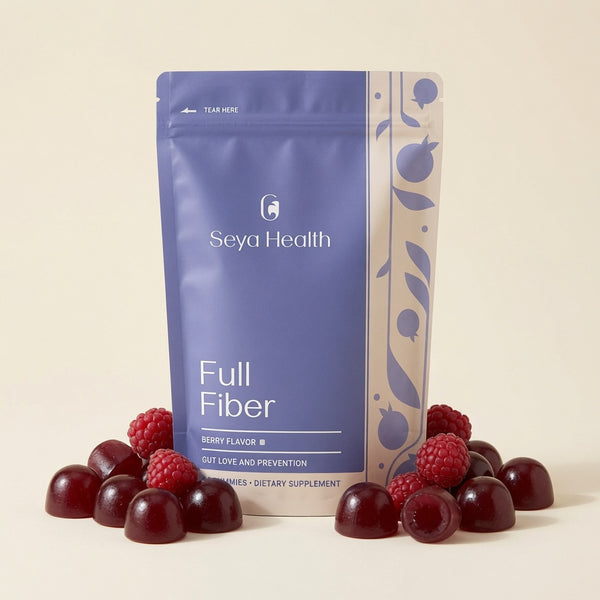
Seya Full Fiber
Most women fall short on fiber. Seya Full Fiber gives you 6 grams from three fibers in three small vegan gummies. Plant based, no gelatin, no sugar alcohols.
Shop Full FiberKeep reading

bone health
Best supplements for women over 40: what the evidence supports for heart, bones and muscles (and what's hype)

creatine
How long does creatine take to work? A realistic timeline for women

constipation