
Home/ The Journal/ fiber
fiber
The Early Signs of Menopause: Is It Stress or a Hormonal Shift?
One morning you wake up drenched in sweat despite the AC being on. The next afternoon, you find yourself snapping at a coworker over a minor email. You feel "off"—your sleep is fragmented, your focus is fading, and your cycle is starting to play hide-and-seek.

Short version: The early signs of menopause and the signs of a hard year look almost identical from the inside. That is not you being dramatic. Perimenopause usually starts in your 40s and runs for years before your last period, and the honest answer to "stress or hormones" is often both at once.
- Menopause happens between 45 and 55 for most women. Perimenopause starts years earlier.
- Hot flashes and night sweats ran a median of 7.4 years in a study of 1,449 women.
- As many as two-thirds of women in perimenopause report memory or focus trouble.
Last updated July 2026.
You woke up soaked at 3am with the air conditioning on.
By Tuesday you snapped at a coworker over an email that did not deserve it. Your sleep is broken. Your focus is gone. Your period showed up 9 days early, then skipped a month.
Here is the direct answer on the early signs of menopause: if you are in your late 30s or 40s, this cluster is usually perimenopause, the transition that runs for years before your last period (MedlinePlus). It is not you working too hard. It is not you losing your grip.

What is perimenopause, exactly?
Menopause is one day, not a season. It is the 12-month mark since your last period. Everything before it is the transition.
That transition usually starts in your 40s, though it can start earlier, and it can last several years. Most women reach menopause between 45 and 55 (MedlinePlus).
So you can be years into the change with periods still arriving. That is normal. It also explains why a blood test on a random Tuesday rarely settles anything.
What are the early signs of menopause?
Five show up first, and they rarely arrive one at a time.
Your cycle gets unpredictable. Shorter one month, skipped the next. Heavy, then barely there. Irregular timing is usually the first flag.
Sleep breaks. Low progesterone makes it harder to fall asleep and stay asleep. Low estrogen brings hot flashes that soak you at night, and bladder changes wake you again (Office on Women's Health).
Focus slips. Words go missing. You reread the same paragraph three times.
Tissues get dry. Less estrogen thins vaginal tissue, so sex can hurt and urinary symptoms show up more often.
Digestion changes. More bloat. Slower days. A gut that stopped running on schedule.
Is it stress or a hormonal shift?
Usually both. And you deserve the honest version rather than the tidy one.
The Office on Women's Health says it plainly: mood changes at this stage "also could be from stress, family changes, or feeling tired." Hormones are not the only author here.
Which is the trap. You blame the job, the kids, the year you had. You tell yourself to try harder. Meanwhile a real biological transition is running underneath all of it, unnamed.
It is a signal, not a character flaw. Naming it correctly is the whole point, because the two causes stack. Broken sleep makes focus worse. Worse focus makes work harder. Harder work costs you more sleep.
You cannot discipline your way out of a hormone curve. You can stop treating it as a personal failing.
How long do hot flashes actually last?
Longer than most women are told.
In SWAN, a study following 1,449 women with frequent hot flashes and night sweats, the median total duration was 7.4 years. For the 881 women with an observable final period, symptoms ran a median 4.5 years past it. Women whose symptoms started early, before the change was obvious, had the longest run of all, over 11.8 years (Avis et al., JAMA Internal Medicine, 2015).
Read that number again. This is not a rough six months.
That is not a reason to despair. It is a reason to stop waiting quietly for it to pass and start managing it with your doctor.
Why does your gut change during perimenopause?
Be careful with what the internet promises here. The direct research linking hormone shifts to bloat is thinner than the confident headlines suggest, and any brand that tells you otherwise is selling.
What is well documented is the baseline. Colon transit runs about 42 hours in women against 30 hours in men (Meier et al., 1995). Women's waste already takes 12 extra hours to make the trip.
Now add a stretch of bad sleep, a changing appetite, and less movement. The slow lane gets slower.
Fiber is the plain lever. Adults need 22 to 34 grams a day (NIDDK), and most women land near 15. Seya's daily fiber gummies deliver about 5 grams, roughly half the dose used in the studies, so the claim stays where the evidence sits: fiber supports regularity. It is a daily habit, not a fix for a hormone transition. More on perimenopause constipation and the fiber gap most women are living in.
These statements have not been evaluated by the Food and Drug Administration. This product is not intended to diagnose, treat, cure, or prevent any disease.
When should you call your doctor?
Call if you soak through a pad or tampon in an hour.
Call if bleeding comes back after 12 full months without a period.
Call if your mood goes dark or heavy, or if you feel unsafe. That is depression, a separate and serious illness, not a mood swing.
Call if sex hurts. There are real options, and enduring it is not one of them.
Bring 3 months of tracked cycles and symptom notes with you. Ask about your thyroid and iron too, since both can produce this same fog and fatigue.
Frequently asked questions
What is the average age of menopause?
Most women reach menopause between 45 and 55 years old, and menopause is defined as 12 months since your last period (MedlinePlus). Perimenopause, the transition before it, usually begins in your 40s and can start earlier. It can run for several years, so it is common to have symptoms while your periods are still arriving.
Is it stress or perimenopause?
Often both. The Office on Women's Health notes that mood changes at this stage could also come from stress, family changes, or being tired. Broken sleep and a real hormonal transition also feed each other. The useful move is not picking one cause, it is tracking your cycles and symptoms for 3 months and taking that record to a clinician.
How long do perimenopause symptoms last?
In the SWAN study of 1,449 women, hot flashes and night sweats lasted a median of 7.4 years total, and a median of 4.5 years past the final period. Women whose symptoms began before the transition was obvious had the longest course, over 11.8 years (Avis et al., 2015).
Does perimenopause cause bloating and constipation?
The direct evidence is thinner than the internet implies, so be skeptical of confident claims. What is documented is that colon transit is already slower in women, about 42 hours versus 30 in men (Meier et al., 1995), and that poor sleep, appetite changes, and less movement all slow things further. Fiber and water are the everyday levers.
Can a blood test confirm perimenopause?
Not reliably on its own, because hormone levels swing week to week during the transition. Doctors generally work from your age, your cycle pattern, and your symptoms. Testing thyroid and iron is still worth asking about, since both can cause the same fatigue and fog and are easy to miss.
Does hormone therapy help with memory problems?
Not for memory. The Office on Women's Health states that menopausal hormone therapy does not fix or prevent memory loss. It is used for other symptoms, and that decision belongs with your doctor. For focus, the levers with evidence behind them are sleep, exercise, staying socially active, and mental stimulation.
Sources
- MedlinePlus: Menopause.
- Office on Women's Health: Menopause symptoms and relief.
- Avis NE, et al. Duration of menopausal vasomotor symptoms over the menopause transition. JAMA Intern Med. 2015.
- Meier R, et al. Influence of age, gender, hormonal status and smoking habits on colonic transit time. Neurogastroenterol Motil. 1995.
- NIDDK: Treatment for Constipation.
Related reading
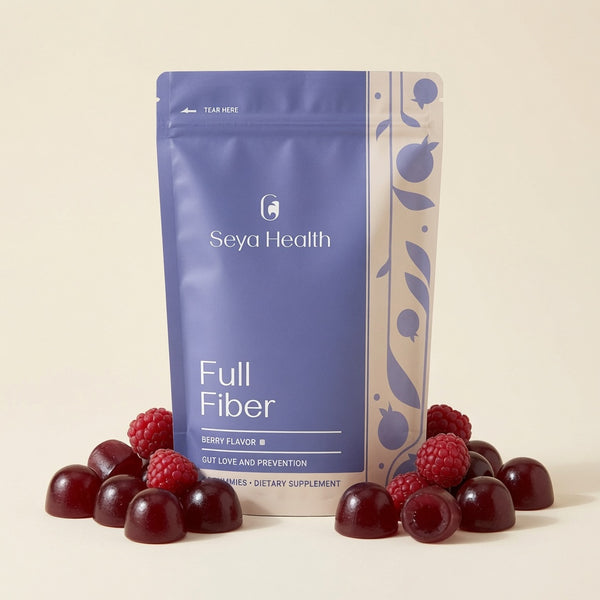
Seya Full Fiber
More than 90% of women fall short on fiber. Seya Full Fiber gives you 6 grams from three fibers in one, in three small gummies that feed the beneficial bacteria in your gut. Plant based, no gelatin, no sugar alcohols.
Shop Full FiberKeep reading

fiber
Can a Multivitamin Replace Vegetables? What Supplements Can't Do for Your Gut

constipation
The Best Way to Beat Constipation in Your 30s (and Where Fiber Gummies Fit)

fiber
The Gut-Skin Axis: Does Your Gut Health Affect Your Skin?
The gut-skin axis, explained: how your gut bacteria and blood sugar affect your skin, w...