
Home/ The Journal/ body composition
body composition
Creatine in a calorie deficit: can it protect muscle while you lose fat?

Short version: Creatine in a calorie deficit may help you keep more muscle, but lifting does most of the work. In a review of 6 diet trials, strength training prevented 93.5% of the muscle loss that dieting alone caused. Creatine adds a smaller boost on top, at 3 to 5 g a day.
- Why muscle drops: eating less slows the repair of muscle by about 27%.
- What protects it: lifting first, then enough protein, then creatine.
- What to expect: a small rise on the scale from water, not fat.
Last updated October 2026.
You cut calories to lose fat. Your body does not always agree on what to burn.
Some of the weight that comes off can be muscle. That is the part most women want to keep.
Here is what the research says about protecting it, and where creatine fits in.
Why do you lose muscle in a calorie deficit?
When you eat less, your body builds new muscle protein more slowly. Muscle is always being broken down and rebuilt, so a slower rebuild means a net loss over time.
In one lab study, 15 adults ate about a third fewer calories for 5 days. Their resting muscle protein synthesis fell by 27%. See Areta et al. (Am J Physiol Endocrinol Metab, 2014).
The same study had good news. One bout of lifting brought muscle building back to normal, even while dieting.
The authors put it plainly: "short-term ED reduces postabsorptive MPS; however, a bout of REX in ED restores MPS." ED means energy deficit, MPS means muscle protein synthesis, and REX means resistance exercise.
How much of the weight you lose is muscle?
It depends a lot on whether you exercise. A review of 52 studies looked at middle-aged and older adults who lost weight.
In diet-only groups, 81% lost at least 15% of their weight as fat-free mass. In groups that dieted and exercised, that fell to 39%. See Weinheimer et al. (Nutr Rev, 2010).
Fat-free mass is everything that is not fat. It includes muscle, water, and bone, so it is not a perfect stand-in for muscle.
Still, the pattern is clear. Dieting alone costs more lean tissue. If muscle loss is your worry, our guide to what sarcopenia is explains why it matters with age.
Does creatine in a calorie deficit prevent muscle loss?
It may help, but the proof is thinner than most ads suggest. Only a few trials test creatine during a real diet.
The longest is a 12-week trial in 64 adults aged 45 to 65, and 40 of them were women. People took 2 doses of 5 g a day while they trained and ate less. The creatine group gained more lean tissue and lost more body fat percentage than placebo. See Chun et al. (JISSN, 2026).
A short trial gives a more modest picture. Men on a very low calorie diet took 20 g of creatine a day for 4 days. They lost 1.4% of their fat-free mass, versus 2.4% on placebo. But their nitrogen losses, a marker of protein breakdown, were about the same. See Rockwell et al. (Med Sci Sports Exerc, 2001).
So part of what creatine "saves" may be water held in muscle. That is not a bad thing. It just means creatine is a helper, not a shield.
Lifting, protein, or creatine: which protects muscle most?
Lifting comes first. Protein comes second. Creatine is the add-on that works best with the other two.
| Tool | What the trial found during weight loss | Source |
|---|---|---|
| Strength training | Prevented 93.5% of the lean mass loss from dieting, about 0.8 kg | Sardeli 2018, 6 trials |
| Higher protein | Lean mass up 1.2 kg on 2.4 g per kg, versus 0.1 kg on 1.2 g per kg | Longland 2016, 40 men |
| Creatine | More lean tissue and a bigger drop in body fat percentage than placebo | Chun 2026, 64 adults |
The lifting review covered older adults with obesity who trained 3 times a week. It concluded that lifting "is able to prevent almost 100% of CR-induced muscle loss." CR means calorie restriction. See Sardeli et al. (Nutrients, 2018).
The protein trial was tough: young men ate about 40% fewer calories and trained 6 days a week for 4 weeks. The high-protein group also lost more fat, 4.8 kg versus 3.5 kg. See Longland et al. (Am J Clin Nutr, 2016).

Can creatine help you build muscle and lose fat at the same time?
Sometimes, yes. This is often called body recomposition, and the trials that saw it all paired creatine with lifting.
In older adults who lift, creatine adds lean tissue. A review of 22 trials and 721 people found an extra 1.37 kg of lean mass with creatine. See Chilibeck et al. (Open Access J Sports Med, 2017).
Those trials did not all include a diet. In the 12-week diet trial above, though, the creatine group still gained lean tissue while losing fat.
Whether creatine burns fat by itself is a separate question. We cover it in does creatine help women lose weight.
Will creatine slow your weight loss progress?
It can make the scale look slower for a few weeks. It does not stop fat loss.
Creatine pulls water into muscle. A review of 143 trials found an average gain of 0.86 kg, about 2 pounds, which can look like a stall. See Pashayee-Khamene et al. (JISSN, 2024). Our creatine weight gain timeline shows how long that lasts.
Track your waist, your strength, and how your clothes fit. Those tell you more than the scale while you cut.
How to use creatine while cutting
- Dose: 3 to 5 g a day is the standard range. See Antonio et al. (JISSN, 2021).
- Lift: 2 to 3 strength sessions a week. Creatine works best with training.
- Protein: spread it across meals. The deficit trials that kept muscle used more than the minimum.
- Deficit size: keep it modest. The 12-week trial cut 300 to 500 calories a day.
- Form: plain creatine monohydrate. Our best creatine for weight loss guide covers what to buy.
On a GLP-1 medicine? Muscle loss is a bigger concern there. Read creatine on a GLP-1, and talk to your doctor before you add anything.
Pregnant, nursing, or living with kidney disease? Ask your doctor first. Creatine can raise creatinine on a blood test, so mention it before lab work. See Antonio et al. (JISSN, 2021).
Where Seya fits, honestly
Seya sells one product today: a fiber gummy that supports regularity. Our creatine gummy is coming January 2027. It is not on sale yet, so we are not sharing a dose or price.
No supplement can promise weight loss or guarantee you keep muscle. This is education, not medical advice.
These statements have not been evaluated by the Food and Drug Administration. This product is not intended to diagnose, treat, cure, or prevent any disease.
Frequently asked questions
Should you take creatine while cutting or on a weight loss journey?
It is a reasonable add-on if you also lift. Lifting and protein protect muscle the most, and creatine adds a smaller boost at 3 to 5 g a day.
Can you take creatine during weight loss?
Yes, for most healthy adults. Diet trials have used it alongside training. Ask your doctor first if you are pregnant, nursing, on a GLP-1, or have kidney disease.
Will creatine affect my weight loss progress?
The scale may rise a pound or two from water in muscle. That is not fat. Track your waist and strength too.
Does creatine prevent muscle loss during a calorie deficit?
It may reduce it. A 12-week trial saw more lean tissue with creatine, but a 4-day trial found protein breakdown was about the same. Lifting matters more.
Does creatine prevent muscle loss during fasting?
No trial has tested that directly. The closest is a 4-day very low calorie diet, where creatine raised muscle creatine by 15% to 16% but did not change protein breakdown.
Can creatine help you build muscle and lose fat at the same time?
Sometimes, mostly when paired with lifting. In one 12-week diet trial, the creatine group gained lean tissue while body fat percentage fell.
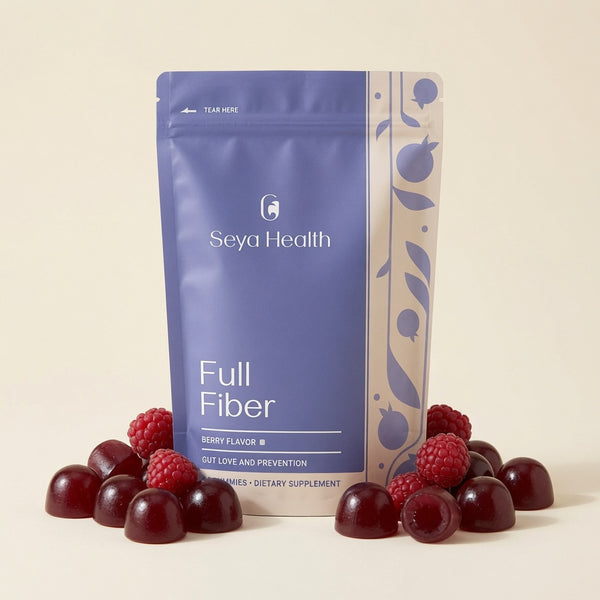
Seya Full Fiber
Most women fall short on fiber. Seya Full Fiber gives you 6 grams from three fibers in three small vegan gummies. Plant based, no gelatin, no sugar alcohols.
Shop Full FiberKeep reading

bone health
Best supplements for women over 40: what the evidence supports for heart, bones and muscles (and what's hype)

creatine
How long does creatine take to work? A realistic timeline for women

constipation