
Home/ The Journal/ bloating
bloating
Cycle Syncing Your Workouts: Exercise to Ease Luteal-Phase Bloat

Short version: Cycle syncing your workouts is sold as a performance rule. The data says phase barely moves performance. What it does move is bloat, and the lever there is gentle movement, timed after meals.
- Mild pedaling cut retained gut gas from 45% at rest to 24% during exercise in a controlled study of people with bloating.
- A 10 to 15 minute walk after each meal beat a prokinetic drug on postprandial fullness and bloat over 4 weeks (p = 0.002).
- Gut transit is significantly slower in the luteal phase, when progesterone is high (p < 0.01). Same food, slower trip.
Last updated August 2026.
Your workout felt fine last week. This week your waistband is tight, your legs feel heavy, and a chart online is telling you to swap strength for restorative yoga because of where you are in your cycle.
Here is the honest version. Exercise does help luteal bloat, just not for the reason the chart gives. Mild movement cut retained gut gas from 45% down to 24% in a controlled study of people who complain of bloating, and their symptom scores dropped with it (Villoria et al., 2006).
You did not get weak this week. Your gut got slower. That is a mechanism, not a character flaw.
Does cycle syncing your workouts actually work?
Not the way it is sold to you.
The largest review of the question pooled studies on how exercise performance changes across the cycle. Performance was only trivially lower in the early follicular phase. Everything else washed out.
The authors said so plainly:
"General guidelines on exercise performance across the menstrual cycle cannot be formed; rather, it is recommended that a personalised approach should be taken based on each individual's response to exercise performance across the menstrual cycle."
— McNulty et al., Sports Medicine, 2020
So a fixed calendar that tells every woman to lift heavy on day 9 and stretch on day 24 is running well past the evidence.
That does not make the idea worthless. It changes what you are syncing for. You are not protecting your squat. You are managing a symptom.
Why does bloat get worse in the luteal phase?
Because your gut slows down after you ovulate.
Researchers measured transit in 15 women twice in one cycle: once on days 8 to 10, once on days 18 to 20. Transit was significantly slower in the luteal window, when progesterone was high (p < 0.01) (Wald et al., 1981).
Slower transit means gas sits longer. Sitting gas is what you feel as pressure.
The feeling itself is messier than the usual story, though. Across 765 cycles in 62 women, the bloated, puffy feeling peaked on the first day of bleeding and was lowest mid-follicular, and hormone levels did not line up neatly with it (White et al., 2011).
Real symptom. Real timing. Sloppier cause than a wellness chart admits.
What kind of exercise eases luteal-phase bloat?
Mild, rhythmic, and honestly kind of boring.
In the gas study, people pedaled gently on and off while gas was infused into the gut. At rest they held on to 45% of it. Pedaling, they held 24%. Symptom scores fell from 3.6 to 2.8 (Villoria et al., 2006).
That is a light load. Not a bootcamp.
The wider evidence points the same direction. Pooling 9 randomized trials and 680 people, exercise improved constipation symptoms (relative risk 1.97, 95% CI 1.19 to 3.27, p = 0.009) (Gao et al., 2019).
Walking. Easy cycling. Slow yoga. Upright and rhythmic beats hard and heroic here.
When in the day should you move?
After you eat.
In a 4-week randomized trial, 94 people with functional bloating (70 of them women) either took a prokinetic drug or took a 10 to 15 minute walk after every meal. Both groups improved. On postprandial fullness and bloat, the walk did better than the drug (p = 0.002) (Hosseini-Asl et al., 2021).
Three meals. Three short walks. That is 30 to 45 minutes total, and you never change clothes for it.
This is the part of cycle syncing worth keeping. Not a different workout. A different habit around meals, in the 2 weeks your transit is slowest.
What should a cycle-synced week actually look like?
Keep your training. Change the walking. Here is the honest version of the chart, on a 28-day example cycle.
| Phase | Days | What actually changes | What to do |
|---|---|---|---|
| Menstrual | 1 to 5 | Bloat scores peak on day 1 | Short, easy movement. Keep the after-meal walks. |
| Follicular | 6 to 13 | Transit is at its quickest | Train how you want. Push if you feel like pushing. |
| Ovulation | Around 14 | Nothing you have to change | Train how you want. |
| Luteal | 15 to 28 | Progesterone rises, transit slows | Same training. Add a 10 to 15 minute walk after each meal. |
Cycle length varies, so count from your own bleed rather than from a template. If your energy genuinely drops in a given week, train lighter that week. That is the personalized approach the researchers asked for.
Where does fiber fit in a bloated week?
It is the daily floor. It is not the rescue.
Adults need 22 to 34 grams of fiber a day (NIDDK). Most women land near 15. That gap is there every day of the month, and the luteal slowdown just makes you notice it.
Two rules make it go smoothly. Add fiber a few grams at a time, not all at once. And add water every time you add fiber, because fiber needs fluid to soften stool instead of bulking it up.
Seya's daily fiber gummies deliver about 5 grams. That is roughly half the dose used in the research, so the claim stays where the evidence actually sits: fiber supports regularity. It is a daily habit, not a fix for a bad afternoon.
More on the daily target in how much fiber women need per day, and on the symptom itself in luteal phase bloating.
These statements have not been evaluated by the Food and Drug Administration. This product is not intended to diagnose, treat, cure, or prevent any disease.
When should you call your doctor?
Call if the bloat keeps building instead of coming and going with your cycle.
Call for severe belly pain, vomiting, or a swollen belly that stays swollen for weeks.
Call if you go 3 or more days with no bowel movement.
Call if you see blood, or if you are losing weight without trying.
Bloat that ignores your cycle is worth a real look. A blog post cannot see your history, and persistent belly swelling has causes worth ruling out.
Frequently asked questions
Does cycle syncing your workouts actually work?
Not as a performance rule. The largest pooled review found performance was only trivially lower in the early follicular phase, and the authors concluded that general guidelines across the cycle cannot be formed and that a personalised approach is better (McNulty et al., 2020). Syncing is more useful as a symptom plan: your gut is slower in the luteal phase, so that is when after-meal walks earn their keep.
What exercise is best for period bloating?
Mild, rhythmic movement. In a controlled study, gentle intermittent pedaling cut retained gut gas from 45% at rest to 24%, and symptom scores fell from 3.6 to 2.8 (Villoria et al., 2006). Walking, easy cycling, and slow yoga all fit that description. Intensity is not the active ingredient here.
How long should you walk after a meal for bloating?
10 to 15 minutes after each meal is what was actually tested. In a 4-week randomized trial of 94 people with functional bloating, that habit outperformed a prokinetic drug on postprandial fullness and bloat (p = 0.002) (Hosseini-Asl et al., 2021). Three meals a day makes it 30 to 45 minutes total, split into pieces short enough to keep doing.
Should you skip workouts during your luteal phase?
There is no evidence you need to. Performance differences across cycle phases were trivial in the pooled data, and the recommendation was to go by your own response rather than by a phase chart. If a given week genuinely feels harder, train lighter that week. Keep moving, because movement is the part that helps the bloat.
Why does your stomach get bigger in the luteal phase?
Partly because gut transit slows. Measured in 15 women, transit was significantly slower on days 18 to 20 than on days 8 to 10, when progesterone was low (p < 0.01) (Wald et al., 1981). Slower transit gives gas more time to sit. The puffy feeling also peaks around the first day of bleeding, and it does not track hormone levels neatly (White et al., 2011).
Does fiber help with luteal-phase bloating?
Fiber supports regularity, which matters most in the 2 weeks your transit is slowest. It is a daily habit rather than a same-day rescue. Adults need 22 to 34 grams a day and most women get about 15. Add it a few grams at a time and drink more water as you go, since adding a lot at once while transit is already slow can make gas feel worse in the short run.
Sources
- Villoria A, Serra J, Azpiroz F, Malagelada JR. Physical activity and intestinal gas clearance in patients with bloating. Am J Gastroenterol. 2006;101(11):2552-7.
- Hosseini-Asl MK, Taherifard E, Mousavi MR. The effect of a short-term physical activity after meals on gastrointestinal symptoms in individuals with functional abdominal bloating: a randomized clinical trial. Gastroenterol Hepatol Bed Bench. 2021;14(1):59-66.
- McNulty KL, et al. The effects of menstrual cycle phase on exercise performance in eumenorrheic women: a systematic review and meta-analysis. Sports Med. 2020;50(10):1813-1827.
- Wald A, et al. Gastrointestinal transit: the effect of the menstrual cycle. Gastroenterology. 1981;80(6):1497-500.
- Gao R, et al. Exercise therapy in patients with constipation: a systematic review and meta-analysis of randomized controlled trials. Scand J Gastroenterol. 2019;54(2):169-177.
- White CP, Hitchcock CL, Vigna YM, Prior JC. Fluid retention over the menstrual cycle: 1-year data from the prospective ovulation cohort. Obstet Gynecol Int. 2011;2011:138451.
- NIDDK: Treatment for Constipation.
Related reading: the luteal phase, explained.
Seya Full Fiber
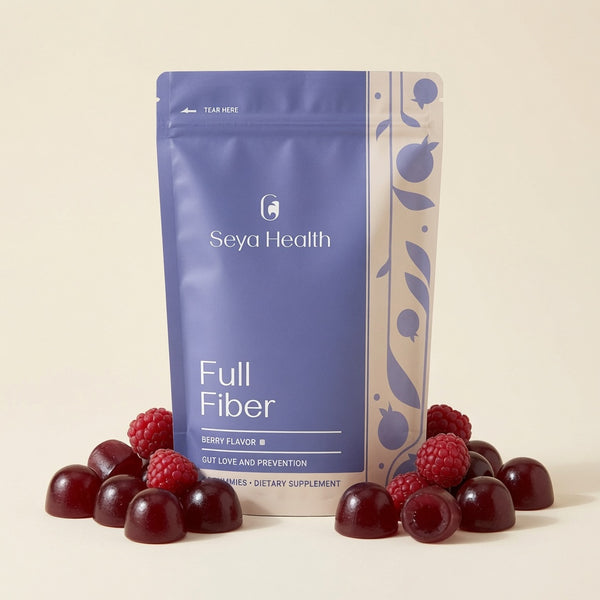
Getting enough fiber from food every day is hard. Seya Full Fiber is 6 grams from three fibers in one, in three small gummies, so you have a reliable daily floor. Plant based, no gelatin, no sugar alcohols, 60 gummies per pouch.
Shop Full FiberKeep reading
fiber
Can a Multivitamin Replace Vegetables? What Supplements Can't Do for Your Gut
constipation
The Best Way to Beat Constipation in Your 30s (and Where Fiber Gummies Fit)
fiber
The Gut-Skin Axis: Does Your Gut Health Affect Your Skin?
The gut-skin axis, explained: how your gut bacteria and blood sugar affect your skin, w...