Home/ The Journal/ dehydration
dehydration
Thirsty or Craving Sugar? How Hydration Affects Your Cravings

Short version on dehydration and sugar cravings: Being low on water does not seem to make you eat more. In a 2019 trial, mild dehydration raised thirst and a taste for salty food, but people ate the same amount at their next meal. The bigger link is what you drink: sugary drinks are the top source of added sugar in the U.S., at 24%.
- Thirst vs. hunger: they are different signals, but both show up around meals, so they are easy to blur.
- Low on water: even 1.4% dehydration left young women more tired, foggy, and headachy.
- Water before meals: 2 cups of water 30 minutes before breakfast cut how much older adults ate by about 13%.
- How much: women who are well hydrated take in about 91 ounces of total water a day, from drinks and food.
Last updated October 2026.
It is 3 p.m. You are dragging, your head feels a little thick, and the vending machine is calling your name. Is that a sugar craving, or are you just thirsty?
You have probably heard the tip "drink a glass of water first, you might just be thirsty." It sounds simple. The research behind it is more interesting, and a bit different from what most people think.
Here is what studies actually show about water and cravings, how to tell thirst from hunger, and how much water women need.
Is there a link between dehydration and sugar cravings?
Probably not directly. The best test so far did not find that being low on water makes people eat more.
In a 2019 crossover trial, 16 healthy adults (8 women, 8 men) spent time in a heat tent and then went without fluids, so they lost about 1.9% of their body weight in water. On another day, the same people got their fluids back. The next day they ate a pasta lunch, as much as they wanted, per Carroll et al., Physiology & Behavior, 2019 (PMID 31676259).
When they were dehydrated, they felt thirstier and wanted salty food more. They also leaned toward foods with more water in them. But they ate the same amount of food, and their levels of ghrelin, a hunger hormone, did not change.
So being dry seems to change what sounds good more than how much you eat. It was a small, short study, so it is not the final word. But it does not support the idea that thirst turns into a sugar binge.
Why do thirst and hunger feel the same?
Because they keep the same schedule. Your body sends them as two different signals, but they tend to arrive together.
In one study, 50 adults rated their hunger and thirst every hour for a week and wrote down what they ate and drank. Hunger rose and fell in two clear peaks a day. Thirst was stronger and steadier all day long, per McKiernan, Houchins, and Mattes, Physiology & Behavior, 2008 (PMID 18499200).
About 75% of what people drank came around meals, and most of it was drinks with calories. The authors also found that neither hunger nor thirst ratings did a good job of predicting how much people ate.
Put that together and you can see the mix-up. You feel a pull to "have something" around mealtime. If the closest thing is a soda, a sweet latte, or juice, you meet a thirst need with sugar.
What are signs you're dehydrated rather than hungry?
Look for signs in your body that point to water, not food. MedlinePlus lists these as common symptoms of dehydration in adults, per MedlinePlus, U.S. National Library of Medicine:
- Feeling very thirsty
- Dry mouth
- Peeing and sweating less than usual
- Dark-colored pee
- Dry skin
- Feeling tired
- Feeling dizzy
True hunger feels different. It builds slowly, your stomach may growl, and almost any food sounds good, not just one sweet thing. A craving is narrow: you want that cookie, right now.
A simple check: if it has been 3 to 4 hours since you ate, you may just be hungry. If you ate an hour ago, your mouth is dry, and your pee is dark, start with water.
Low on water can feel like low on energy
Mild dehydration can make you feel worn down, which is often when a sweet pick-me-up sounds best.
In a lab study, 25 young women walked on a treadmill on and off for 8 hours. On the days they lost about 1.4% of their body weight in water, they felt more tired, had a harder time focusing, and got more headaches. Tasks felt harder, too, per Armstrong et al., Journal of Nutrition, 2012 (PMID 22190027).
That study did not look at cravings. But tired, foggy, and headachy is a common moment to reach for sugar. Fixing the water first is an easy test.

How do sugary drinks feed the craving cycle?
This is the real link between thirst and sugar. Much of the sugar we take in, we drink.
The Dietary Guidelines for Americans 2020 to 2025 report that people in the U.S. get about 270 calories a day from added sugars. Sugary drinks like soda, sports drinks, and fruit drinks are the top source, at 24%. Sweetened coffee and tea add another 11%.
Your body does not count liquid sugar well
Sugar in a drink does not fill you up the way the same sugar in food does.
In a small trial, 15 adults got about 450 extra calories a day of sugar for 4 weeks, once as soda and once as jelly beans. With the jelly beans, they ate less at other times and made up for it. With the soda, they did not eat any less, and their weight went up only during the soda weeks, per DiMeglio and Mattes, International Journal of Obesity and Related Metabolic Disorders, 2000 (PMID 10878689).
So when you quench thirst with a sweet drink, you get the sugar but not much fullness. And you are still a bit thirsty after a very sweet drink, which keeps the loop going. Swapping some of those drinks for water is one of the simplest ways to cut added sugar.
Does drinking water reduce cravings?
Water before a meal can help some people eat a little less at that meal. There is no good study yet showing it stops sugar cravings.
In one trial, 24 adults around age 61 drank 500 mL of water (about 2 cups) 30 minutes before breakfast. They ate about 13% less at that meal than on a day with no water first, per Davy et al., Journal of the American Dietetic Association, 2008 (PMID 18589036).
A 12-week follow-up put 48 adults aged 55 to 75 on a lower-calorie diet. Half also drank 2 cups of water before each meal. That group lost about 2 kg (4.4 pounds) more, per Dennis et al., Obesity, 2010 (PMID 19661958). These were older adults on a diet plan, so the results may not carry over to everyone, and nobody should expect a set result.
What large surveys show
Large surveys point the same way but cannot prove cause. In U.S. data on 9,528 adults, 32.6% were not drinking enough water, and that group had higher BMIs on average, per Chang et al., Annals of Family Medicine, 2016 (PMID 27401419).
The fair takeaway: drinking water first is a cheap, safe thing to try. It gives you a pause, and sometimes the urge fades. If it does not, the craving likely has another cause, like short sleep, a skipped meal, or your cycle. Our guide on why you crave sugar walks through those.
How much water do women need a day?
About 91 ounces (2.7 liters) of total water a day, from all drinks and food. That is the average for women who are well hydrated, per the National Academies.
About 80% of that comes from drinks, and coffee and tea count. The other 20% comes from food, like fruit, vegetables, and soup. So most women land around 9 cups of fluid a day. You may need more if you are very active, it is hot out, or you are pregnant or nursing.
The same report says most healthy people meet their needs by letting thirst be their guide. You do not have to force down a gallon. Just do not ignore thirst, and do not answer it with sugar.
If you take a fiber supplement, water matters more. Our piece on how fiber works with water explains why.
How can you tell a craving from thirst in the moment?
Try this short routine the next time a sweet urge hits:
- Drink a full glass of water. Plain, sparkling, or with a slice of lemon.
- Wait 10 to 15 minutes. Do something else for a bit.
- Check in. Is the urge weaker? Then thirst or boredom may have been part of it.
- Still hungry? Eat a real snack with protein and fiber, like Greek yogurt with berries or an apple with peanut butter.
- Still want the sweet thing? Have a small portion and enjoy it. Cravings are normal.
A few habits help, too. Keep a water bottle where you can see it. Drink a glass with each meal. Swap one sweet drink a day for water or unsweetened tea. If you crave sweets in the afternoon, check whether you skipped water since lunch.
Where does fiber fit?
Fiber and water work as a team. Fiber holds on to water in your gut, and meals with fiber and protein tend to digest more slowly. Fiber will not switch off cravings, and we do not claim it does.
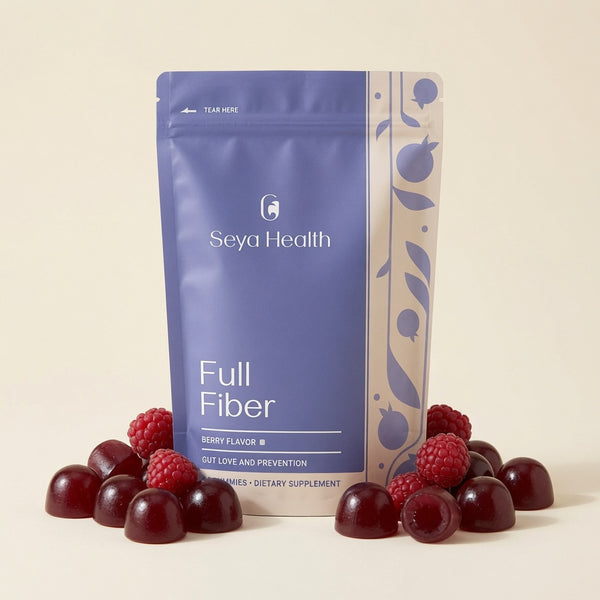
Most women fall short on fiber. Seya Full Fiber is a vegan gummy with resistant tapioca fiber, about 6 g per serving, plus magnesium citrate and ginger root. It supports regularity and helps close part of your daily fiber gap. Drink water with it, like you would with any fiber. For the blood sugar side, see fiber and blood sugar after 40, and if you use a GLP-1, our piece on food noise may help.
This is education, not medical advice.
These statements have not been evaluated by the Food and Drug Administration. This product is not intended to diagnose, treat, cure, or prevent any disease.
When should you see a doctor?
Talk to your doctor if:
- You are very thirsty all the time and peeing a lot, or you feel hungrier than usual and very tired. The NIDDK lists these as common signs of diabetes, so ask about a blood sugar test.
- You feel dizzy, confused, or faint, or your pee stays dark even when you drink.
- Your cravings are strong enough to make you feel out of control around food.
Frequently asked questions
Can dehydration cause sugar cravings?
There is little proof that it does. In a 2019 trial, mild dehydration raised thirst and the desire for salty food, but people ate the same amount at their next meal and their hunger hormone did not change.
Does drinking water reduce cravings?
It may help a little. Drinking 2 cups of water 30 minutes before breakfast cut how much older adults ate by about 13%. No study has shown it stops sugar cravings, but it is a safe first step.
How much water do women need a day?
Women who are well hydrated take in about 91 ounces (2.7 liters) of total water a day. About 80% comes from drinks and 20% from food. Most healthy women can let thirst guide them.
What are signs you're dehydrated rather than hungry?
Thirst, dry mouth, dark pee, peeing less, dry skin, tiredness, and dizziness point to water. Hunger builds slowly and makes most foods sound good, while a craving is for one specific food.
Why do I crave sweets when I'm thirsty?
Often because the drink nearby is sweet. Sugary drinks are the top source of added sugar in the U.S., at 24%, and liquid sugar does not fill you up the way food does.
Seya Full Fiber
Most women fall short on fiber. Seya Full Fiber gives you 6 grams from three fibers in three small vegan gummies. Plant based, no gelatin, no sugar alcohols.
Shop Full Fiber