
Home/ The Journal/ brain and appetite
brain and appetite
Food Noise and the Brain: How GLP-1s Quiet Cravings in Women

Short version: Food noise is the constant, unwanted thinking about food that keeps running after you have eaten. It is a signal, not a character flaw. It runs on a reward circuit. GLP-1 receptors sit directly on that circuit.
- A 2025 paper in Nutrition & Diabetes defines food noise as "persistent thoughts about food" that feel "unwanted and/or dysphoric," and can do real harm.
- Your brain makes its own GLP-1, down in the hindbrain. Those neurons wire straight into the reward pathway.
- In rats, 32.4% reach the ventral tegmental area, 41.5% the nucleus accumbens core, and 46.8% the shell.
- In 30 adults on semaglutide for 12 weeks, food eaten across a day of free-choice meals fell 24%.
- That trial found a lower preference for high-fat food. It did not find the sweet signal switching off.
- Fiber acts on the gut end of the same hormone. At about 5 g a day, Seya's claim is regularity. Nothing past it.
Last updated July 2026.
You already ate. You are not hungry. You are thinking about the kitchen anyway.
Food noise is the name for that. In 2025, obesity researchers writing in Nutrition & Diabetes gave it a formal definition. Their words: "persistent thoughts about food that are perceived by the individual as being unwanted and/or dysphoric."
You have probably filed this under willpower. Almost everyone does.
Here is what the research says instead. The volume knob is physical. It sits in a reward circuit. GLP-1 receptors sit on that circuit. In one 12-week trial, the people on semaglutide ate 24% less across a normal day without deciding to.
What is food noise?
Food noise is a stream of thoughts about food that you did not ask for and cannot turn down.
The term arrived from patients before it arrived from science. The 2025 Nutrition & Diabetes paper pinned it down. It also named the cost: food noise "may cause harm to the individual, including social, mental, or physical problems," the authors wrote.
They draw one line that matters. Everyone thinks about food. What sets food noise apart is "its intensity and intrusiveness, resembling rumination," per the same paper.
A 2023 review in Nutrients framed it behaviorally. It called food noise "heightened and/or persistent manifestations of food cue reactivity," which lead to intrusive thoughts about food.
So it has a name and a mechanism now.
That matters more than it sounds. If the loudness comes from a circuit, then quieting it is not a test of your character.
Why do we get so preoccupied with food?
Because food cues reach your reward system before they reach your judgment.
The research term is food cue reactivity. A smell. A wrapper. A delivery app on your home screen. The cue lands. The reward system responds. Only then do you get a thought you can argue with.
The 2023 Nutrients review built a model called CIRO: Cue, Influencer, Reactivity, Outcome. The cue is the trigger. Influencers set the volume, like how long since you ate. Reactivity is your brain's response. Outcome is what you do next.
That review lists what patients describe. They report thinking about foods all the time, especially highly palatable, energy-dense foods. They report checking food delivery apps "multiple times a day," in their own words.
Read that twice. Opening a delivery app for the fourth time at 4pm is a cue doing its job.

What part of the brain controls hunger?
The hypothalamus. But hunger and wanting run on two systems, and food noise lives mostly in the second one.
A 2022 review in the British Journal of Pharmacology puts the fuel job where it has sat for decades. Classical studies, the authors write, pointed to "the mediobasal hypothalamus in the regulation of energy balance and glucose homeostasis."
That is your fuel gauge. It tracks energy in against energy out.
The reward pathway is separate wiring. It runs from the ventral tegmental area to the nucleus accumbens. It deals in wanting, not in fuel.
Which is why an empty stomach and a loud craving are not one event. One is a fuel reading. The other is a reward signal.
You feed the first one. The second one you have to understand.
Why are GLP-1 receptors present in the brain?
Because your brain makes GLP-1 itself. It was never only a gut hormone.
The 2022 pharmacology review is direct. GLP-1 comes from "intestinal L-cells" and also from "a discrete population of neurons in the caudal medulla," which sits in your hindbrain. GLP-1 receptors are "highly abundant" in the brain nuclei that handle energy balance.
Those hindbrain neurons do not stay local. A 2012 study in Endocrinology traced them, in rats, straight into the reward pathway.
| Brain area | Job in the reward pathway | Direct GLP-1 links from the hindbrain (rats) |
|---|---|---|
| Ventral tegmental area | where dopamine neurons sit | 32.4% |
| Nucleus accumbens core | reward-seeking behavior | 41.5% |
| Nucleus accumbens shell | how rewarding a food registers | 46.8% |
In all three, switching those receptors on cut how much the animals ate, "especially intake of highly-palatable foods," per the study. Blocking them did the reverse. High-fat intake went up.
What does the nucleus accumbens do with a food cue?
It converts a signal into wanting.
Dopamine release into the nucleus accumbens is the currency of that conversion. More dopamine, more pull toward the thing in front of you. Food rewards run through this circuit. So does the wanting that arrives before them.
GLP-1 sits on that dial. The 2023 Nutrients review says GLP-1 medications "dampen the release of dopamine in the nucleus accumbens," and also speed its breakdown. That finding came from alcohol work. The circuit is the same one food cues use.
So brain activation is the honest frame here. The drugs act on a reward pathway. They do not act on your resolve.
How do GLP-1s quiet food noise?
By lowering the reward signal. In practice it shows up as eating less without trying to.
The clearest number comes from a 2017 crossover trial in Diabetes, Obesity and Metabolism. 30 adults with obesity. 12 weeks. Once-weekly semaglutide, stepped up to 1.0 mg.
Across a full day of free-choice meals, total energy intake fell 24% against placebo. That is a drop of 3,036 kJ (P < .0001).
"Less hunger and food cravings, better control of eating and a lower preference for high-fat foods." — Blundell et al., Diabetes, Obesity and Metabolism, 2017
Now the honest limit. No trial has measured food noise itself as a validated endpoint. The first questionnaire for it arrived in 2025. What exists today is patient report plus a mechanism that lines up with it.
Worth saying plainly: those 30 adults were reported as one group. That is not a women-only number.
Why can't I stop eating sugar on semaglutide?
Because the preference drop that trial measured was in fat, not in sweet.
Semaglutide lowered "relative preference for fatty, energy-dense foods," in the authors' summary. Sweet did not show the same fall.
Turning a reward signal down is not the same as switching it off. A quieter circuit still fires. And sugar is the cue that gets reinforced hardest, all day, by design.
Habit is the other half. The reward pathway explains the wanting. It does not explain the 4pm walk to the same drawer you have walked to for six years.
One trial in 30 people is also not the last word on sweet. If sugar stays loud on a GLP-1, that is a common report.
Talk to your prescriber before you change anything about a medication.
Where does fiber fit in the same system?
At the other end of the same hormone. Fiber works in your gut, which is where most of your GLP-1 comes from.
A 2015 trial in Gut starts from the mechanism. Colonic microbiota "ferment dietary fibres, producing short chain fatty acids," per the paper. One of those acids, propionate, turned out to be the interesting one.
Propionate "significantly stimulated the release of PYY and GLP-1 from human colonic cells," the team reported. So they built an inulin-propionate ester to carry it to the colon. 10 g of it raised postprandial PYY and GLP-1 and cut energy intake at the next meal. A longer arm ran 24 weeks in 60 overweight adults.
Read the limits with the result. That was an engineered delivery molecule, not a bowl of lentils. And it did not measure food noise.
The plain version still stands. Americans average about 16 g of fiber a day, against a 21 to 38 g recommendation, per MedlinePlus. We break that gap down in how much fiber women need per day.
What can Seya honestly promise here?
Regularity. That is the claim, and it is the only one.
Seya's gummies carry about 5 g of resistant tapioca fiber a day, in 3 vegan gummies. That is roughly half the dose most fiber studies use. The evidence grade is C, so supporting regularity is what we say.
It is not a GLP-1. It does not quiet food noise, and nothing on this page says otherwise.
Where fiber earns its place for GLP-1 users is duller and more useful. Appetite drops. Food volume drops. The bathroom gets difficult. That is the gap fiber fills, and the full version is in what to do about GLP-1 constipation.
Talk to your doctor before adding fiber if you are pregnant, have inflammatory bowel disease, have had bowel surgery, or take medication that affects digestion.
These statements have not been evaluated by the Food and Drug Administration. This product is not intended to diagnose, treat, cure, or prevent any disease.
Related reading: how GLP-1 actually works, what GLP-1s do for women beyond diabetes, how fullness actually works, and our daily fiber gummy for women.
Frequently asked questions
What is food noise?
Food noise is persistent, unwanted thinking about food that continues after you have eaten. A 2025 paper in Nutrition & Diabetes defined it as "persistent thoughts about food" that a person experiences as "unwanted and/or dysphoric," in the authors' words. The same paper notes it may cause social, mental, or physical harm.
What separates it from ordinary food thoughts is "its intensity and intrusiveness, resembling rumination," per that paper. A 2023 review in Nutrients describes the same thing as heightened or persistent food cue reactivity. The first validated questionnaire for food noise arrived in 2025, so this is a very new research target.
How do GLP-1 medications quiet food noise?
They lower the reward signal that makes food cues loud. GLP-1 receptors sit throughout the brain's reward pathway, including the ventral tegmental area and the nucleus accumbens. Activating them reduces intake of highly palatable food in animal studies.
In a 2017 crossover trial, 30 adults with obesity took once-weekly semaglutide at 1.0 mg for 12 weeks. Total energy intake across a day of free-choice meals fell 24%, a drop of 3,036 kJ versus placebo. The authors reported less hunger, fewer food cravings, better control of eating, and a lower preference for high-fat foods. No trial has yet measured food noise itself as a validated endpoint.
Why do we get so preoccupied with food?
Because food cues activate the reward system before conscious judgment gets involved. Researchers call this food cue reactivity. A 2023 review in Nutrients organized it into the CIRO model: Cue, Influencer, Reactivity, Outcome.
A cue can be a smell, a wrapper, or an app icon. Influencers such as time since your last meal set how loudly the cue registers. The same review records patients who describe thinking about foods all the time, and checking food delivery applications "multiple times a day," in their own words.
What part of the brain controls hunger?
The hypothalamus. A 2022 review in the British Journal of Pharmacology points to "the mediobasal hypothalamus in the regulation of energy balance," which makes it the body's fuel gauge.
Wanting is handled elsewhere. The reward pathway runs from the ventral tegmental area to the nucleus accumbens, and responds to food cues rather than to energy status. That is why a craving and an empty stomach are two different events. It is also why food noise can be loud on a full stomach.
Why are GLP-1 receptors present in the brain?
Because the brain produces GLP-1 on its own. It comes from "intestinal L-cells" and also from "a discrete population of neurons in the caudal medulla," per a 2022 pharmacology review. GLP-1 receptors are highly abundant in the brain nuclei that regulate energy balance.
Those hindbrain neurons project directly into the reward system. A 2012 study in Endocrinology traced them in rats. 32.4% reach the ventral tegmental area, 41.5% the nucleus accumbens core, and 46.8% the nucleus accumbens shell. Activating GLP-1 receptors in all three reduced food intake, especially intake of highly palatable foods.
Why can't I stop eating sugar on semaglutide?
Because the food-preference change measured in the 2017 semaglutide trial was a lower relative preference for fatty, energy-dense foods. A drop in sweet preference was not part of that finding.
Lowering a reward signal is not the same as removing it, so a quieter circuit still responds to sugar cues. Habit accounts for part of it too, since a routine built over years does not depend on the reward pathway alone. That trial ran in 30 people, so it is not the final word on sweet foods. Talk to your prescriber before changing anything about a medication.
Can fiber help reduce food noise?
There is a plausible mechanism and no direct evidence. Gut bacteria ferment dietary fiber into short chain fatty acids. One of them, propionate, "significantly stimulated the release of PYY and GLP-1 from human colonic cells" in a 2015 study in Gut. In that trial, 10 g of an engineered inulin-propionate ester raised postprandial GLP-1 and reduced energy intake.
That was a targeted delivery molecule rather than ordinary fiber, and food noise was not an outcome it measured. Seya's fiber gummies supply about 5 g of resistant tapioca fiber a day. That is roughly half the dose used in most fiber research. So the honest claim at that dose is support for regularity, and nothing beyond it.
Related reading
Seya Full Fiber
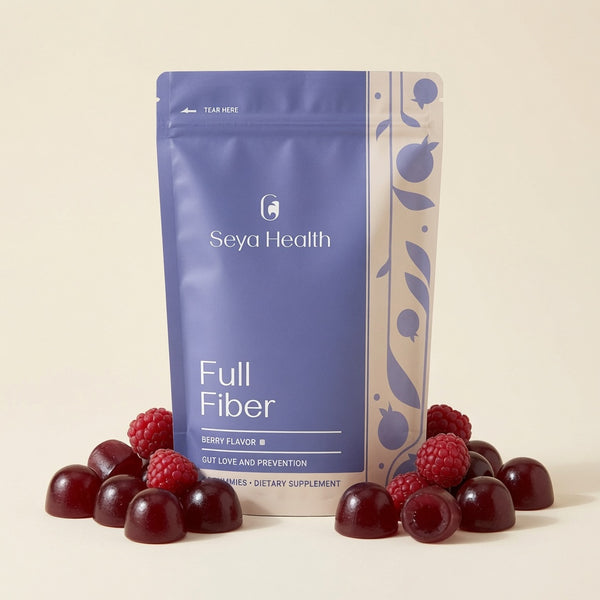
Getting enough fiber from food every day is hard. Seya Full Fiber is 6 grams from three fibers in one, in three small gummies, so you have a reliable daily floor. Plant based, no gelatin, no sugar alcohols, 60 gummies per pouch.
Shop Full FiberKeep reading
fiber
Can a Multivitamin Replace Vegetables? What Supplements Can't Do for Your Gut

constipation
The Best Way to Beat Constipation in Your 30s (and Where Fiber Gummies Fit)
fiber
The Gut-Skin Axis: Does Your Gut Health Affect Your Skin?
The gut-skin axis, explained: how your gut bacteria and blood sugar affect your skin, w...