
Home/ The Journal/ constipation
constipation
How Fiber Works With Water: Staying Full, Hydrated, and Regular After 40

Short version: Fiber and water are one system, not two habits. In a 117-person trial, both groups ate 25 g of fiber a day. The group told to drink 2 liters of water improved significantly more on stool frequency and on laxative use. Same fiber. Different water. Different result.
- The Rome trial landed on a specific number: 1.5 to 2.0 liters of fluid a day alongside 25 g of fiber.
- Total water for women is about 2.7 liters (91 oz) a day counting food and drinks, per the National Academies. Roughly 80% of that comes from what you drink.
- Gel-forming fiber carries an FDA choking warning if you take it dry. The label calls for a full 8 oz glass per dose.
- Drinks are a bad fiber source. A raw orange has 2.4 g per 100 g. Its juice has 0.2 g.
- The mineral-deficiency fear points at phytate, not at fiber. In one year-long trial, added fiber raised calcium absorption.
Last updated September 2026.
You added the fiber. Two weeks later you feel worse.
Heavier. Slower. More bloated than the day you started.
Here is the part the label skips. Fiber and water work as one system, and 117 patients in a Rome hospital showed what happens when you run only half of it.
Everyone in that 1998 trial ate about 25 g of fiber a day. One group also drank 2 liters of water. That group gained more stool frequency and cut more laxative use than the group who drank as they pleased.
So this was probably never about your discipline. You changed one input in a machine that needs two.
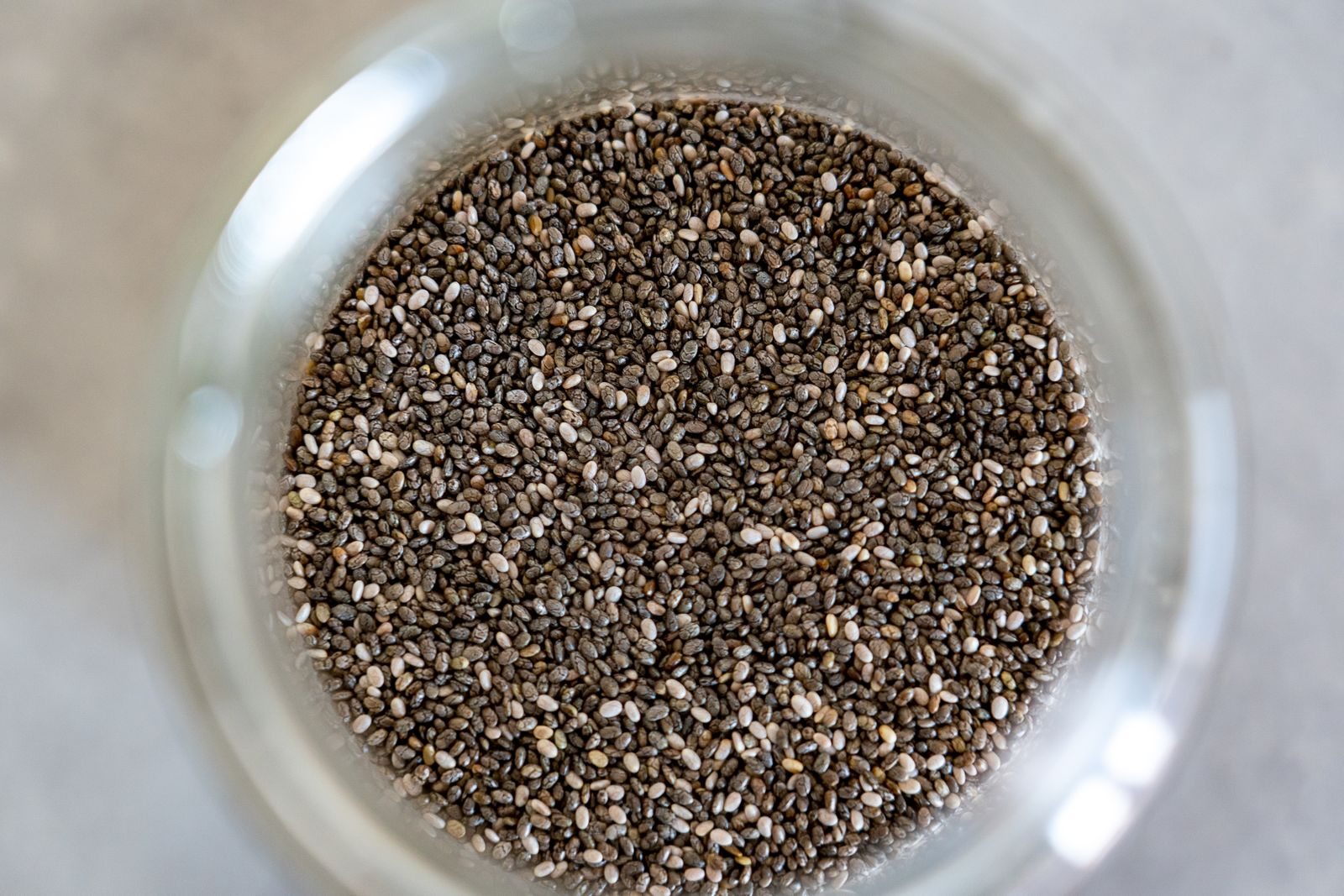
What do fiber and water actually do together?
Fiber is a category, not a substance. Its members behave very differently once they reach your gut.
A 2017 review in the Journal of the Academy of Nutrition and Dietetics sorted the mess out. In the large bowel, it found only two mechanisms that produce a laxative effect.
First: gel-forming soluble fibers, like psyllium and oat beta-glucan, hold water tightly and resist drying out. They stay wet the whole way through.
Second: coarse, gritty insoluble particles, like whole wheat bran, physically irritate the gut lining. The lining answers by secreting water and mucus.
Two routes. One destination. More water in the stool, so what leaves is bulky and soft instead of hard and slow.
Both routes share a catch. The fiber has to survive fermentation and still be there at the end. Fiber your bacteria eat on the way down holds nothing.
And both routes need water in the system to start with. A gel without water is just a powder.
Does fiber still work if you skip the water?
A little. Far less than it should.
Researchers in Rome recruited 117 adults with chronic functional constipation, aged 18 to 50. For two months everyone ate a standard diet delivering roughly 25 g of fiber a day. Then the groups split.
Group 1 drank whatever they liked and landed at 1.1 liters a day. Group 2 got instructions to drink 2 liters of mineral water, and landed at 2.1.
Both groups got better. Stool frequency rose. Laxative use fell.
Group 2 got significantly more of both, at p < 0.001 for each. Same fiber. Double the water.
The authors put a number on it. A 25 g fiber day raises stool frequency, and pushing fluid to 1.5 to 2.0 liters a day significantly enhances that effect.
NIDDK says it plainly: drink water and other liquids "to help the fiber work better."
The FDA goes further with gel-forming fiber. Psyllium products carry a required warning: without enough fluid it can swell and block your throat or esophagus. The instruction is a full 8 oz glass of liquid per dose.
That is a choking hazard on a federal label, not a marketing suggestion.
How much water do you need after 40?
There is a real number, and it runs bigger than most women guess.
The National Academies set the adequate intake for total water at about 2.7 liters a day for women, or 91 ounces. For men the figure is 3.7 liters, 125 ounces.
Read "total water" carefully. It counts everything. Coffee, tea, soup, milk, and the water sitting inside your food.
About 80% of the total arrives as drinks. The other 20% comes from what you eat.
So the beverage share works out near 2.2 liters, roughly nine cups a day. The old eight-glasses folklore lands accidentally close.
The same report says something people skip past. On an ordinary day, thirst makes an adequate guide. You do not owe anyone a milliliter count.
Fiber changes that math. Push fiber up and you need more water than your usual thirst signal asks for.
What high-fiber fluids are healthy to drink?
Almost none of them. That is the honest answer, and it saves you money.
Fiber lives in the solid structure of a plant. Juice a fruit and you pour most of it down the drain.
Figures below come from USDA FoodData Central, per 100 g.
| Food or drink | Fiber per 100 g | Water content |
|---|---|---|
| Cucumber, raw with peel | 0.5 g | 95.2% |
| Watermelon, raw | 0.4 g | 91.4% |
| Orange juice, raw | 0.2 g | 88.3% |
| Orange, raw | 2.4 g | 86.8% |
| Prune juice, canned | 1.0 g | 81.2% |
A whole orange carries 12 times the fiber of the juice squeezed out of it. Same fruit. One step of processing.
Prune juice does best of the drinks at 1.0 g per 100 g. A full cup still gets you only about 2.5 g against a 25 g day.
So the move is simple. Eat water-rich whole foods, and drink plain water beside them. A blender keeps the fiber. A juicer throws it away.
Which type of fiber absorbs the least water?
The soluble ones that never gel. This catches people out, because "soluble" sounds like the wet one.
Inulin, fructooligosaccharides, and wheat dextrin all dissolve. None of them thicken. They stay watery, your bacteria ferment them quickly, and very little survives to the far end of the colon.
The 2017 review is direct about what follows. Soluble fermentable fibers of that kind deliver no laxative effect at all. It names wheat dextrin and fine, smooth wheat bran particles as fibers that can go the other way and constipate.
Grind matters more than the soluble label. Coarse wheat bran works. The same bran milled fine does not.
The heavyweights for holding water are the gel formers: psyllium, oat beta-glucan, raw guar gum. Those are also the ones carrying the drink-a-full-glass warning.
So "soluble good, insoluble bad" is the wrong frame. The real question is whether a fiber still exists by the time it reaches your colon, and whether it holds water when it arrives. We split the two categories further in soluble vs. insoluble fiber.
Does fiber keep you from absorbing calories?
A little, and not in the way most people picture.
In a controlled feeding study, 17 people ate diets varying in fat and in fiber. As fiber went up, fat and protein digestibility went down, and the metabolizable energy of the whole diet dropped with it.
Some of what you eat leaves uncounted. The effect is real. It is also small, and it is no shortcut.
The fullness question has a stranger answer.
Fourteen volunteers took 7.4 g of psyllium in a double blind crossover trial. They then reported 13% less hunger and ate 17% less energy than on placebo.
Here is the twist. The researchers tracked gastric emptying directly, using a double-labeled meal, and found no delay whatsoever.
The gel never sat in anyone's stomach like a sponge. That mental image is wrong.
What it did instead was stretch absorption out along the intestine, flattening the after-meal glucose, insulin, and triglyceride curves. The fullness came from the flatter curve.
Which puts satiety downstream of the same thing that needs water: a gel intact enough to slow the traffic. More on that in fiber and satiety.
Does too much fiber cause mineral deficiencies?
The fear is older than the evidence, and it aims at the wrong molecule.
The compound that binds iron, zinc, and calcium in whole grains and beans is phytate. Phytate travels with fiber. Phytate is not fiber.
In trials, added fiber often moves minerals the other direction.
Adolescents in a year-long randomized trial took 8 g a day of inulin-type fructans or a placebo. Calcium absorption in the fiber group ran 8.5 percentage points higher at 8 weeks, and their bone mineralization improved across the full year.
That is fermentable fiber feeding bacteria, which acidifies the colon, which frees more calcium to cross the wall.
Two honest caveats. That trial ran in growing teenagers, not in women over 40. And if you already run low on iron, or you take a mineral supplement, the timing around a large fiber dose is worth raising with your clinician.
For most women eating normal food, the deficiency worry sits in the wrong place. We cover the genuine limits in can you eat too much fiber.
How to add fiber without the bloat
Four rules. All boring. All load-bearing.
- Go slow. NIDDK says to add fiber a little at a time so your body adjusts. Jumping from 12 g to 25 g in a week is how women end up bloated and quitting by Friday.
- Raise water at the same time. Not afterward. Every extra gram needs fluid to do anything at all.
- Drink a full 8 oz glass with gel-forming fiber. That comes off a federal label, not a wellness blog.
- Know the target. 25 g a day through age 50, then 21 g. NIDDK gives the adult range as 22 to 34 g depending on age and sex.
Most women sit nowhere near it. More than 90% of US women fall short of the target, and the average shortfall runs near half a day's worth. We break that down in why most women fall short on fiber, and set targets by age in how much fiber women over 40 need.
So the first fix is rarely a new product. It is beans, and a bigger glass.
Where Seya fits, honestly
We make a fiber gummy. One product. It closes part of the gap, and it never replaces the glass of water.
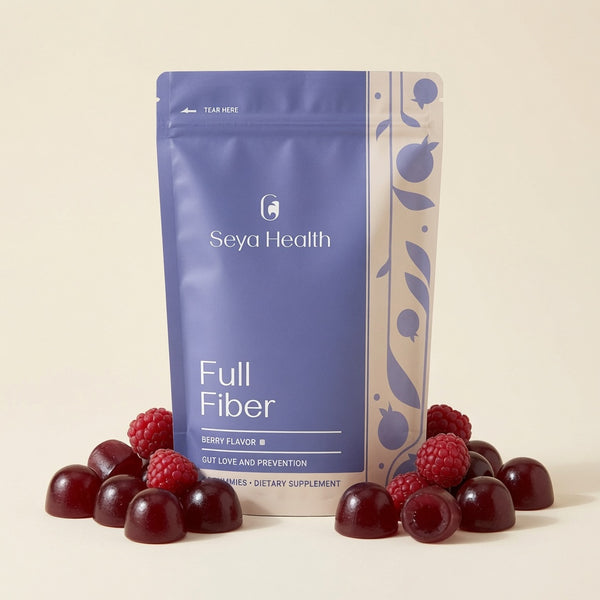
3 gummies deliver 5,650 mg of dietary fiber. That works out to 5.65 g, or 16% of the Daily Value. The label prints the split: 4,500 mg resistant tapioca fiber, 950 mg prebiotic soluble fiber, 200 mg cellulose, plus 80 mg magnesium as magnesium citrate and 100 mg ginger root.
5.65 g covers about a fifth of a 25 g day. Food covers the rest.
What we can honestly claim is that it supports regularity. Drink water with it, exactly as you would with any fiber you add.
This is education, not medical advice. If constipation is new, severe, or arrives with blood, pain, or unexplained weight change, that is a clinician's call rather than a supplement's. Talk to one before starting anything new, especially if you take medication.
These statements have not been evaluated by the Food and Drug Administration. This product is not intended to diagnose, treat, cure, or prevent any disease.
Frequently asked questions
How much water should you drink with fiber?
The best trial on this put 117 adults with chronic constipation on about 25 g of fiber a day, then told half of them to drink 2 liters of mineral water. Both groups improved, and the water group improved significantly more on stool frequency and on laxative use, at p < 0.001 for each.
The authors concluded that 1.5 to 2.0 liters of fluid a day enhances what 25 g of fiber can do. With gel-forming fiber specifically, the FDA-mandated label instruction is a full 8 oz glass of liquid per dose.
What high-fiber fluids are healthy to drink?
Very few drinks carry meaningful fiber, because fiber sits in the solid structure of a plant. Per 100 g, USDA FoodData Central gives raw orange juice 0.2 g of fiber against 2.4 g for a whole raw orange, a 12-fold difference. Canned prune juice does best among common drinks at 1.0 g per 100 g, so a cup supplies roughly 2.5 g of a 25 g daily target.
A better approach is water-rich whole food plus plain water. Cucumber with peel is 95.2% water, watermelon 91.4%, and a raw orange 86.8%. Blending keeps the fiber; juicing removes it.
Which type of fiber absorbs the least water?
Non-viscous soluble fibers hold the least: inulin, fructooligosaccharides, and wheat dextrin dissolve without thickening, ferment quickly, and largely disappear before the far colon. A 2017 review in the Journal of the Academy of Nutrition and Dietetics found these deliver no laxative effect, and named wheat dextrin and fine, smooth wheat bran particles as potentially constipating.
The high water-holders are gel formers such as psyllium, oat beta-glucan, and raw guar gum. Among insoluble fibers, coarse particles work mechanically by prompting water and mucus secretion, while the same fiber milled fine does not.
Does fiber keep you from absorbing calories?
Slightly. In a controlled feeding study of 17 people, raising dietary fiber lowered fat and protein digestibility and reduced the metabolizable energy of the diet. The effect is real and modest.
Fullness works through a different route than most people assume. In a double blind crossover trial, 7.4 g of psyllium cut hunger ratings 13% and energy intake 17% versus placebo, yet caused no delay in gastric emptying. The gel slowed absorption along the intestine and flattened the after-meal glucose, insulin, and triglyceride curves.
Does eating too much fiber cause mineral deficiencies?
For most women eating ordinary amounts of food, no. The compound that binds iron, zinc, and calcium in whole grains and legumes is phytate, which travels alongside fiber without being fiber.
Some fiber does the opposite. In a year-long randomized trial, adolescents taking 8 g a day of inulin-type fructans absorbed 8.5 percentage points more calcium at 8 weeks than placebo and showed better bone mineralization at one year. That trial studied growing teenagers, so it does not transfer directly to women over 40. If you run low on iron or take mineral supplements, ask a clinician about timing around large fiber doses.
Can fiber make constipation worse?
It can, in two situations. Adding fiber without adding fluid gives the gut bulk it cannot move easily, and the 2017 physics review names wheat dextrin and finely ground wheat bran as fibers that can constipate rather than loosen.
Large national survey data complicates the picture further. Across 9,373 US adults in NHANES, low liquid intake predicted constipation in women and men, while dietary fiber intake did not predict it at all. Constipation affected 10.2% of women and 4.0% of men.
Related reading
Seya Full Fiber
Getting enough fiber from food every day is hard. Seya Full Fiber is 6 grams from three fibers in one, in three small gummies, so you have a reliable daily floor. Plant based, no gelatin, no sugar alcohols, 60 gummies per pouch.
Shop Full FiberKeep reading

fiber
Can a Multivitamin Replace Vegetables? What Supplements Can't Do for Your Gut

constipation
The Best Way to Beat Constipation in Your 30s (and Where Fiber Gummies Fit)
fiber
The Gut-Skin Axis: Does Your Gut Health Affect Your Skin?
The gut-skin axis, explained: how your gut bacteria and blood sugar affect your skin, w...