
Home/ The Journal/ acid reflux
acid reflux
Eat to Extinguish: The Best Foods and Drinks for Heartburn Relief
When your chest is on fire, your first instinct is likely to reach for a quick-fix antacid. But while those tablets neutralize acid for a moment, your diet is the real key to preventing the "burn" from returning. By choosing foods that are low-acid and high-fiber, you can keep your Lower Esophageal Sphincter (LES) closed and your stomach happy.

Short version: The best foods for heartburn relief are low-acid, low-fat, and high-fiber. Oatmeal, brown rice, root vegetables, bananas, and melon. They calm the burn without loosening the valve at the top of your stomach. About 20% of US adults get acid reflux, and women's hormones tilt the odds.
- Eat low-acid and high-fiber. Skip fatty, fried, and heavily acidic foods that relax the valve.
- In one study, more fiber cut the share of people with heartburn from 93.3% to 40% in 10 days.
- Progesterone relaxes that valve, so heartburn climbs in the second half of your cycle and in pregnancy.
Last updated July 2026.
The best foods for heartburn relief are low in acid, low in fat, and high in fiber. Oatmeal, brown rice, root vegetables, bananas, and melon. They calm the burn two ways: they do not relax the valve at the top of your stomach, and the fiber helps you feel full, so you eat less in one sitting.
About 20% of adults in the US deal with acid reflux, and for women the odds run a little differently. Here is what to eat, what to sip, and what to skip.
First, the reframe worth keeping. That burn is not a verdict on your willpower. It is not proof you ate something "bad." It is mechanical. A ring of muscle called the lower esophageal sphincter, the LES, sits at the top of your stomach. It is supposed to stay shut. When it opens at the wrong time, acid splashes up. Food does not cause the burn by being "acidic enough." It causes it by loosening that valve or by piling pressure behind it.
What are the best foods for heartburn relief?
Foods that keep the LES tight and do not sit heavy. That means low-fat, high-fiber, and gentle on the stomach.
Your firewalls are the high-fiber staples. Oatmeal, brown rice, whole-grain bread, and root vegetables like sweet potato and carrot. Fiber fills you up sooner, so you are less likely to overeat and push acid upward. It also feeds your gut and keeps things moving.
Then the low-acid soothers. Bananas and melon sit high on the pH scale, so they are easy on an already-irritated throat. Avocado and olive oil give you fat that is gentler than fried or greasy food, which is the worst offender for a loose valve.
The NIH's digestive-disease institute is blunt about the mechanics: reflux happens when the LES weakens or relaxes when it should not. Every food choice below is really about that one valve.
What are the best drinks to calm the burn?
Plain water is the quiet winner. It rinses acid back down and adds nothing that provokes the valve.
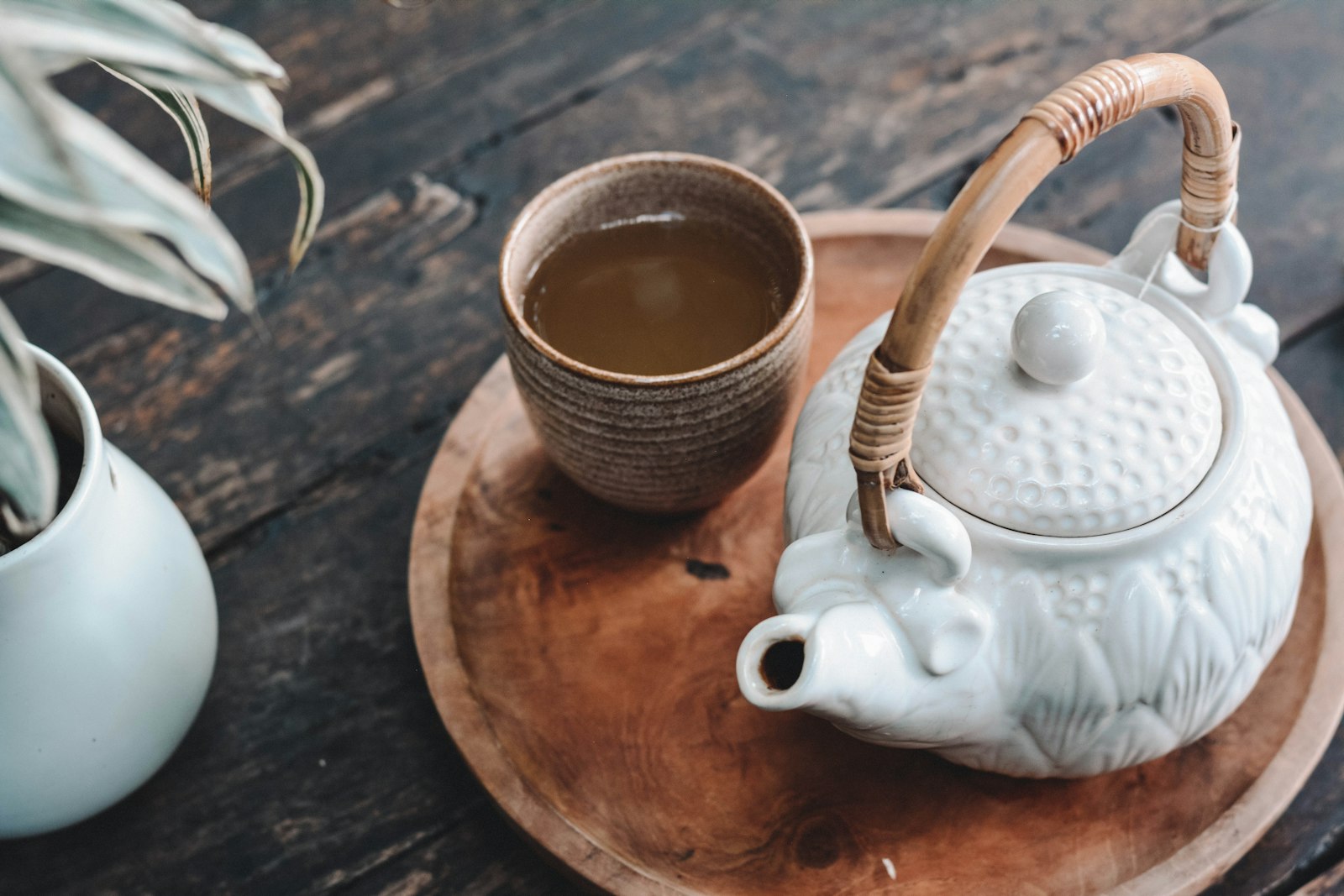
Beyond water, reach for soothing, low-acid sips. Ginger has a long record as a digestive calmer, so ginger tea is an easy go-to. Chamomile and fennel tea are gentle too. A small glass of low-fat or plant milk can buffer the burn for a few minutes when you are mid-flare.
Skip the ones that loosen the valve: coffee, alcohol, and carbonated drinks. More on why below.
Why does fiber help with heartburn?
Because fiber works on both sides of the problem: pressure and the valve itself.
The clearest evidence is small but striking. In a 2018 trial in the World Journal of Gastroenterology, 30 people with reflux added psyllium fiber, 5 grams three times a day, for 10 days. The share who reported heartburn dropped from 93.3% to 40%. Their reflux episodes fell from about 68 to 42 a day. And the resting pressure of the LES, the valve, more than doubled, from 5.4 to 11.3 mmHg.
"Fiber-enriched diet resulted in an increase of minimal LES pressure, a decrease in the number of gastroesophageal refluxes, and a decrease in heartburn episodes." — Morozov and colleagues, World Journal of Gastroenterology (2018)
Bigger-picture data agrees. In a large cohort, people eating the most fiber had about a 25% lower risk of reflux symptoms than those eating the least, a relative risk of 0.75, per an analysis in Clinical Gastroenterology and Hepatology (2023).
Most women are nowhere near enough fiber. The average is about 15 grams a day against a target near 25. That is the same shortfall we cover in the fiber gap in women, and it touches heartburn too.
What foods and drinks make heartburn worse?
The triggers share one job: they loosen the valve or slow your stomach so food and acid sit longer.
Fat is the big one. High-fat and fried foods relax the LES and slow digestion, which raises the odds acid comes back up, per a review of food and reflux in Current Opinion in Pharmacology (2017). Coffee and chocolate can relax the valve directly. Alcohol and fizzy drinks do too. Citrus, tomato, and spicy food do not loosen the valve, but they can sting a throat that is already raw.
One honest note. The American College of Gastroenterology does not tell everyone to cut all of these blindly. The evidence for banning them across the board is thin. Triggers are personal. Track which foods set you off, and cut those, not a generic list.
Calm it vs. trigger it
| Eat and sip | Go easy on | Why |
|---|---|---|
| Oatmeal, brown rice, whole grains | Fried and fast food | Fiber fills you up; fat relaxes the valve |
| Sweet potato, carrot, root veg | Rich, creamy, greasy dishes | Gentle fiber vs. slow, heavy digestion |
| Bananas, melon | Citrus, tomato | Low-acid vs. acid that stings a raw throat |
| Avocado, olive oil | Butter, lard, fatty cuts | Gentler fat vs. valve-loosening fat |
| Water, ginger, chamomile, fennel tea | Coffee, alcohol, soda, chocolate | Soothing vs. valve-relaxing |
Why do women get heartburn differently?
Because of one hormone: progesterone. It relaxes smooth muscle, and the LES is smooth muscle.
When progesterone rises, the valve loosens a little. That is why heartburn tends to climb in the second half of your cycle, and why it is so common in pregnancy. Heartburn shows up in about 26% of pregnancies in the first trimester and more than 51% by the third, tracking the steady rise in progesterone, per an analysis in The American Journal of Medicine.
So if your reflux flares on a schedule, that is not in your head. It is a valve responding to your hormones. The same cyclical pattern drives luteal phase bloating. Most heartburn advice was written as if a woman's gut were a smaller version of a man's. It is not, and the hormone timing is the proof.
How should you eat to keep the burn away?
Change how you eat, not just what. A few small habits do most of the work.
- Eat smaller meals. A packed stomach pushes the valve open. Stop before you are full.
- Do not lie down for 2 to 3 hours after eating. Gravity keeps acid where it belongs.
- Add fiber slowly. A jump from 15 to 30 grams overnight ferments hard and leaves you gassy. Climb a few grams every few days, and drink more water as you go.
- Find your own triggers. Keep a two-week note of what you ate and when you burned.
If a slow, backed-up gut is part of your picture, our guide to how much fiber women need per day gives you the target to build toward.
Seya's job is to stay specific, not loud. Fiber, as a daily habit, is linked to fewer reflux symptoms and better regularity. Our 3 vegan gummies deliver about 5 grams of fiber from resistant tapioca, ingredients you can name. The evidence that fiber supports regularity earns a grade of C at that dose, so that is exactly what we claim. It is an honest daily fiber habit, not a heartburn treatment, and it does not replace the low-acid, low-fat eating above.
These statements have not been evaluated by the Food and Drug Administration. This product is not intended to diagnose, treat, cure, or prevent any disease. Frequent heartburn can signal GERD or other conditions; see a doctor if it happens more than twice a week.
Related reading: our daily fiber gummy for women, the fiber gap in women, and more from the Seya journal.
Frequently asked questions
What are the best foods for heartburn relief?
The best foods for heartburn relief are low-acid, low-fat, and high-fiber: oatmeal, brown rice, root vegetables like sweet potato and carrot, bananas, and melon. They fill you up without loosening the valve at the top of your stomach or slowing digestion. Fatty and fried foods do the opposite, so keep those light.
What drinks help calm heartburn?
Plain water is best; it rinses acid down and provokes nothing. Ginger, chamomile, and fennel teas are soothing, low-acid sips, and a small glass of low-fat or plant milk can buffer the burn for a few minutes. Avoid coffee, alcohol, carbonated drinks, and chocolate drinks, which can relax the valve and let acid up.
Does fiber help with acid reflux?
It can. In a 2018 trial, people who added psyllium fiber for 10 days saw heartburn drop from 93.3% to 40% and their valve pressure more than double. Higher fiber intake is also linked to about a 25% lower risk of reflux symptoms. Fiber helps you feel full so you overeat less, which eases the pressure that pushes acid up. It supports regularity, but it will not fix reflux on its own.
What foods make heartburn worse?
Fatty and fried foods are the main triggers, because fat relaxes the lower esophageal valve and slows digestion. Coffee, chocolate, alcohol, and carbonated drinks can loosen the valve too. Citrus, tomato, and spicy foods do not loosen it but can sting an already-irritated throat. Triggers are personal, so track which foods set you off rather than cutting everything.
Why do women get heartburn more than men?
Progesterone relaxes smooth muscle, including the valve at the top of the stomach, so heartburn tends to rise in the second half of the menstrual cycle and in pregnancy, where it affects about 26% of women in the first trimester and more than 51% by the third. If your reflux flares on a schedule, that is a valve responding to your hormones, not a willpower problem.
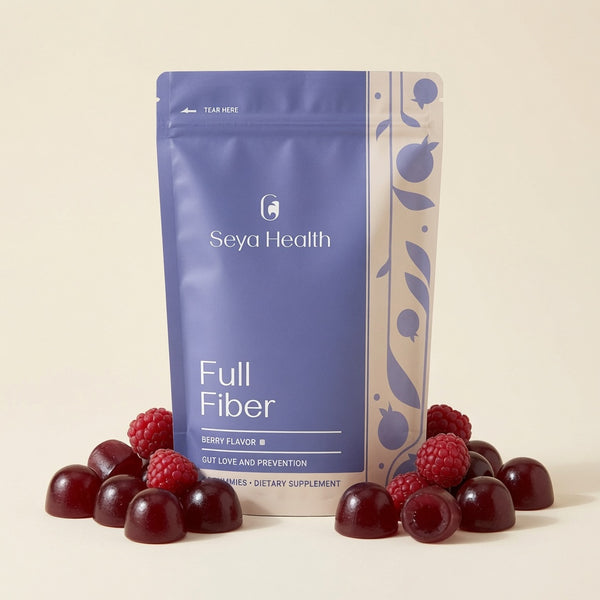
Seya Full Fiber
More than 90% of women fall short on fiber. Seya Full Fiber gives you 6 grams from three fibers in one, in three small gummies that feed the beneficial bacteria in your gut. Plant based, no gelatin, no sugar alcohols.
Shop Full FiberKeep reading
fiber
Can a Multivitamin Replace Vegetables? What Supplements Can't Do for Your Gut

constipation
The Best Way to Beat Constipation in Your 30s (and Where Fiber Gummies Fit)
fiber
The Gut-Skin Axis: Does Your Gut Health Affect Your Skin?
The gut-skin axis, explained: how your gut bacteria and blood sugar affect your skin, w...