Home/ The Journal/ constipation
constipation
Fiber gummies during pregnancy: are they safe and do they help?

Short version: Fiber gummies during pregnancy are generally seen as a low-risk way to add fiber, because fiber stays in your gut and is barely absorbed into the blood. Constipation is common: in one study it hit up to 26% of women in a single trimester. Fiber can help you go more often, but the trials are small. Clear any supplement with your prenatal care team first.
- Safety: bulk-forming fiber is thought to be the safest laxative type in pregnancy, per ACOG.
- Does it help: one small trial found 2.24 more bowel movements a week with fiber.
- The target: about 28 g of fiber a day in pregnancy. Most women get less.
- Check the label: look at every ingredient, not just the fiber.
Last updated October 2026.
You are pregnant, you are backed up, and the bottle in your hand says "fiber gummy." Is it okay to take?
For most people, fiber is one of the first things a doctor suggests. But a gummy is more than fiber, and pregnancy is not the time to guess.
Here is what the research says, what to check on the label, and when to call your doctor instead.
Are fiber gummies safe during pregnancy?
Fiber itself is considered low-risk in pregnancy. The full gummy is what you need to check.
Fiber works inside your gut. Very little of it passes into your blood, so very little can reach the baby. A review for Canadian family doctors noted that laxatives, including bulk-forming fiber, "have minimal systemic absorption" and are not expected to raise the risk of birth defects. See Trottier et al. (Can Fam Physician, 2012).
The American College of Obstetricians and Gynecologists (ACOG) goes a step further. It says bulk-forming laxatives "are thought to be the safest laxatives." See ACOG, Problems of the Digestive System.
A fiber gummy is a bulk-forming product. But it also has a sweetener, a gelling agent, and often other add-ins. Those extras are where your questions should go.
Why is constipation so common in pregnancy?
Hormones slow your gut down, and prenatal iron can make it worse.
ACOG explains that higher hormone levels in pregnancy "can slow down the digestive system." Slower movement means stool stays in the colon longer and gets drier.
How common is it? A study that tracked 103 women found these rates of constipation:
| Time point | Women with constipation |
|---|---|
| First trimester | 24% |
| Second trimester | 26% |
| Third trimester | 16% |
| 3 months after birth | 24% |
The same study found that women taking iron supplements were 3.5 times as likely to be constipated. Many prenatal plans include iron, so this one matters. See Bradley et al. (Obstet Gynecol, 2007).
Constipation is not only a pregnancy problem. For the bigger picture, read constipation in your 30s.
Can fiber gummies help pregnancy constipation?
Fiber can help you go more often. The proof in pregnancy is thin, though.
A Cochrane review looked for every trial on treating constipation in pregnancy. It found very few. In one trial of 40 women, those given fiber had 2.24 more bowel movements a week than women given nothing. Hard stools also dropped by 11% to 14%. The authors rated this moderate-quality evidence. See Rungsiprakarn et al. (Cochrane, 2015).
The same review compared stimulant laxatives with bulk-forming fiber. Stimulants worked more often, but caused more belly discomfort. Women were no happier with one than the other.
Two honest limits. That trial did not test a gummy. And the review found too little data to judge any treatment fully. Fiber is a sensible first step, not a sure fix.
How much fiber do you need while pregnant?
About 28 g a day. Most pregnant women fall short.
An Australian study of 804 women late in pregnancy found a median intake of 24.1 g a day. Only 29.5% reached the recommended 28 g. Women who ate the most fiber ate more fruit, especially apples and bananas. See Pretorius and Palmer (Nutrients, 2020).
So the gap is often just a few grams. A gummy can cover part of it. Food should cover the rest. For daily targets in more detail, see how much fiber women need per day.

What should you check on a fiber gummy label when pregnant?
Read the whole Supplement Facts panel, then show it to your clinician.
- The fiber type and grams. Common types are resistant tapioca fiber, inulin, polydextrose, and soluble corn fiber. Grams per serving vary a lot from brand to brand.
- Added sugar. Gummies are often sweetened. If you have gestational diabetes or are watching blood sugar, count it.
- Herbs and extras. Some gummies add herbs, vitamins, or minerals. Each one is a separate question for your care team.
- Minerals you already take. Your prenatal vitamin may already supply magnesium or other minerals. Add up the totals.
- Third-party testing. The FDA does not approve supplements before they are sold, per its dietary supplement Q&A. A batch-testing claim tells you more about what is in the bottle.
We walk through each part of a label in what is in a fiber gummy.
How do you start fiber gummies during pregnancy safely?
Low and slow, with water, and away from other pills.
- Ask your OB, midwife, or pharmacist first. Bring the bottle.
- Start with half a serving for a few days.
- Drink water through the day. Fiber pulls water into stool.
- Space it from your prenatal vitamin and medicines. Fiber can change how some pills absorb. See fiber and medication timing.
- Expect some gas at first. It usually eases as your gut adjusts.
If gas or bloating gets in the way, read can you eat too much fiber.
When should you call your doctor instead?
Do not self-treat these. Call your care team if you have:
- No bowel movement for several days with pain or swelling in your belly.
- Blood in your stool, or black stool.
- Severe cramping, or cramps that come and go in a pattern.
- Vomiting, or you cannot keep fluids down.
- Constipation that does not improve after a week or two of more fiber and fluid.
Stronger laxatives exist, but the Canadian review advises using osmotic and stimulant types only short term or now and then in pregnancy, to avoid dehydration. That call belongs to your clinician.
Where Seya fits, honestly
Seya makes a vegan fiber gummy that supports regularity. Its fiber is resistant tapioca fiber, with a little prebiotic soluble fiber and cellulose, about 6 g per serving. It also has 80 mg of magnesium as magnesium citrate and 100 mg of ginger root.
Two of those extras come up often in pregnancy. The NIH says ginger "may be helpful" for pregnancy nausea and that ginger supplements "may be safe" in pregnancy, but to check with your provider. See NCCIH, Ginger. For magnesium forms, see magnesium citrate vs. glycinate vs. oxide.
Seya has not been studied in pregnant women. Show the label to your prenatal care team before you take it.
This is education, not medical advice.
These statements have not been evaluated by the Food and Drug Administration. This product is not intended to diagnose, treat, cure, or prevent any disease.
Frequently asked questions
Are fiber gummies safe during pregnancy?
Fiber is considered low-risk in pregnancy because very little is absorbed into the blood. ACOG calls bulk-forming laxatives the safest type. Check every other ingredient in the gummy with your clinician before you start.
Can fiber gummies help pregnancy constipation?
They may help you go more often. In one small trial, pregnant women given fiber had 2.24 more bowel movements a week. No trial has tested fiber gummies in pregnancy specifically.
How much fiber should I eat while pregnant?
The usual target is about 28 g a day. In one study of 804 pregnant women, fewer than a third reached it.
Can I take a fiber gummy with my prenatal vitamin?
Space them a few hours apart. Fiber can affect how some pills absorb. Your pharmacist can give you a schedule.
Is it normal to be constipated in early pregnancy?
Yes. In one study, 24% of women were constipated in the first trimester. Pregnancy hormones slow digestion, and iron supplements raise the odds.
Written and reviewed by the Seya Health Editorial Team. Every health claim on this page is sourced to primary research or a medical body, as of October 2026. This article is educational and not a substitute for medical advice.
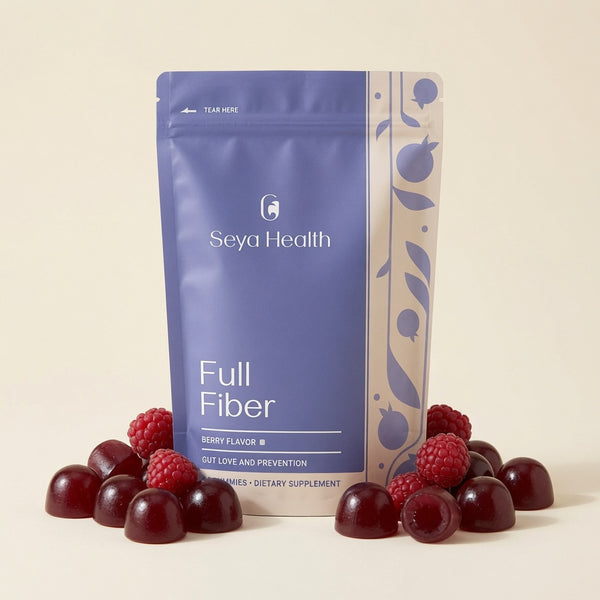
Seya Full Fiber
Most women fall short on fiber. Seya Full Fiber gives you 6 grams from three fibers in three small vegan gummies. Plant based, no gelatin, no sugar alcohols.
Shop Full Fiber