
Home/ The Journal/ clean label
clean label
What's Actually in a Fiber Gummy? Sweeteners, Prebiotics, and Label Red Flags

Short version: Fiber gummy ingredients come down to 4 lines. Which fiber. How much of it. What sweetens it. What colors it. Most panels answer 2 and hope you stop reading. The FDA counts only 18 isolated fibers as dietary fiber. Anything else on that line is a carb in a costume.
- FDA has approved 7 isolated fibers and intends to add 11 more, per its questions and answers on dietary fiber. A fiber off that list cannot be counted on the panel.
- Prebiotic fiber worked in trials at 3 to 20 g a day. Most gummies give you under 1 g of it.
- Sugar alcohols "can also produce abdominal gas, bloating, and diarrhea in some individuals," per FDA. Brands are allowed to leave the amount off the label.
- The current dietary guidelines cap added sugar at 10 g per meal.
Last updated September 2026.
You bought the gummies because they were easier than the powder.
Then you turned the jar around.
Fiber gummy ingredients are not hard to read once you know the 4 lines that matter. Which fiber it uses. How many grams you actually get. What makes it sweet. What makes it colored. Everything else on that panel is packaging.
Here is how to read it in about 30 seconds.
What are fiber gummy ingredients?
Four things, every time.
- A fiber. Usually resistant tapioca fiber, inulin, polydextrose, or soluble corn fiber.
- A gelling agent. Gelatin, or a plant version like pectin or carrageenan.
- A sweetener. Sugar, a sugar alcohol ending in -itol, or a no-calorie sweetener.
- Flavor and color. The part brands say least about.
The rest of the jar is water and filler. So the label check is 4 questions, not 40.
What counts as fiber on a US label?
Less than you would guess. The FDA keeps a list, and if a fiber is not on it, it cannot be called fiber.
The rule defines dietary fiber as "non-digestible soluble and insoluble carbohydrates (with 3 or more monomeric units), and lignin that are intrinsic and intact in plants; isolated or synthetic non-digestible carbohydrates (with 3 or more monomeric units) determined by FDA to have physiological effects that are beneficial to human health."
Read the second half again. An isolated fiber only counts once the FDA has decided it does something for you.
Seven have cleared that bar: beta-glucan soluble fiber, psyllium husk, cellulose, guar gum, pectin, locust bean gum, and hydroxypropylmethylcellulose. The agency intends to add 11 more, including inulin and inulin-type fructans, polydextrose, galactooligosaccharide, resistant maltodextrin, high amylose starch, glucomannan, and acacia gum.
So the first check is simple. Find the fiber's real name in the ingredient list. Not "fiber blend." The name.
How much prebiotic fiber do you need for it to do anything?
More than a gummy usually holds. The trials that made prebiotic fiber famous used doses most jars never approach.
A 2024 systematic review pooled 17 randomized controlled trials covering 713 people with functional constipation. Fructooligosaccharides raised bowel frequency against control, with a 95% confidence interval of 0.80 to 1.50. The dose across those trials ran from 3 to 20 g a day, per Foods, 2024 (PMID 39766936).
Now go look at a gummy panel. "Chicory root prebiotic fiber, 500 mg" is half a gram. The low end of the trials was 6 times that.
The same review logged mild bloating as the common side effect, and no serious ones. Prebiotic fiber is real. It just has to show up in a real amount.
The daily target is 25 g of fiber for women, and about 21 g after 50, per the National Academies. More than 90% of US women fall short, per Thompson, Nutrients, 2021. A jar that delivers 1 g is not closing that gap. We break the math down in how much fiber women actually need.
Why do sugar-free gummies make you gassy?
Sugar alcohols. Not your gut being difficult.
These are the ingredients ending in -itol. Maltitol, sorbitol, xylitol, erythritol, isomalt, lactitol, mannitol.
They sweeten without much sugar. They cost you something on the other end. The FDA is blunt about it:
"Sugar alcohols can also produce abdominal gas, bloating, and diarrhea in some individuals because they are not completely absorbed by the body and are fermented by bacteria in the large intestine." — US Food and Drug Administration, Interactive Nutrition Facts Label, October 2021
Two of them carry a required warning. A food is labeled "excess consumption may have a laxative effect" once foreseeable daily intake reaches 50 g of sorbitol or 20 g of mannitol.
Here is the part nobody tells you. Below those thresholds, listing the grams is voluntary. FDA says manufacturers "may voluntarily list the amount in grams (g) per serving of sugar alcohols." So a jar can be sweetened with maltitol and never print how much.
If sugar-free gummies bloated you, that was not a sensitive stomach. That was an ingredient doing exactly what the FDA says it does. It is a mechanism, not a character flaw.
Is erythritol in gummies safe?
Unsettled, and the honest answer is more useful than the scary one.
A 2023 study in Nature Medicine linked higher blood erythritol to major cardiac events. The patients were already being assessed for heart risk.
The top quartile carried adjusted hazard ratios of 1.80 and 2.21 across two validation groups. The same team showed erythritol raised platelet activity in the lab (Witkowski et al., Nat Med. 2023 Mar;29(3):710-718).
Then the FDA read it. Its June 2023 memo called the statistics sound. The conclusion, limited:
"Most notably, the observational studies in this paper are incapable of establishing causation, and there were critical confounding variables, such as diet, that were not accounted for in their analysis." — FDA, Sweetener Publication Review, June 15, 2023
So: worth watching, not settled, and studied in people who already had heart risk. That is the whole truth, and headlines rarely carry it.
How much sugar should a fiber gummy have?
Less than you think, because the guidance moved.
The 2025-2030 Dietary Guidelines for Americans landed in January 2026. They dropped the old "10% of daily calories" framing.
The new line is a cap of 10 g of added sugar per meal. Plus this sentence: "No amount of added sugars or non-nutritive sweeteners is recommended or considered part of a healthy or nutritious diet."
Note what that covers. Sugar and the sugar substitutes. A "zero sugar" gummy does not automatically clear the bar.
What to do with that in a store: read the Added Sugars line, not the Total Sugars line. Total sugars include sugar that came along with real fruit. Added sugars is the number the guidelines are talking about.
What about the colors and the flavors?
Colors are the fastest red flag on the panel, because one of them is being pulled off the market.
On January 15, 2025, the FDA revoked the authorization for FD&C Red No. 3 in food and ingested drugs. It acted under the Delaney Clause, which bars any color additive shown to induce cancer in animals. Food makers have until January 15, 2027 to comply, and drug makers until January 18, 2028.
Which means a red or pink gummy on a shelf today can still legally contain it. Check the ingredient list for "FD&C Red No. 3" or "erythrosine."
"Natural flavor" is vaguer than it sounds, but it is not a scandal. It is a legal category, not a hiding place for sugar.
The 6-line label check
Run these in order. It takes under a minute.
| What to look at | Good sign | Red flag |
|---|---|---|
| Fiber name | Named ingredient, on the FDA list | "Fiber blend" with no names |
| Fiber amount | Grams per serving, and a % Daily Value | Milligrams that look big, grams that are not |
| Per-ingredient doses | Every fiber listed with its own amount | One lumped total that hides the split |
| Sweetener | No -itol ingredients, or the grams printed | "Sugar-free" with no sugar alcohol amount |
| Added Sugars line | Low or zero, printed clearly | Only Total Sugars shown |
| Color | No synthetic dye, or none you cannot pronounce | FD&C Red No. 3, erythrosine |
If you want the same lens applied to actual products, see our breakdown of fiber gummies for women.
Where Seya fits, honestly
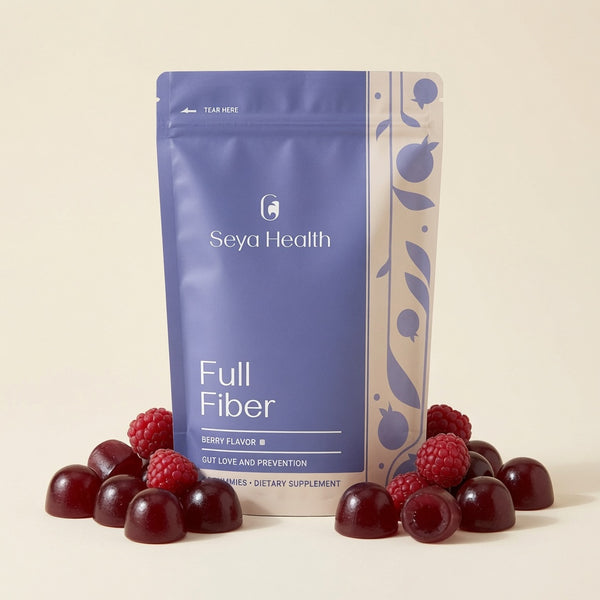
Same test, our own jar. Here is the panel so you can check it yourself.
3 gummies give you 25 calories and 5,650 mg of dietary fiber. That is 5.65 g, or 16% of the Daily Value.
The split is printed: 4,500 mg of resistant tapioca fiber, 950 mg of prebiotic soluble fiber, 200 mg of cellulose. Then 80 mg of magnesium as magnesium citrate and 100 mg of ginger root.
Total sugars are 3 g. No sugar alcohols. No artificial sweeteners. No artificial colors. The chew comes from carrageenan, a red seaweed extract, not gelatin.
The number we will not round up
That 950 mg of prebiotic soluble fiber sits below the 3 to 20 g range used in the trials above.
It is not a clinical dose of a prebiotic on its own. We are not going to pretend otherwise.
What the 5.65 g total can honestly claim is that it supports regularity. It is about a fifth of the 25 g daily target, which means it closes part of your gap, not all of it. The rest still comes from your plate. More on that in what happens when you add fiber too fast.
Full Fiber Gummies are $24.99 for 20 servings, third-party tested every batch.
This is education, not medical advice. Talk to a qualified clinician before starting a new supplement, especially if you take medication or have a digestive condition.
These statements have not been evaluated by the Food and Drug Administration. This product is not intended to diagnose, treat, cure, or prevent any disease.
Frequently asked questions
What are fiber gummies actually made of?
Four things. An isolated fiber such as resistant tapioca fiber, inulin, polydextrose, or soluble corn fiber. A gelling agent, usually gelatin or a plant option like pectin or carrageenan. A sweetener, which is either sugar, a sugar alcohol ending in -itol, or a non-nutritive sweetener. And flavor plus color. The FDA recognizes 7 isolated fibers as dietary fiber today and intends to add 11 more, so any fiber outside that list cannot be counted on the Nutrition Facts panel.
Is a fiber supplement as good as fiber from food?
No, and it is not meant to be. Whole foods carry a mix of fiber types along with water, vitamins, and plant compounds a single isolated fiber does not have. Women need about 25 g of fiber a day, and about 21 g after 50, and more than 90% of US women fall short. A supplement is a way to close part of that gap on the days your plate does not. Think of it as the floor, not the ceiling.
Is chicory-root prebiotic fiber actually effective?
Yes, at the dose the studies used. A 2024 review of 17 randomized trials in 713 people with functional constipation found fructooligosaccharides increased bowel frequency, with mild bloating as the usual side effect and no serious ones. The doses ranged from 3 to 20 g a day. Many gummies contain well under 1 g of prebiotic fiber, which is far below anything tested, so check the milligram amount before you judge the ingredient.
Why do sugar-free gummies cause gas and bloating?
Sugar alcohols. FDA states they "can also produce abdominal gas, bloating, and diarrhea in some individuals because they are not completely absorbed by the body and are fermented by bacteria in the large intestine." Foods reaching 50 g of sorbitol or 20 g of mannitol a day must carry a laxative warning. Below that, printing the gram amount is voluntary, so a sugar-free gummy can contain maltitol or sorbitol without telling you how much.
Should you avoid erythritol?
The evidence is mixed and worth knowing in full. A 2023 Nature Medicine study tied higher blood erythritol to cardiac events in patients already under cardiac assessment, with adjusted hazard ratios of 1.80 and 2.21 in two validation groups. FDA's June 2023 review agreed the statistics were sound but concluded the observational design was "incapable of establishing causation" and that confounders such as diet were not accounted for. It is unresolved, not proven either way.
How much added sugar is acceptable in a supplement?
The 2025-2030 Dietary Guidelines for Americans, released in January 2026, set a per-meal cap of 10 g of added sugar and state that "no amount of added sugars or non-nutritive sweeteners is recommended or considered part of a healthy or nutritious diet." On a label, read the Added Sugars line rather than Total Sugars, since total sugars also count sugar that arrived with fruit.
What is the best time of day to take fiber gummies?
Whenever you will remember, with water. Consistency matters more than timing, because the effect on regularity builds over days rather than hours. Many women take them in the morning with breakfast. Add new fiber gradually, roughly 5 g more per week, so your gut bacteria have time to adjust. Rushing the increase is what causes the gas people then blame on the fiber itself.
Seya Full Fiber
Your gut bacteria run on fiber. Seya Full Fiber delivers 6 grams from three fibers in one to feed the beneficial bacteria in your gut and support short-chain fatty acid production. Plant based, no gelatin, no sugar alcohols.
Shop Full FiberKeep reading
fiber
Can a Multivitamin Replace Vegetables? What Supplements Can't Do for Your Gut

constipation
The Best Way to Beat Constipation in Your 30s (and Where Fiber Gummies Fit)

fiber
The Gut-Skin Axis: Does Your Gut Health Affect Your Skin?
The gut-skin axis, explained: how your gut bacteria and blood sugar affect your skin, w...