
Home/ The Journal/ digestive health
digestive health
Can You Eat Too Much Fiber? Signs, Side Effects & How to Add It Safely

Short version: Yes, you can eat too much fiber. But it is hard to overdo it from food alone, and the target is not the danger. The trouble almost always comes from adding a lot of fiber too fast, or not drinking enough water with it. The fix is slow and boring, and it works.
- The daily target is about 25 g of fiber for women. The average woman gets about 17 g, roughly half.
- There is no official upper limit for fiber. The side effects come from the jump, not a magic number.
- Add it slowly: about 2 to 3 g more every few days, with more water, and most of the gas and bloating settles.
Last updated August 2026.
Yes, you can eat too much fiber. Or more honestly, you can add it too fast.
Fiber is good for you. Most women do not get enough of it. The daily target is about 25 g, and the average woman gets about 17 g a day, according to a clinical review of dietary fiber on the NIH Bookshelf. So the usual problem is too little, not too much.
But go from 17 g to 40 g in one afternoon and your gut will let you know. Gas. Bloating. Cramps. That is what too much fiber feels like, and it is almost always a speed problem, not a total problem.
Here is what the excess looks like, why it happens, and how to add fiber without the misery.
Can you actually eat too much fiber?
You can, but it is hard to do from food alone.
Fiber is filling. Before you eat enough broccoli, beans, and oats to hurt yourself, you are usually too full to keep going. The gap between "healthy amount" and "too much" is wide.
The real overshoot happens two ways. You lean hard on fiber powders and bars on top of a big salad day. Or you go from a low-fiber week to a very high-fiber day, all at once, and your gut never got the memo.
There is no official upper limit set for fiber. Unlike some vitamins, there is no line where one more gram becomes toxic. The discomfort is about the change, not a threshold.
What are the signs of too much fiber?
The signs are loud and low in your belly.
Increasing fiber too quickly can cause bloating, gas, cramping, and general stomach discomfort, per the same NIH clinical review. You might also feel overly full, or swing between constipation and loose stools while your gut adjusts.
Here is why. Fiber is not digested in your stomach. It travels down to your colon, where your gut bacteria ferment it. That fermentation makes gas. More fiber, faster, means more gas than your system is used to moving.
You added kale and beans and oatmeal all at once to do something good for your body. Then your stomach turned on you. That is not you failing at healthy eating. It is a gut handed a week of fiber in a single day.
Can too much fiber cause acidity or reflux?
Not the way spicy food does, but the pressure can feel like it.
Fiber does not pour acid into your stomach. What a sudden fiber load does is make gas and slow things down, and that bloating and belching can feel like reflux pushing up. The feeling is real. The cause is pressure, not extra acid.
Soluble fiber pulls in water and turns to a gel that slows digestion, while insoluble fiber adds bulk and moves things along, as MedlinePlus explains. Slower and fuller, done too fast, is what you are feeling.
If the burning is frequent or severe, that is a reason to see a clinician, not to blame your oatmeal.
Can too much fiber back you up or block you?
It can, and the missing piece is almost always water.
Fiber needs fluid to do its job. Insoluble fiber adds bulk, and bulk without enough water can turn hard and stubborn instead of soft and easy. That is how a lot of fiber with too little water leaves you more constipated, not less.
A true blockage is rare, and it usually takes a big fiber load, very little fluid, and sometimes a gut that already has trouble. Severe belly pain, vomiting, and no gas passing are emergency signs. That is a clinician call, right away, not a home fix.
For most women the lesson is smaller. Drink more water when you eat more fiber. They work as a pair.
Does too much fiber block nutrient absorption?
A little, and not enough to fear at normal amounts.
Very high fiber intakes can bind small amounts of minerals like iron, zinc, and calcium and carry them out before you absorb them. At the everyday target of about 25 g a day, this is not a real worry for a healthy woman eating a mixed diet.
It matters more if you push fiber very high while eating little of those minerals. The answer is not less fiber. It is a balanced plate and a sane dose.
How much fiber is too much?
There is no single magic number, and that is the honest answer.
Because no upper limit is set, "too much" is really "too much, too fast, for you." A jump from 17 g to 40 g or more in a day is a common trigger. So is stacking powders on an already high-fiber day.
Your own line depends on your gut, your history, and your water. The FDA lists 28 g a day as the Daily Value on nutrition labels, and hitting that steadily is the aim, not blowing past it in a rush.
How to add fiber safely
Slow and watered. That is the whole method.
Add about 2 to 3 g of fiber every few days and let your gut catch up before you add more, the way the NIH review lays out. Rushing is the thing that hurts. Patience is the thing that works.
Drink more water as you go. Fiber and fluid are a team, and skipping the water is what turns bulk into a brick.
Mix your sources too. You get both soluble and insoluble fiber from high-fiber foods for women, and it helps to know how soluble and insoluble fiber differ. If your gut is sensitive or you live with IBS, ramp even slower and read how fiber affects IBS.
Where Seya fits, honestly
Seya makes one product at launch. A fiber gummy.
Three vegan gummies deliver about 5 g of fiber a day. That is a small, steady dose you add on purpose, which is exactly the slow ramp your gut wants. It is not a mega-dose, and it is not meant to be. We break down the format in how fiber gummies work.
The honest claim is narrow. Fiber supports regularity. It will not fix everything or melt a number off a scale, and a measured 5 g is far below the level where "too much" is even a question.
Want the targets first? Start with how much fiber women need per day, or the midlife version in how much fiber women over 40 need. Then add slowly toward it.
The bloated, backed-up, off feeling you blamed on yourself? Often it is just fiber added too fast. Not a flaw. A pace you can fix.
This is education, not medical advice.
These statements have not been evaluated by the Food and Drug Administration. This product is not intended to diagnose, treat, cure, or prevent any disease.

Frequently asked questions
What are the side effects of eating too much fiber?
The common side effects are gas, bloating, cramping, and general stomach discomfort, and sometimes constipation or loose stools while your gut adjusts. They usually come from adding fiber too quickly rather than from any single amount. Fiber is fermented by your gut bacteria in the colon, which makes gas, so a big fast increase makes more gas than your system is used to moving. Adding fiber slowly, about 2 to 3 g more every few days with extra water, settles most of it.
Can too much fiber cause acidity?
Not directly. Fiber does not add acid to your stomach. But a sudden fiber load makes gas and slows digestion, and that bloating and belching can feel like acid reflux pushing up. The feeling is real, but the cause is pressure, not extra acid. If burning or reflux is frequent or severe, see a clinician rather than assuming it is the fiber.
How much fiber is too much?
There is no official upper limit for fiber, so there is no single number that is "too much" for everyone. Trouble usually starts when you jump from a low intake to a very high one fast, for example from about 17 g to 40 g or more in a day, or when you stack fiber powders on an already high-fiber day. The general daily goal on U.S. nutrition labels is 28 g, and reaching that steadily, not overshooting it in a rush, is the aim.
Does too much fiber block nutrient absorption?
Very high fiber intakes can bind small amounts of minerals like iron, zinc, and calcium and carry them out before you fully absorb them. At the everyday target of about 25 g a day, this is not a meaningful worry for a healthy woman eating a balanced diet. It only becomes a concern with very high fiber intake paired with a low intake of those minerals, and the fix is a balanced plate and a sensible dose, not cutting fiber out.
Related reading
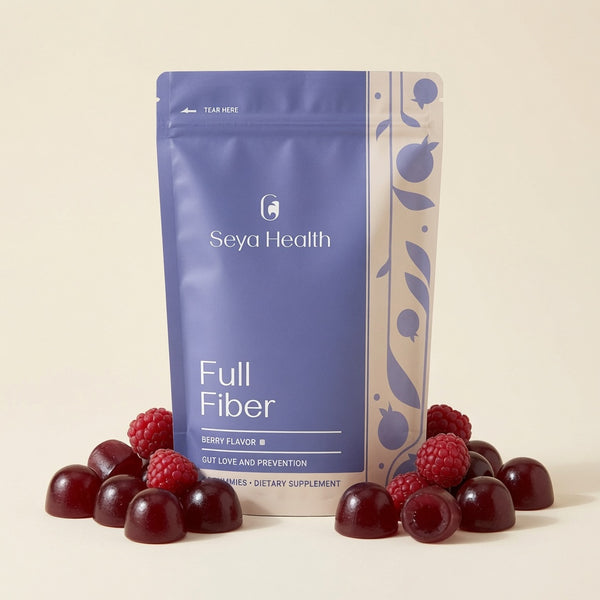
Seya Full Fiber
Your gut bacteria run on fiber. Seya Full Fiber delivers 6 grams from three fibers in one to feed the beneficial bacteria in your gut and support short-chain fatty acid production. Plant based, no gelatin, no sugar alcohols.
Shop Full FiberKeep reading

fiber
Can a Multivitamin Replace Vegetables? What Supplements Can't Do for Your Gut

constipation
The Best Way to Beat Constipation in Your 30s (and Where Fiber Gummies Fit)

fiber
The Gut-Skin Axis: Does Your Gut Health Affect Your Skin?
The gut-skin axis, explained: how your gut bacteria and blood sugar affect your skin, w...