
Home/ The Journal/ constipation
constipation
Fiber vs. Laxatives for GLP-1 Constipation: What to Reach For First

Short version: Fiber and laxatives for GLP-1 constipation do different jobs on different clocks. Fiber is the daily floor. A laxative is a short rescue, and the slowdown you feel is the medicine working, not you failing. Start with fiber and water. Keep the drug question with your doctor.
- Constipation showed up in 24.2% of people on semaglutide 2.4 mg in pooled trials, against 11.1% on placebo.
- Gastroenterology guidelines call polyethylene glycol a strong recommendation and fiber a conditional one.
- The label on polyethylene glycol says once a day, for up to 2 weeks. Two capfuls a day is double that.
Last updated July 2026.
You are on a GLP-1. You are backed up. And you are standing in front of a shelf of boxes trying to guess which one is the right answer.
Order matters more than brand. Fiber and water are the daily base, a laxative is a short rescue, and anything past 2 weeks is a conversation with your doctor. Constipation hit 24.2% of people on semaglutide 2.4 mg in pooled trials, versus 11.1% on placebo (Wharton et al., 2022).
You did not lose your discipline. The drug slowed your gut on purpose. That slowdown is the whole reason it works.
What is the difference between fiber and a laxative?
Fiber is food. A laxative is a drug.
Fiber adds bulk and holds water inside the stool, so it stays soft and keeps moving. You take it every day. It works on the average of your week, not on the next hour.
A laxative works on one trip to the bathroom. Osmotic ones, like polyethylene glycol 3350, pull water into your colon. Stimulant ones push the muscle of the colon to squeeze. Softeners try to wet the stool that is already there.
Different jobs. Different clocks.
One builds a floor. The other picks you up off it.
Should you use fiber or laxatives for GLP-1 constipation first?
Fiber and water first. Then take the rest to your doctor.
That order is not brand loyalty. It is just what you control every day: what you eat, and what you drink.
The joint gastroenterology guideline is honest about the strength of the evidence, and it does not flatter fiber. Polyethylene glycol earned a strong recommendation for long-running constipation. Fiber earned a conditional one, with the best data sitting behind psyllium (AGA-ACG clinical practice guideline, 2023).
Read that plainly. The drug has the stronger trial record for getting you unstuck. Fiber has the daily job of keeping you from getting stuck in the first place.
Both of those can be true at once.
Is 2 capfuls of polyethylene glycol a day too much?
The label says one capful, once a day, for up to 2 weeks (MedlinePlus).
Two capfuls a day is double the labeled dose. That is not a call to make from a blog post, and it is not one to make from a comment thread either.
If one dose stopped working, that is information your doctor wants. It is not a reason to double it on your own.
The 2-week window matters just as much as the number. Constipation on a GLP-1 is usually not a 2-week problem. It tends to track your dose, and it can follow you for months. A product labeled for 2 weeks was never designed to carry that.
What is the best stool softener to take every day?
Here is the uncomfortable part. The softener most people reach for has the weakest record in the aisle.
Docusate is the classic one. Put head to head against psyllium fiber, it lost on every measure that mattered. Stool water content rose 2.33% on psyllium against 0.01% on docusate. Bowel movements ran 3.5 a week against 2.9 (McRorie et al., 1998).
A fiber beat the thing sold as the gentle daily option.
So "what is the best daily stool softener" may be the wrong question to be asking. The daily lever is fiber and water. The rescue lever is a drug, and a drug you use daily forever is a decision for your doctor, not a default.
How much fiber do you actually need on a GLP-1?
Adults need 22 to 34 grams a day (NIDDK). Most women land near 15.
On a GLP-1 you are eating less food, so that gap gets wider without you doing a single thing wrong. Read more on why most women fall short on fiber.
And women start the day behind on the clock. Colon transit runs about 42 hours in women versus 30 hours in men (Meier et al., 1995). Same meal, slower trip.
Add fiber a few grams at a time. Add water every time you add fiber. Fiber without enough water makes stool harder, not softer.
Seya's daily fiber gummies deliver about 5 grams. That is roughly half the dose used in the studies, so the claim stays where the evidence actually sits: fiber supports regularity. It is a daily habit. It is not a rescue, and it does not replace food, water, or your prescription.
These statements have not been evaluated by the Food and Drug Administration. This product is not intended to diagnose, treat, cure, or prevent any disease.
When should you call your doctor about GLP-1 constipation?
Call if you go 3 or more days with no bowel movement and food and water have not moved anything.
Call for severe belly pain, bloat that keeps building, or vomiting.
Call if you see blood.
Call before you start any daily laxative routine, and before you push past the 2 weeks the label allows.
Never stop or change your prescription on your own. Your prescriber owns the dose and rules out everything a blog cannot see.
Frequently asked questions
Is 2 capfuls of polyethylene glycol a day too much?
It is double the labeled dose. The label says one capful, once a day, for up to 2 weeks (MedlinePlus). If one dose is not working anymore, that is a reason to call your doctor, not a reason to take two. Ongoing constipation on a GLP-1 usually outlasts the 2-week window the product was labeled for, which is exactly why the decision belongs with a clinician.
What is the best stool softener to take every day?
Docusate, the most common one, performed poorly head to head against psyllium fiber: stool water content rose 2.33% on psyllium versus 0.01% on docusate, and weekly bowel movements ran 3.5 versus 2.9 (McRorie et al., 1998). The daily lever with the better everyday profile is fiber and water. Any daily drug routine is a call for your doctor.
Should you take fiber or a laxative first for GLP-1 constipation?
Fiber and water first, because those are the levers you control every day and they carry the least risk. A laxative is a short rescue. Gastroenterology guidelines rate polyethylene glycol strongly and fiber conditionally, so the drug has the stronger trial record for getting unstuck, while fiber does the daily work of staying regular.
Can you take fiber and a laxative at the same time?
Ask your doctor or pharmacist, since it depends on the product and on your history. One general point holds either way: fiber needs water to work. Adding fiber without adding fluid makes stool harder, not softer, and that is the most common way people make things worse while trying to fix them.
Does fiber make GLP-1 constipation worse?
It can, if you add a lot at once or skip the water. Fiber pulls water into the stool, so it needs fluid to soften rather than bulk. Build up a few grams at a time over a couple of weeks and drink more as you go. Adults need 22 to 34 grams a day, and most women are near 15.
How long does GLP-1 constipation last?
In the pooled semaglutide trials, most gut side effects were mild to moderate, temporary, and clustered during and shortly after dose increases (Wharton et al., 2022). That means it often eases once your dose settles. It does not mean you should wait it out in silence if it drags on or gets painful.
Sources
- Wharton S, et al. Gastrointestinal tolerability of once-weekly semaglutide 2.4 mg. Diabetes Obes Metab. 2022.
- AGA-ACG Clinical Practice Guideline: Pharmacological Management of Chronic Idiopathic Constipation. 2023.
- McRorie JW, et al. Psyllium is superior to docusate sodium for treatment of chronic constipation. Aliment Pharmacol Ther. 1998.
- MedlinePlus: Polyethylene Glycol 3350.
- NIDDK: Treatment for Constipation.
- Meier R, et al. Influence of age, gender, hormonal status and smoking habits on colonic transit time. Neurogastroenterol Motil. 1995.
Related reading: how to relieve GLP-1 constipation and how much fiber women need per day.
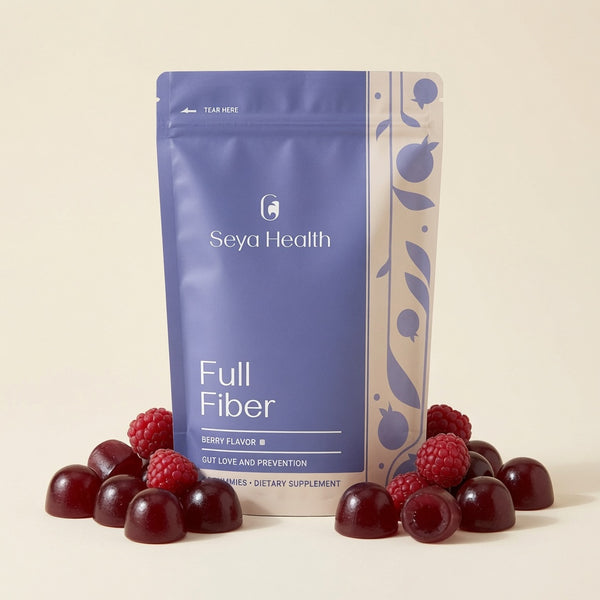
Seya Full Fiber
More than 90% of women fall short on fiber. Seya Full Fiber gives you 6 grams from three fibers in one, in three small gummies that feed the beneficial bacteria in your gut. Plant based, no gelatin, no sugar alcohols.
Shop Full FiberKeep reading
fiber
Can a Multivitamin Replace Vegetables? What Supplements Can't Do for Your Gut

constipation
The Best Way to Beat Constipation in Your 30s (and Where Fiber Gummies Fit)
fiber
The Gut-Skin Axis: Does Your Gut Health Affect Your Skin?
The gut-skin axis, explained: how your gut bacteria and blood sugar affect your skin, w...