
Home/ The Journal/ appetite
appetite
GLP-1 side effects, explained: why women feel less hungry (and why some stop)

Short version: GLP-1 side effects are mostly gut trouble. The same drugs make you feel less hungry by slowing your stomach and turning down appetite signals in your brain. That is a drug doing work, not willpower finally kicking in. The trade-off is a gut that acts up, and the load falls harder on women.
- The most common side effects are nausea (about 44%), diarrhea (30%), vomiting (25%), and constipation (24%) on semaglutide 2.4 mg, per pooled STEP-trial data.
- Women make up 72.3% of the constipation cases and 76.7% of the nausea and vomiting cases in one large real-world dataset.
- 64.8% of adults without type 2 diabetes are off the drug inside a year. The gut is a big part of why.
Last updated August 2026.
You are less hungry than you have been in years. The snack drawer does not call at 3pm anymore.
If you are on a GLP-1, that quiet is the drug working. Not your discipline finally showing up.
But the same drug that turns down hunger brings GLP-1 side effects, and they land hardest on the gut.
Here is the number that frames the whole thing. On semaglutide 2.4 mg, about 44% of people report nausea, against 16% on a placebo, per a pooled analysis of the STEP trials (PMID 34514682). The appetite drop and the queasy stomach come from the same place. So it helps to know what these drugs are actually doing before you decide how to ride out the side effects.
What are GLP-1 drugs actually doing to your body?
Two things, mostly. They slow your stomach down, and they talk to the part of your brain that runs hunger.
GLP-1 is a hormone your gut already makes after you eat. Drugs like semaglutide and tirzepatide are copies of it, dialed up and made to last. A 2025 review in The American Journal of Medicine lays out the pathways: they act centrally on appetite neurons in the hypothalamus, and peripherally they slow how fast the stomach empties.
Slower stomach means food sits longer. You feel full sooner, and you stay full. That single change is behind both the smaller appetite and most of the gut complaints below.
Why do you feel less hungry on a GLP-1?
Because the drug is turning down a signal, not testing your resolve.
Hunger is not a character trait. It runs on chemistry. Your gut sends fullness messages up to your brain, and your brain decides you are done. GLP-1 drugs make those messages louder and hold them longer. The wanting quiets because the signal changed, not because you got stronger overnight.
This matters for how you talk to yourself. If you spent years blaming your willpower for the 3pm pull, that was never the real lever. The pull was a signal. The drug reaches the signal in a way that "just be disciplined" never could.

What are the most common GLP-1 side effects?
Gut symptoms, and a lot of them. In the STEP trials, 73% of people on semaglutide reported a gastrointestinal side effect, against 47% on placebo, per the FDA Wegovy prescribing information.
Here is the breakdown from the pooled STEP data, drug versus placebo.
| Side effect | Semaglutide 2.4 mg | Placebo |
|---|---|---|
| Nausea | 43.9% | 16.1% |
| Diarrhea | 29.7% | 15.9% |
| Vomiting | 24.5% | 6.3% |
| Constipation | 24.2% | 11.1% |
The reassuring part is in the same paper. 98.1% of these events were mild to moderate, and 99.5% were non-serious. Most showed up during the weeks the dose was climbing, then eased. See Wharton et al., Diabetes, Obesity and Metabolism, 2022 (PMID 34514682).
So the gut noise is common, usually manageable, and often loudest early. That is worth knowing before the first rough week talks you out of the whole thing.
Are the side effects worse for women?
Yes, and by a wide margin. The gut symptoms land harder and more often on women than on men.
In a real-world analysis of GLP-1 users in the All of Us dataset, women made up 72.3% of the constipation cases, 76.7% of the nausea and vomiting cases, and 71.5% of the abdominal pain cases. Male sex was linked to lower odds of nausea and vomiting (adjusted odds ratio 0.47). That is Rahman et al., Pharmaceuticals, 2024.
This is the Seya thesis in miniature. The drug was largely dosed and studied on a male baseline, then handed to women who feel it differently. If your side effects seem heavier than your brother's, you are not imagining it. You are the pattern.
Why do so many women stop taking GLP-1s?
Because the side effects and the cost wear them down before the results feel worth it. Most people do not last a year.
In a 2025 JAMA Network Open study, 64.8% of adults without type 2 diabetes had stopped their GLP-1 within 1 year, and 84.4% within 2 years. For people using it purely for weight, staying on is the exception, not the rule. See Do et al., JAMA Network Open, 2025.
The gut is a big reason people quit, and it is also the most fixable one. We go deep on that in why women stop taking GLP-1s, and how fiber helps them stay on.
Can you make the gut side effects easier?
Often, yes. Constipation is the one you have the most control over, and the playbook is boring on purpose.
More fiber, more water, and time. The National Institute of Diabetes and Digestive and Kidney Diseases puts fiber and fluid at the front of its constipation guidance. A 2022 meta-analysis in the American Journal of Clinical Nutrition found fiber supplements improved stool frequency in people with chronic constipation.
The catch is that a slowed stomach and a sudden pile of fiber can both make you bloated. So go slow. Add fiber in small steps, drink more as you climb, and give your gut a couple of weeks. Most US women are starting from a fiber deficit anyway, which we cover in the fiber gap.
Where Seya fits, honestly
Seya sells one product. A fiber gummy.
It delivers about 5 g of fiber a day from resistant tapioca fiber. On a GLP-1, that is one small, steady way to support regularity while your gut adjusts. It is not a drug, not a dose of the medication, and not a reason to skip your doctor.
We say the honest version. At 5 g, the evidence supports regularity and nothing louder. Food still does the heavy lifting. A gummy helps close a few grams on the days the food does not.
This is education, not medical advice. Talk to the clinician who prescribed your GLP-1 before you change your fiber, your fluids, or your dose, especially if the nausea or vomiting is severe or will not settle.
These statements have not been evaluated by the Food and Drug Administration. This product is not intended to diagnose, treat, cure, or prevent any disease.
Frequently asked questions
What are the side effects of GLP-1 drugs?
The most common are gut related. On semaglutide 2.4 mg, about 44% of people report nausea, 30% diarrhea, 25% vomiting, and 24% constipation, against much lower rates on placebo, per pooled STEP-trial data. In those trials 98.1% of the events were mild to moderate and most appeared during dose escalation, then eased.
Why do people feel less hungry on GLP-1 treatments?
Because the drug slows the stomach and acts on appetite centers in the brain. GLP-1 is a gut hormone that signals fullness; these drugs are longer-lasting copies of it. They make food leave your stomach more slowly and strengthen the fullness message to the brain, so hunger drops. It is a change in the signal, not a change in willpower.
Do women get worse side effects on GLP-1s than men?
The data says yes. In a real-world analysis of the All of Us dataset, women were 72.3% of constipation cases, 76.7% of nausea and vomiting cases, and 71.5% of abdominal pain cases, and male sex was linked to lower odds of those symptoms. Women appear to feel the gut side effects more often and more strongly.
Why do people stop taking GLP-1s?
Side effects and cost lead the list. In a 2025 JAMA Network Open study, 64.8% of adults without type 2 diabetes had stopped within 1 year and 84.4% within 2 years. Gut symptoms are one of the most common and most manageable reasons people quit.
How long do GLP-1 side effects last?
For most people the gut symptoms are worst during the weeks the dose is increasing, then settle. Pooled trial data showed the events were usually transient and clustered around dose escalation. If nausea, vomiting, or constipation is severe or does not improve, contact the clinician who prescribed the medication.
Related reading
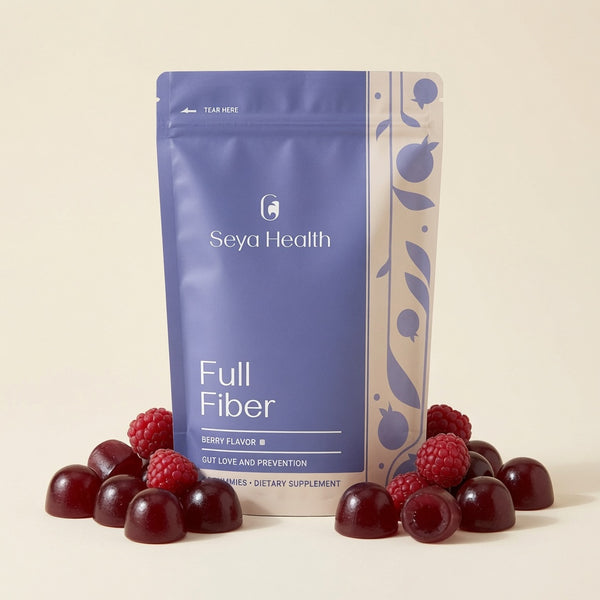
Seya Full Fiber
Getting enough fiber from food every day is hard. Seya Full Fiber is 6 grams from three fibers in one, in three small gummies, so you have a reliable daily floor. Plant based, no gelatin, no sugar alcohols, 60 gummies per pouch.
Shop Full FiberKeep reading

fiber
Can a Multivitamin Replace Vegetables? What Supplements Can't Do for Your Gut

constipation
The Best Way to Beat Constipation in Your 30s (and Where Fiber Gummies Fit)
fiber
The Gut-Skin Axis: Does Your Gut Health Affect Your Skin?
The gut-skin axis, explained: how your gut bacteria and blood sugar affect your skin, w...