
Home/ The Journal/ constipation
constipation
Why Women Stop Taking GLP-1s, and How Fiber Helps Them Stay On

Short version: Why women stop taking GLP-1s comes down to two things, and neither is willpower. When a doctor records a reason, adverse effects and cost are the two that come up most. Most people are off the drug inside a year, and the gut symptoms land harder on women.
- 64.8% of adults without type 2 diabetes had stopped within 1 year. 84.4% had stopped within 2 years.
- In pooled trial data, 24.2% on semaglutide 2.4 mg reported constipation, against 11.1% on placebo.
- In a real-world group of 10,328 users, 30.4% reported constipation, and women were 71.5% of the abdominal pain cases.
Last updated August 2026.
You started in January. It is August, the pen is still in the fridge, and you have not touched it in six weeks.
Here is why women stop taking GLP-1s, in one number. 64.8% of adults without type 2 diabetes were off the drug inside a year.
You are not the exception here. You are the pattern.
And the pattern has a cause that gets far less airtime than it should. Your gut.
Why women stop taking GLP-1s: the real numbers
A team tracked 125,474 US adults who started liraglutide, semaglutide, or tirzepatide between 2018 and 2023. Two thirds of that group, 65.4%, were women.
Inside 1 year, 64.8% of the people without type 2 diabetes had stopped. Inside 2 years, 84.4% had. Among people with diabetes the rates ran lower, at 46.5% and 64.1%.
Then the researchers read the clinical notes to find out why. Two reasons came up more than any others. Adverse effects and cost. The full analysis is in the JAMA Network Open study of GLP-1 discontinuation and reinitiation (2025).
Cost is a policy problem. Adverse effects are a body problem. This article is about the second one.
What actually drives people off these drugs?
Mostly the gut.
Pooled results from the STEP 1 through 3 trials covered 2,117 adults on semaglutide 2.4 mg and 1,262 on placebo. Nausea showed up in 43.9% against 16.1% on placebo. Vomiting, 24.5% against 6.3%. Diarrhea, 29.7% against 15.9%. Constipation, 24.2% against 11.1%.
Most of it was mild or moderate, 98.1% of events, and it clustered around the weeks when the dose went up. Only 4.3% of people quit the trial for gut reasons. Those figures come from the pooled gastrointestinal tolerability analysis of semaglutide 2.4 mg (Diabetes, Obesity and Metabolism, 2022).
A trial is a controlled world, though. Everyone gets coached, monitored, and called. Outside of one, the same symptoms arrive with no support attached.
Do women get worse side effects than men?
Yes. And this is where the research gap starts to show.
An analysis of 10,328 new GLP-1 users in the NIH All of Us cohort found abdominal pain in 57.6%, diarrhea in 32.7%, constipation in 30.4%, and nausea or vomiting in 23.4%.
Now split that by sex. Of the 5,949 people reporting abdominal pain, 71.5% were women. Being male cut the odds of abdominal pain roughly in half, with an adjusted odds ratio of 0.50. Read the All of Us cross-sectional analysis of GLP-1 gastrointestinal adverse events (Pharmaceuticals, 2024).
So the medication most used by women is the one whose gut burden falls hardest on women. The escalation schedule stays the same for everybody.
If you came off it because you felt terrible, that was not fragility. That was a real signal from a body the dosing plan was never built around.
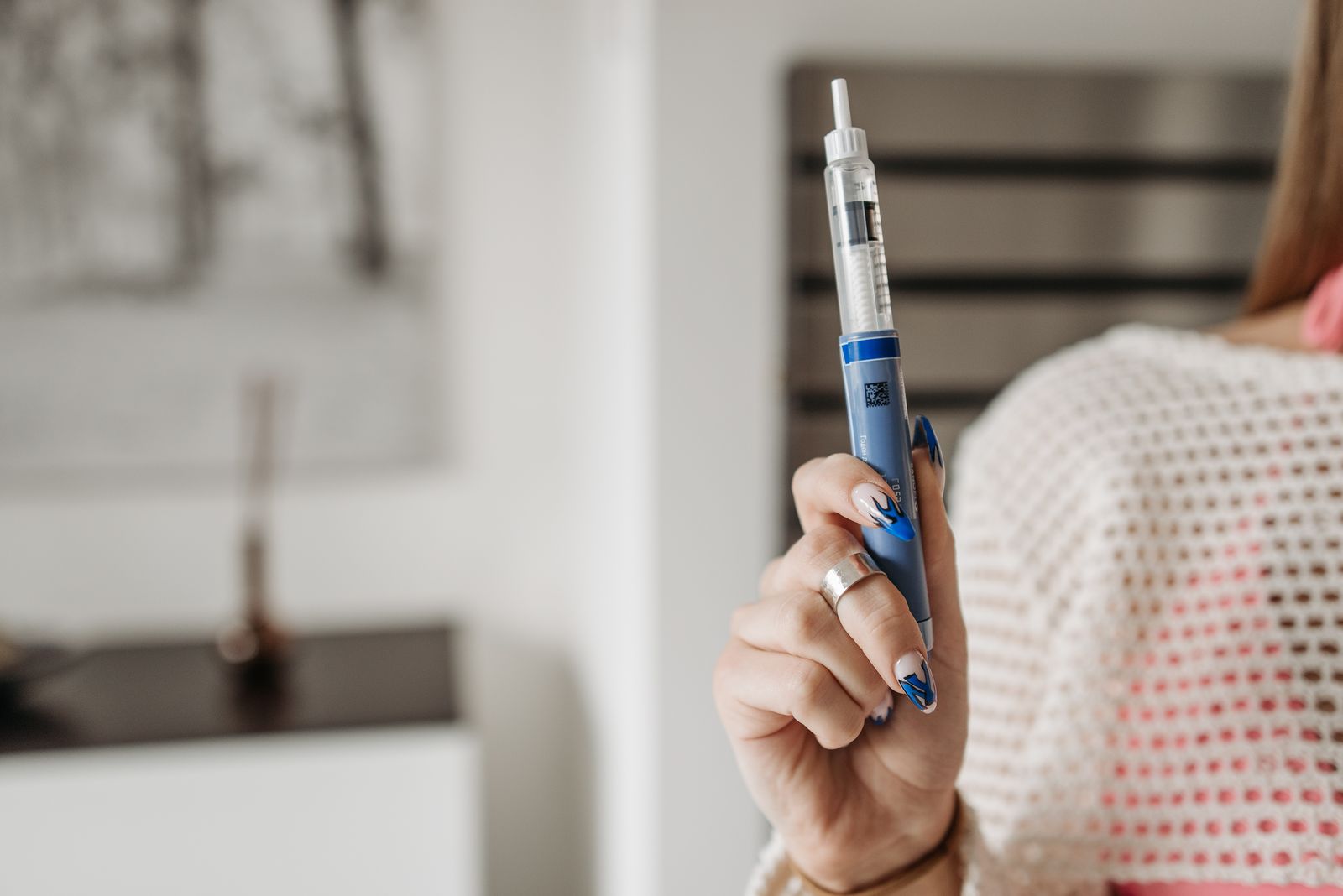
What causes constipation on a GLP-1?
The drug slows your stomach down on purpose.
GLP-1 medications delay gastric emptying. Food sits longer, fullness arrives sooner, and you eat less. That slowdown is the mechanism doing exactly what it was designed to do. We break the machinery down in how GLP-1 works.
Two things follow from it.
The whole system moves slower. And far less food goes in, which means far less fiber goes in with it.
Slow transit plus a thin fiber intake is the standard setup for a hard, infrequent stool. The NIDDK puts fiber and fluid at the front of its constipation guidance for that reason.
Can fiber help you stay on a GLP-1?
Nobody has tested that. We are going to say so plainly.
There is no trial of a fiber supplement in women taking GLP-1s. Anyone selling you that claim is ahead of the evidence.
What has been tested is narrower, and it is still useful. A meta-analysis of 16 randomized trials in 1,251 adults found that 66% of people responded to fiber against 41% on control. Fiber raised stool frequency and improved consistency, with psyllium performing best.
The catch is the dose. Doses above 10 g a day drove most of the benefit, and it took 4 weeks or more to show up. See the updated meta-analysis of fiber supplementation for chronic constipation (American Journal of Clinical Nutrition, 2022).
One more line from that paper, because it rarely makes the label. Flatulence was higher in the fiber groups than the control groups.
How much fiber, and when?
Start before you need it. Not after.
- Aim at the target, not the average. American women average about 15 g of fiber a day. General guidance sits closer to 25 g.
- Climb slowly. Add roughly 3 to 5 g at a time and hold it for a few days. Fast jumps buy you gas.
- Drink more water. Fiber needs fluid to work with. Without it you can make things harder, literally.
- Time it to your escalation week. Gut symptoms cluster when the dose steps up, so that is the week to already be steady.
- Judge it at 4 weeks. Not at day 3. The trials that worked ran a month or longer.
And know when this stops being a food question. Severe pain, vomiting you cannot keep ahead of, no bowel movement for several days, or any symptom that frightens you belongs with your prescriber, not a supplement aisle. Dose changes are their call.
If you are already stuck, we walk through the practical order of operations in how to relieve GLP-1 constipation and fiber versus laxatives.
Where Seya fits, honestly
Seya makes one product at launch. A fiber gummy.
Three vegan gummies deliver about 5 g of resistant tapioca fiber. That is roughly half the 10 g threshold that carried the constipation trials, so we grade our own evidence a C and make one claim. It supports regularity.
It is not a reason to stay on a GLP-1, and it is not a replacement for one. It does not fix nausea, and it will not undo a dose that is wrong for you.
What a fiber gap looks like across a whole diet is covered in the fiber gap. What the drugs do beyond blood sugar is in GLP-1s for women, beyond diabetes.
This is education, not medical advice. Talk to the clinician who wrote your prescription before you add anything to it.
These statements have not been evaluated by the Food and Drug Administration. This product is not intended to diagnose, treat, cure, or prevent any disease.
Frequently asked questions
Why do people stop taking GLP-1s?
Most people stop, and they stop early. In a study of 125,474 US adults, 64.8% of those without type 2 diabetes had discontinued within 1 year and 84.4% within 2 years. Among people with type 2 diabetes the figures were 46.5% and 64.1%. When a specific reason appeared in the clinical notes, adverse effects and cost were the two most frequent. Gastrointestinal symptoms are the most common adverse effects of this drug class.
Are GLP-1 medications only for people with diabetes?
No. Several GLP-1 receptor agonists carry dual labeling, meaning they are approved both for type 2 diabetes and for chronic weight management in adults who meet the criteria. The large discontinuation study above tracked both groups separately, and 48,950 of the 125,474 adults in it did not have type 2 diabetes. Retention differs sharply between the two groups, which is one reason the distinction matters.
Do women get worse gut side effects on GLP-1s than men?
The real-world data points that way. In 10,328 new GLP-1 users in the NIH All of Us cohort, women made up 71.5% of the 5,949 people reporting abdominal pain, and male sex was associated with roughly half the odds of abdominal pain, at an adjusted odds ratio of 0.50. Women also make up about 65% of GLP-1 users overall, so the population carrying most of the gut burden is also the population the dosing schedule was least studied in.
Does fiber help with GLP-1 constipation?
No trial has tested fiber supplementation specifically in people taking GLP-1s, so nobody can honestly promise that. Fiber does have randomized evidence for chronic constipation on its own. Across 16 trials in 1,251 adults, 66% responded to fiber against 41% on control, with doses above 10 g a day and durations of 4 weeks or more working best. Extra gas is a common side effect of adding it.
How much fiber should you take on a GLP-1?
Work toward the general daily target of about 25 g rather than the roughly 15 g American women average, and get there gradually. Adding 3 to 5 g at a time every few days, alongside more water, is easier on a gut that is already moving slowly. Timing an increase ahead of a dose escalation week gives you a head start. Judge the result at about 4 weeks.
When should you call your doctor about GLP-1 side effects?
Call if you have severe or persistent abdominal pain, vomiting you cannot keep down fluids through, signs of dehydration, no bowel movement for several days, or blood in your stool. Any dose change is a decision for your prescriber. Gut symptoms often ease after a dose has been held steady for a while, so a plan may exist that does not involve stopping altogether.
Related reading
- How Much Fiber Do Women Actually Need? Grams by Age, and Why It's More Than You Think
- GLP-1 side effects, explained: why women feel less hungry (and why some stop)
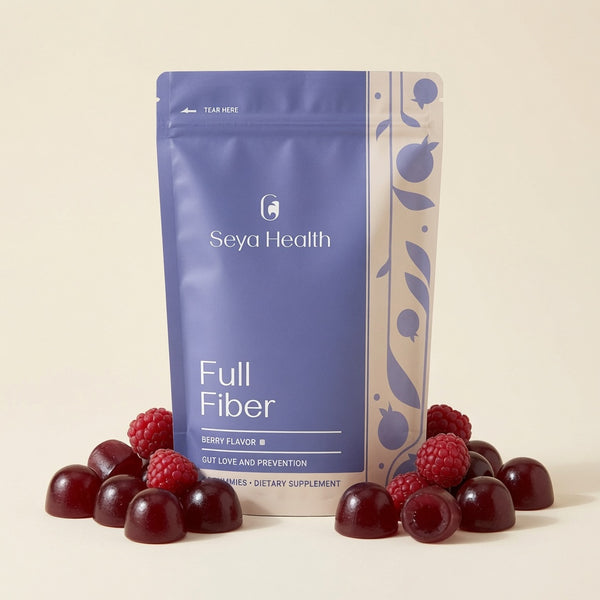
Seya Full Fiber
Your gut bacteria run on fiber. Seya Full Fiber delivers 6 grams from three fibers in one to feed the beneficial bacteria in your gut and support short-chain fatty acid production. Plant based, no gelatin, no sugar alcohols.
Shop Full FiberKeep reading

fiber
Can a Multivitamin Replace Vegetables? What Supplements Can't Do for Your Gut

constipation
The Best Way to Beat Constipation in Your 30s (and Where Fiber Gummies Fit)
fiber
The Gut-Skin Axis: Does Your Gut Health Affect Your Skin?
The gut-skin axis, explained: how your gut bacteria and blood sugar affect your skin, w...