Short version: How does creatine work? Your muscles store it as phosphocreatine, a quick backup fuel. It rebuilds ATP, the energy your muscles burn, in the first few seconds of a hard lift or sprint. A normal diet leaves your muscles only 60% to 80% full. Taking creatine raises those stores by 20% to 40%, per the ISSN (2017).
- Best for: short, hard efforts like lifting, jumping, and sprints.
- Less help for: long, steady cardio, which runs on a different system.
- In women: one 10-week trial found 20% to 25% bigger strength gains than placebo. Larger reviews are more mixed.
- Not magic: creatine helps you do a bit more work. The training still does the building.
Last updated October 2026.
You are on your last rep. The bar slows. Your legs burn.
What runs out first in that moment is not willpower. It is fast fuel inside your muscle cells.
Creatine is part of that fuel system. Here is how it works, in plain terms, and what it can and cannot do for your strength.
What fuel do your muscles actually burn?
Every muscle squeeze runs on one molecule: ATP. Think of it as cash your muscles spend on each move.
The catch is that muscles keep very little ATP on hand. So the body has three ways to make more, and they work at different speeds.
| Energy system | Speed | Main fuel | Leads during |
|---|---|---|---|
| Phosphocreatine (creatine) system | Fastest | Phosphocreatine stored in muscle | The first few seconds of an all-out effort |
| Glycolysis | Fast | Glucose and stored carbs | Hard efforts past about 10 seconds |
| Aerobic system | Slow but steady | Carbs and fat, with oxygen | Efforts longer than 2 to 3 minutes |
A 2010 review sums up the timing. In a max effort of up to 5 to 6 seconds, the phosphocreatine system does most of the work. Carb burning does not hit top speed until about 10 to 15 seconds in. See Baker et al. (J Nutr Metab, 2010).
How does creatine work in muscles?
About 95% of the creatine in your body sits in your muscles, per the ISSN position stand. See Kreider et al. (JISSN, 2017).
There, an enzyme called creatine kinase snaps a phosphate onto it. That makes phosphocreatine, a charged-up form ready to use.
Here is the cycle, step by step:
- You lift. Your muscle spends ATP and is left with a used-up form called ADP.
- Phosphocreatine steps in. It hands its phosphate to ADP, which turns it back into ATP.
- You keep going. That happens almost instantly, so the muscle can keep pushing hard.
- You rest. Between sets, your body recharges creatine back into phosphocreatine.
The ISSN says this buffer helps keep ATP available "particularly during maximal effort anaerobic sprint-type exercise." That is the core of the whole story.

Why does creatine help with short, intense efforts?
Because it tops up the fastest fuel tank, and that tank is small.
Most people get 1 to 2 g of creatine a day from food. A pound of raw beef or salmon has about that much. On a normal diet, your muscle stores sit about 60% to 80% full, per the ISSN.
Taking creatine fills them more. The ISSN says supplements raise muscle creatine and phosphocreatine by 20% to 40%. More stored fuel means you can keep ATP up a little longer and recover it a little faster.
A classic 1993 study showed what that looks like. Twelve people did five rounds of 30 all-out leg contractions, with one minute of rest between rounds. After 5 days of creatine, their peak force was higher in the later rounds. The placebo group saw no change. See Greenhaff et al. (Clin Sci, 1993).
That is the real payoff for strength training. You may squeeze out one more rep or hold your form deeper into a set. Over weeks, that extra work adds up.
What creatine does not do
Creatine is not a stimulant. You will not feel a buzz or a rush, and it is not a substitute for food or sleep.
It also helps less as efforts get longer. A 2021 review notes that efforts longer than 2 to 3 minutes run mostly on the aerobic system. Results for long cardio are mixed. See Wax et al. (Nutrients, 2021).
And it does not build muscle on its own. It lets you train a bit harder. The lifting is what drives the change.
Will creatine help women lift heavier?
It might. The evidence is good, but thinner for women than for men.
The best-known trial in women is from 1997. Nineteen women who did not train lifted weights for 10 weeks. Those on creatine raised their muscle phosphocreatine by 6%. Their max strength rose 20% to 25% more than the placebo group. See Vandenberghe et al. (J Appl Physiol, 1997).
Bigger reviews mostly agree that creatine helps strength in general:
- Legs: a review of 60 trials found better squat and leg press results with creatine. See Lanhers et al. (Sports Med, 2015).
- Upper body: a review of 53 trials found better bench and chest press results. Sex did not change the effect. See Lanhers et al. (Sports Med, 2017).
Now the honest part. A 2024 review of 23 trials found clear strength gains in men. Women showed no significant gains. But only 49 women were in it, so the data were too thin to say much. See Wang et al. (Nutrients, 2024).
A 2021 review focused on women still concluded that creatine "appears to be effective" for strength before menopause. It works best for jumping, sprinting, and lifting. See Smith-Ryan et al. (Nutrients, 2021).
So the fair summary is this: likely helpful, modest in size, and still under-studied in women.
Do you have to keep taking it?
Yes, if you want the stores to stay up. In the 1997 trial, muscle phosphocreatine fell back to normal within 4 weeks after the women stopped.
Most studies use about 3 to 5 g a day for upkeep. Some start with a short loading week. You can read about that in our post on creatine loading side effects.
Wondering when to take it? Our guide on creatine before or after a workout covers timing. And if you want the bigger picture, see what creatine does for women.
Who should check with a doctor first
Creatine is one of the most studied supplements. Still, talk to your doctor before you start if any of these apply:
- You have kidney disease or take medicine that affects your kidneys.
- You are pregnant or nursing.
- You have blood work coming up. Creatine can raise creatinine, a lab marker doctors read for kidney function. See Naeini et al. (BMC Nephrol, 2025).
For the full list of what is real and what is myth, read our guide to creatine side effects in women.
Where Seya fits, honestly
Right now, the only Seya product you can buy is our fiber gummy, which supports regularity.
A Seya creatine gummy is coming January 2027. Until it launches, we will not share its dose, price, or ingredients.
Comparing forms in the meantime? Our guide to creatine gummies vs powder vs capsules lays out the trade-offs. This is education, not medical advice.
These statements have not been evaluated by the Food and Drug Administration. This product is not intended to diagnose, treat, cure, or prevent any disease.
Frequently asked questions
How does creatine give muscles energy?
Muscles store creatine as phosphocreatine. During a hard effort, it hands a phosphate to ADP to rebuild ATP, the molecule muscles burn for every contraction.
How does creatine work in muscles?
About 95% of body creatine sits in muscle. Supplements raise muscle creatine and phosphocreatine by 20% to 40%, so you have more fast fuel on hand.
Why does creatine help with short, intense efforts?
The phosphocreatine system leads during the first few seconds of an all-out effort. Longer efforts rely more on carbs and oxygen, so creatine helps them less.
Will creatine help women lift heavier?
Possibly. In a 10-week trial, 19 women on creatine gained 20% to 25% more max strength than placebo. Larger reviews include few women and are mixed.
Does creatine help women get stronger?
It can support strength gains when paired with lifting. Creatine lets you do a bit more work per session. The training itself drives the strength.
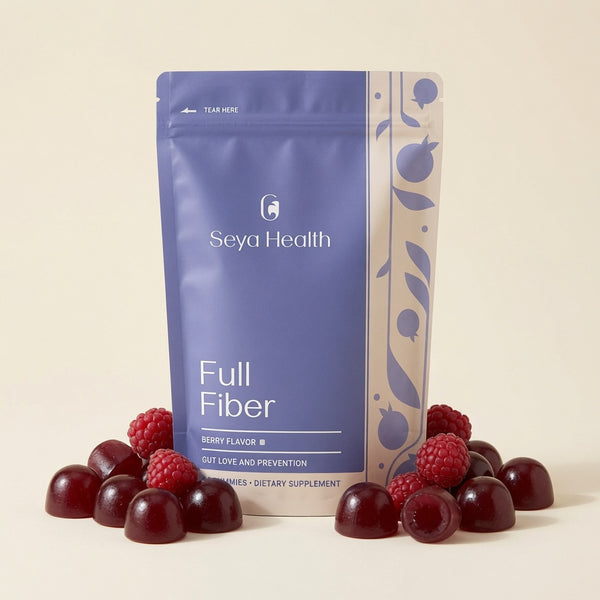
Seya Full Fiber
Most women fall short on fiber. Seya Full Fiber gives you 6 grams from three fibers in three small vegan gummies. Plant based, no gelatin, no sugar alcohols.
Shop Full Fiber