
Home/ The Journal/ constipation
constipation
How much fiber do women over 40 really need (and when too much backfires)

Short version: Fiber for women over 40 has a target that goes down, not up. And past a point, adding more stops helping and starts causing symptoms.
- The federal calorie-based goal is 25.2 g a day for women 31 to 50, and 22.4 g for women 51 and older.
- US women average 9.9 g of fiber per 1,000 calories. The target is 14 g. Only 9% of women hit it.
- In 7 trials covering 187 adults over 50, fiber supplements more than doubled the odds of bowel symptoms like gas and bloating.
Last updated August 2026.
You have been told to eat more fiber. Nobody told you the number moves.
Most women past 40 have never seen this figure. The federal daily goal for a woman aged 31 to 50 is 25.2 g. At 51 it drops to 22.4 g.
Down. Not up.
So the target is not a bigger version of the number you were handed at 25. It is a different number, and how you climb to it matters more than the number itself.
How much fiber for women over 40 is the right daily target?
About 22 to 25 g a day, depending on your age and how much you eat.
The target was never a flat figure. It is built on calories. The reference goal is 14 g of fiber for every 1,000 calories you eat. Your calorie needs fall as you get older, so the fiber goal falls with them.
That works out like this for women, straight from the federal nutritional goals table.
| Age (women) | Daily fiber goal |
|---|---|
| 19 to 30 | 28 g |
| 31 to 50 | 25.2 g |
| 51 and older | 22.4 g |
Those figures come from the Dietary Guidelines nutritional goals table (ODPHP), which lists 14 g per 1,000 kcal as the basis for the fiber recommendation.
For the full breakdown by age, and why the 38 g figure you keep seeing is a man's number, we wrote that up separately in how much fiber women actually need.
Why does the target go down after 50?
Because the target follows calories, and calories follow age.
A lower goal is not permission to eat less fiber. It is arithmetic. You are eating fewer calories on average, so the number attached to those calories shrinks.
What does not shrink is the reason you need it. Constipation gets more common with age, not less. In the medical literature the median prevalence is 16% across all adults and 33.5% in people aged 60 and older, and women report it about 1.5 times as often as men. See the clinical review of chronic constipation (2019).
So the goal drops. The need does not.
Are you actually short on fiber?
Statistically, yes. Almost everyone is.
Researchers looked at more than 14,600 US adults in the national nutrition survey between 2013 and 2018. Women averaged 9.9 g of fiber per 1,000 calories. Men averaged 8.7 g. The target for both is 14 g.
Only 9% of women and 5% of men reached it. The write-up is from the American Society for Nutrition.
Nine percent. That is not a discipline problem across a whole country. That is a food-supply problem, and you were handed it.
We went deeper into how that gap opened in the fiber gap.
When does more fiber stop helping?
Sooner than the internet suggests, and the honest answer is that fiber does some things well and other things barely at all.
A meta analysis pooled 5 trials on fiber and constipation. Fiber beat placebo on how often people went. It showed no significant difference in stool consistency, treatment success, laxative use, or painful bowel movements. That is Yang et al., World Journal of Gastroenterology, 2012.
The picture in older adults is tighter still.
A 2025 review in Foods pooled 7 randomized trials covering 187 people over 50. Stool frequency did not improve to a significant degree. Laxative and enema use dropped clearly. Helpful gut bacteria went up.
And the odds of bowel symptoms, meaning gas, bloating, and belly discomfort, were 2.4 times higher on fiber than on placebo. The review is Dietary fiber supplementation for chronic constipation in the elderly (2025).
Read that carefully. Real benefit. Real cost. In exactly the age group this article is about.
What happens if you add too much, too fast?
You get gas. Then you decide you are doing it wrong.
That conclusion is the part worth rewriting. Bloating after a fiber jump is not a sign your gut is broken or that you lack willpower with food. It is fermentation. Your gut bacteria eat the fiber you just added, and gas is what that reaction makes. It is a signal, not a character flaw.
The bacteria also need time. In the 2025 review, the trials that raised fiber also raised bifidobacteria, the population doing the fermenting. That shift is not instant.
Which is why the pace matters more than the total. Clinical guidance is to climb by roughly 2 to 3 g every few days rather than doubling overnight, and to raise fluid at the same time so the fiber has something to move with.
Two to four weeks is a reasonable window to judge it. Not two days.
Does cutting fiber back ever help?
In one specific situation, the evidence says yes, and it is worth knowing about.
A study followed 63 people with constipation that had no organic cause. Colonoscopy had ruled out disease first. They stopped fiber for 2 weeks, then added back only what felt tolerable.
In the 41 who stayed off fiber, bowel movements went from one every 3.75 days to one a day. Bloating was reported by 100% of the group on high fiber and 0% of the group on none. Straining went the same way.
The authors wrote that "idiopathic constipation and its associated symptoms can be effectively reduced by stopping or even lowering the intake of dietary fiber." See Ho et al., World Journal of Gastroenterology, 2012.
Now the caveats, because they are large. It was 63 people at one center. There was no placebo group and no blinding. Everyone had already been cleared of disease by a specialist.
This is not a reason to drop fiber on your own. It is a reason to stop assuming that more is always the answer, and to take the question to a clinician if you have been climbing for months and getting worse.
How do you raise fiber after 40 without the backfire?
Slowly, with water, and with a target that fits your calories rather than a headline.
Four things do most of the work.
Pick your real number first. Roughly 25 g if you are in your 40s, roughly 22 g from 51. Not 38 g.
Climb in small steps. Two to three grams every few days beats a weekend overhaul, and it gives the bacteria time to catch up.
Drink more as you climb. Fiber pulls water into the gut. Without the water it can sit there and make things stiffer, which is the opposite of the point.
Spread it across the day. Three moderate fiber meals are easier on your gut than one enormous salad at 8pm.
If midlife slowdown is what brought you here, we covered the mechanism in perimenopause and constipation, and the food side in high-fiber foods for women.
Where Seya fits, honestly
Seya sells one product. A fiber gummy.
It delivers about 5 g of fiber a day, which is a fraction of a 22 to 25 g goal, not a replacement for it. We say that plainly because the evidence grade at that dose supports regularity and nothing louder.
Food does the heavy lifting. A supplement closes part of a gap on the days food does not.
And the gummy is subject to the same rule as everything else on this page. Start low, go up slowly, drink water. Being a supplement does not exempt it from fermentation.
This is education, not medical advice. Talk to a qualified clinician before changing your fiber intake, especially if you have a gut condition or take medication that affects digestion.
These statements have not been evaluated by the Food and Drug Administration. This product is not intended to diagnose, treat, cure, or prevent any disease.
Frequently asked questions
How much fiber does a woman over 40 need per day?
About 25.2 g a day for women aged 31 to 50, and 22.4 g a day for women 51 and older, according to the federal nutritional goals table. The figure is calculated from calories at a rate of 14 g of fiber per 1,000 calories, so it falls as calorie needs fall with age. The widely quoted 38 g figure is the goal for younger men, not for women.
Why does the fiber recommendation go down after 50?
Because the recommendation is tied to calorie intake rather than to age directly. The reference basis is 14 g of fiber per 1,000 calories consumed. Average calorie needs decline after 50, so the fiber goal declines with them, from 25.2 g to 22.4 g a day for women. The need for fiber itself does not fall. Chronic constipation is more common after 60, affecting about 33.5% of that age group compared with 16% of adults overall.
Can you eat too much fiber?
Yes, and the main cost is symptoms rather than danger. A 2025 meta-analysis of 7 randomized trials in 187 adults over 50 found that fiber supplementation raised the odds of bowel symptoms such as gas, bloating, and abdominal discomfort by about 2.4 times compared with placebo, while not significantly improving stool frequency in that group. Adding fiber gradually, by roughly 2 to 3 g every few days alongside more fluid, reduces that effect.
Why does fiber make me more bloated?
Gut bacteria ferment fiber, and gas is a normal product of that reaction. When intake jumps quickly, gas production outpaces the gut's ability to adapt. Research on fiber supplementation shows a matching rise in bifidobacteria, the bacteria doing the fermenting, which takes time to settle. Most guidance suggests giving a change 2 to 4 weeks before judging it, and increasing fluid intake alongside the fiber.
Does cutting back on fiber help constipation?
Sometimes, in people whose constipation has no organic cause. A 2012 study of 63 such patients, all cleared by colonoscopy first, found that the 41 who stopped fiber went from one bowel movement every 3.75 days to one a day, with bloating falling from 100% of the high-fiber group to 0%. The study was small, unblinded, and conducted at a single center, so it is a reason to raise the question with a clinician rather than to cut fiber on your own.
Does fiber fix stool consistency?
Not reliably. A meta-analysis of 5 trials found that dietary fiber increased how often people had a bowel movement compared with placebo, but showed no significant difference in stool consistency, treatment success, laxative use, or painful bowel movements. Fiber is better understood as support for regularity than as a fix for every constipation symptom.
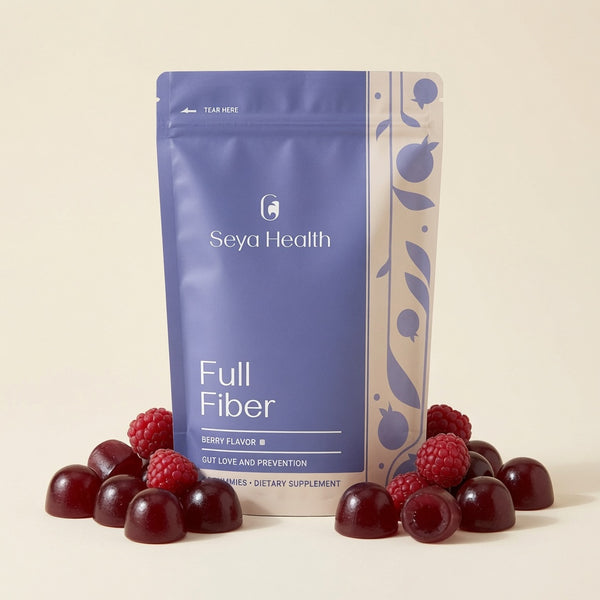
Seya Full Fiber
Getting enough fiber from food every day is hard. Seya Full Fiber is 6 grams from three fibers in one, in three small gummies, so you have a reliable daily floor. Plant based, no gelatin, no sugar alcohols, 60 gummies per pouch.
Shop Full FiberKeep reading

fiber
Can a Multivitamin Replace Vegetables? What Supplements Can't Do for Your Gut

constipation
The Best Way to Beat Constipation in Your 30s (and Where Fiber Gummies Fit)
fiber
The Gut-Skin Axis: Does Your Gut Health Affect Your Skin?
The gut-skin axis, explained: how your gut bacteria and blood sugar affect your skin, w...