
Home/ The Journal/ body composition
body composition
Losing Weight in Perimenopause: Why It's Harder, and What Helps

The short version: Losing weight in perimenopause is harder for a reason most articles get wrong. Your weight does not start climbing faster. Underneath a scale number that barely shifts, fat gain doubles from 1.0% to 1.7% a year and muscle starts going the other way. That is a different problem, and it has a different answer.
- In SWAN, fat gain doubled at the start of the transition, from 1.0% to 1.7% a year. Lean mass flipped from rising to falling.
- Body weight itself climbed in a straight line. It did not accelerate when the transition began.
- Visceral fat, the kind packed around your organs, was flat before the transition. Then it rose 6.24% a year.
- Your metabolism does not crash at 40. In a study spanning ages 8 days to 95 years, energy use held steady from 20 to 60.
- Across 101 trials in 5,697 women, exercise cut fat mass by 1.27 kg and added 0.66 kg of lean mass.
Last updated September 2026.
Nothing changed. That is the maddening part.
You eat what you ate at 38. You walk the same route. The scale creeps up anyway, and your jeans fit differently in a way the scale does not explain.
You are not imagining it, and you are not doing it wrong. But the story you have been told about why is mostly wrong, and the wrong story leads to the wrong fix.
Here is what the long-running research on midlife women actually found.
Why is losing weight in perimenopause harder?
Because the problem is not the number. It is what the number is made of.
SWAN scanned 1,246 women with DXA, over and over, for years. Average age at the start was 47. Average age at the final period was 52.
Before the transition, fat mass rose about 1.0% a year. Once the transition began, that rate roughly doubled to 1.7%. In kilograms: 0.25 a year before, 0.45 a year during.
At the same moment, lean mass turned around. It had been rising 0.2% a year. It began falling 0.2% a year.
So you are gaining fat twice as fast and losing muscle at the same time. Two years after your final period, both trends flatten out again.
Why the scale hides all of it
This is the part almost nobody tells you.
In the same study, body weight climbed in a straight line through midlife. There was no jump at the start of the transition. None.
Fat went up faster and muscle went down, and the two roughly cancelled on the scale. You can gain 3 kg of fat, lose most of a kilo of muscle, and watch the scale barely move.
That is why your clothes tell a different story than your bathroom floor does. The scale is measuring the wrong thing.
Where the fat goes changes too
A second SWAN analysis followed 380 women for a median of 11.8 years and looked at where fat landed.
| Measure | Before the transition | During the transition | After |
|---|---|---|---|
| Android (belly) fat | +1.21% a year | +5.54% a year | +0.90% a year |
| Visceral fat | flat | +6.24% a year | +1.47% a year |
| Gynoid (hip) fat | flat | +2.03% a year | −0.87% a year |
| Waist measurement | +0.55% a year | +0.96% a year | +0.55% a year |
Visceral fat sits around your organs and carries the metabolic risk. It was going nowhere, then it climbed 6% a year.
Notice the last row. Your waist tape barely registered a shift that big. Neither will your scale.
Does your metabolism slow down at 40?
No. This one is worth saying plainly.
A 2021 Science study pooled doubly labeled water data, the gold standard for measuring real daily energy use, across ages 8 days to 95 years. Adjusted for fat-free mass, daily energy use was stable from age 20 to 60. The decline starts in older age.
But read the adjustment. Energy use tracks fat-free mass, which is mostly muscle.
Your metabolism is not slowing down on its own schedule. It follows the muscle. Lose muscle and you burn less, which is the real mechanism, and it points straight at what to do about it.
How much does movement actually help?
More than a smaller plate does, and the numbers are specific.
SWAN tracked 3,064 women aged 42 to 52 for three years. They gained 2.1 kg and 2.2 cm at the waist on average. Change in menopausal status was not linked to gaining weight.
Reported exercise was. Each one-point rise on their five-point activity scale went with 0.32 kg less gained, at p < 0.0001.
A 2023 review pooled 101 randomized trials covering 5,697 postmenopausal women. Exercise versus no exercise produced:
- 1.27 kg less fat mass
- 1.86 percentage points lower body fat
- 1.45 cm off the waist
- 0.66 kg more fat-free mass, with almost no disagreement between studies
- Lower visceral fat, at a standardized effect of −0.38
Aerobic or weights? The split matters
The same review separated the two, and the answer is not "pick one."
Aerobic training moved the fat numbers more. Resistance training moved the muscle numbers more. Doing both beat doing either alone.
That maps cleanly onto what the transition does to you. It takes muscle and adds belly fat, so you want the thing that builds muscle and the thing that reduces fat.
The federal guideline is 150 minutes a week of moderate activity, or 75 vigorous, plus strength work on 2 days covering all the major muscle groups.
Most women hit some version of the first half and skip the second. The second half is the one aimed at what actually changed.
Where fiber fits, and where it does not
Fiber helps here. It is a smaller lever than movement, and the honest version is worth having.
A review of controlled feeding studies found that adding 14 g of fiber a day went with roughly 10% lower calorie intake and about 1.9 kg off body weight over 3.8 months. Women with obesity saw about 2.4 kg; leaner women saw 0.8 kg.
A 12-month randomized trial put that to a harder test. Researchers gave 240 adults with metabolic syndrome one instruction, hit 30 g of fiber a day, and compared it to the full American Heart Association diet.
The fiber-only group dropped 2.1 kg. The multi-rule group dropped 2.7 kg. The gap between them was 0.6 kg, with a confidence interval that crossed zero.
One simple change got most of the way there. That is a useful finding for anyone who has abandoned a complicated plan.
Two limits, though. Neither study was run in perimenopausal women. And a couple of kilograms over a year is real but modest next to what movement does to body composition. We cover fiber's appetite mechanism separately in can fiber help women over 40 lose weight.
The overlooked reason movement helps at midlife
Your gut slows down in perimenopause. Falling estrogen and progesterone change transit time, and a lot of women notice it before they notice anything else.
Exercise acts on that directly. A meta-analysis of 9 randomized trials and 680 people found exercise improved constipation symptoms, with a relative risk of 1.97. In the aerobic subgroup it was 2.42.
Be careful with that number. The studies disagreed sharply with each other, and the authors flagged a high risk of bias. Call it supportive, not settled.
Still, the practical point holds. The walk you take for your waist is also working on your gut. We go deeper in perimenopause and constipation.
What to actually do this week
Four things, in order of how much they matter.
- Add two strength sessions. This is the lever aimed at the thing that changed. Bodyweight counts to start.
- Keep the walking. 150 minutes a week, split however fits your life.
- Get your fiber to target. That is 25 g a day through age 50, and 21 g after. More than 90% of US women fall short.
- Stop weighing yourself daily. A tape measure and how your clothes fit will catch a composition shift that the scale is built to miss.
Add fiber gradually and drink more water while you do, or you will trade one complaint for gas. The ramp is laid out in high-fiber foods for women over 40.
Where Seya fits, honestly
We make a fiber gummy. It is not a weight product, and we are not going to dress it up as one.
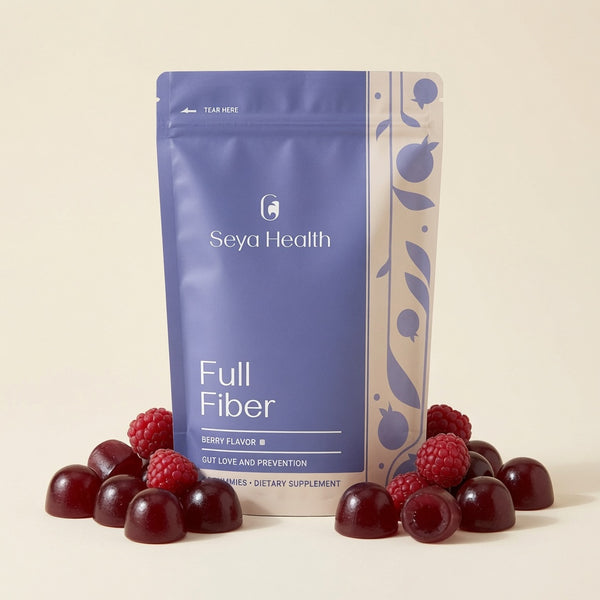
3 gummies deliver 5,650 mg of dietary fiber, which is 5.65 g, or 16% of the Daily Value. The label prints the full split: 4,500 mg of resistant tapioca fiber, 950 mg of prebiotic soluble fiber, 200 mg of cellulose, plus 80 mg of magnesium as magnesium citrate and 100 mg of ginger root.
What that honestly supports is regularity. It closes about a fifth of a 25 g fiber day. Food closes the rest, and nothing in the jar builds muscle.
This is education, not medical advice. If your weight or your cycle has changed sharply, that is a conversation for a clinician, who can also rule out thyroid and other causes. Talk to one before starting any new supplement, especially if you take medication.
These statements have not been evaluated by the Food and Drug Administration. This product is not intended to diagnose, treat, cure, or prevent any disease.
Frequently asked questions
Why is it harder to lose weight during perimenopause?
Because your body composition shifts even when your weight does not. In the SWAN study of 1,246 women, fat gain doubled from 1.0% to 1.7% a year at the start of the transition, while lean mass flipped from rising 0.2% a year to falling 0.2% a year.
Body weight itself climbed in a straight line with no acceleration. Since muscle drives how much energy you burn, losing it lowers your daily burn while the scale stays quiet about the whole exchange.
How can a woman lose weight during menopause?
Movement is the strongest lever in the evidence. Across 101 randomized trials in 5,697 postmenopausal women, exercise reduced fat mass by 1.27 kg, body fat by 1.86 percentage points, and waist circumference by 1.45 cm, while adding 0.66 kg of fat-free mass.
Aerobic work moved the fat numbers most and resistance work moved the muscle numbers most, so combining them beat either alone. The federal target is 150 minutes of moderate activity a week plus strength work on 2 days.
What is the easiest way to lose weight after menopause?
Pick one change and hold it. In a 12-month trial of 240 adults, a group told only to reach 30 g of fiber a day dropped 2.1 kg, against 2.7 kg for a group following the full American Heart Association diet.
The difference between them was 0.6 kg, with a confidence interval crossing zero. A single simple rule got most of the result, which matters if complicated plans have not stuck for you before.
How can you lose weight during menopause naturally?
Combine two strength sessions a week with 150 minutes of walking or similar activity, and bring fiber to 25 g a day through age 50 or 21 g after. More than 90% of US women fall short of that fiber target.
In SWAN, each one-point rise on a five-point exercise scale went with 0.32 kg less gained over three years, at p < 0.0001. Change in menopausal status, by contrast, was not linked to gaining weight at all.
Does perimenopause make you gain weight, or is it just aging?
Mostly aging, for the scale number. SWAN found no acceleration in body weight at the start of the transition, and change in menopausal status was not associated with weight gain in a separate analysis of 3,064 women.
What the transition does drive is where fat sits. In 380 women followed a median of 11.8 years, visceral fat was flat beforehand and then rose 6.24% a year, and belly fat went from 1.21% to 5.54% a year.
Does your metabolism slow down in your 40s?
Not on its own. A 2021 Science analysis of doubly labeled water data spanning ages 8 days to 95 years found that daily energy use, adjusted for fat-free mass, stayed stable from age 20 to 60 and declined only in older adults.
Energy use does track fat-free mass, which is mostly muscle. So the drop women notice at midlife follows the lean mass they are losing, which is why resistance work is the more targeted response.
Related reading
Seya Full Fiber
Your gut bacteria run on fiber. Seya Full Fiber delivers 6 grams from three fibers in one to feed the beneficial bacteria in your gut and support short-chain fatty acid production. Plant based, no gelatin, no sugar alcohols.
Shop Full FiberKeep reading

fiber
Can a Multivitamin Replace Vegetables? What Supplements Can't Do for Your Gut

constipation
The Best Way to Beat Constipation in Your 30s (and Where Fiber Gummies Fit)
fiber
The Gut-Skin Axis: Does Your Gut Health Affect Your Skin?
The gut-skin axis, explained: how your gut bacteria and blood sugar affect your skin, w...