
Home/ The Journal/ fiber
fiber
Can Fiber Help Women Over 40 Lose Weight? What the Science Actually Says

Short version: Can fiber help women over 40 lose weight? Yes, a little, and the effect is real. In a 20-month study of 252 women, each extra gram of daily fiber was tied to 0.25 kg less weight gained. Fiber will not melt a number off the scale. It makes eating less feel less like a fight.
- An extra 14 g of fiber a day cut calorie intake by about 10%. Body weight fell 1.9 kg over 3.8 months, per Howarth et al., Nutrition Reviews, 2001.
- After 40 the game changes. At the start of the menopause transition, the rate of fat gain doubles and lean mass starts to drop, per the SWAN study.
- Gel-forming fiber has the most direct body-weight evidence. Fermentable prebiotic fiber, like resistant tapioca, works through gut hormones and supports regularity.
Last updated September 2026.
You eat less than you did at 30. The scale went up anyway.
So, can fiber help women over 40 lose weight? Yes, modestly, and the numbers are worth knowing. In a 20-month study of 252 women, every extra gram of daily fiber was linked to 0.25 kg less weight gained. Body fat dropped 0.25 points per gram too, per Tucker and Thomas, Journal of Nutrition, 2009 (PMID 19158230).
That is not magic. It is a lever. And it is one most women have barely touched, because more than 90% of US women eat less fiber than the daily target.
This article covers what the studies actually found, why 40 is a turning point, which fiber does the most, and what a realistic plan looks like.
Can fiber help women over 40 lose weight, or just feel fuller?
Both, and the fullness is how the weight part happens.
Three kinds of evidence line up. First, the cohort data. In the Tucker study above, almost half the women gained weight over 20 months. Higher fiber lowered that risk on its own, even after the researchers accounted for exercise. In their words:
"Increasing dietary fiber significantly reduces the risk of gaining weight and fat in women, independent of several potential confounders, including physical activity, dietary fat intake, and others." — Tucker and Thomas, Journal of Nutrition, 2009
Second, the intake data. People were free to eat as much as they wanted. An extra 14 g of fiber a day still cut calorie intake by about 10%, and body weight by 1.9 kg over 3.8 months, per Howarth, Saltzman, and Roberts, Nutrition Reviews, 2001 (PMID 11396693). The drop was bigger in people carrying extra weight: 2.4 kg versus 0.8 kg.
Third, the trials. A meta-analysis pooled 62 randomized trials with 3,877 people. Gel-forming fiber, added to a normal diet with no calorie cutting, lowered body weight by 0.33 kg and waist size by 0.63 cm, per Jovanovski et al., American Journal of Clinical Nutrition, 2020 (PMID 31897475).
Small numbers. Real numbers. Read them as a floor, not a promise.
What changes after 40 that makes this harder?
Your body starts moving weight into fat and out of muscle, and it does it faster than before.
The SWAN study followed women through menopause with body scans. At the start of the transition, the rate of fat gain doubled. Lean mass began to fall. That pattern ran until 2 years after the final period, per Greendale et al., JCI Insight, 2019 (PMID 30843880).
"At the start of the [menopause transition], rate of fat gain doubled, and lean mass declined; gains and losses continued until 2 years after the FMP." — Greendale et al., JCI Insight, 2019
Here is the part worth sitting with. You did not get lazy at 47. Your body changed lanes, and the old habits stopped matching the new physiology. That is a mechanism, not a character flaw.
Now stack the fiber gap on top. Women need about 25 g of fiber a day, about 21 g after 50, per the National Academies. More than 90% of US women fall short, most by roughly half, per Thompson, Nutrients, 2021 (PMID 34836289). We break that down in the fiber gap.
How does fiber make it easier to eat less?
It slows your stomach and turns up your fullness hormones, so you stop sooner without deciding to.
Gel-forming fiber soaks up water and thickens in your stomach. Food leaves more slowly. You feel full longer on the same plate. We cover that mechanism in fiber and satiety.
Fermentable fiber works further down. Gut bacteria eat it and release short-chain fatty acids. Those nudge the gut to release GLP-1 and PYY, two hormones that tell your brain you have had enough. In a 24-week trial, 10 g a day of a propionate-releasing fiber raised those hormones after meals. It also reduced weight gain in overweight adults, per Chambers et al., Gut, 2015 (PMID 25500202).
There is one more effect people miss. Fiber helps you stick with a plan. In the POUNDS Lost trial, 345 adults cut 750 calories a day for 6 months. Of everything the researchers measured, fiber intake was the single strongest predictor of how much weight came off. It also predicted whether people kept following their diet at all, per Miketinas et al., Journal of Nutrition, 2019 (PMID 31174214).
Fiber is not the diet. It is what makes the diet survivable.
What kind of fiber is best when you're trying to lose weight?
Gel-forming fiber for the direct body-weight evidence. Fermentable fiber for the hormone route. Most whole foods give you both.
| Fiber type | Found in | What the weight evidence shows |
|---|---|---|
| Gel-forming (viscous) soluble | Oats, barley, beans, psyllium | 0.33 kg lower weight and 0.63 cm smaller waist across 62 trials, with no calorie cutting |
| Fermentable prebiotic | Resistant starch, inulin, cooled potatoes, green bananas | Raises GLP-1 and PYY after meals; 10 g a day reduced weight gain over 24 weeks |
| Insoluble | Wheat bran, vegetable skins, nuts | Adds bulk and supports regularity; little direct weight data |
One more study reframes the whole question. In a 12-month trial of 240 adults, one group got a single instruction. Eat 30 g of fiber a day. The other followed the full American Heart Association diet with a dozen rules. The fiber-only group lost 2.1 kg. The full-diet group lost 2.7 kg, per Ma et al., Annals of Internal Medicine, 2015 (PMID 25686165).
One rule got you most of the way. That matters when you are tired of rules.
Which high-fiber beans are the best to eat?
Navy beans, then black beans, lentils, and chickpeas. All four beat almost any vegetable gram for gram.
Per 100 g cooked, roughly two-thirds of a cup, per USDA FoodData Central:
- Navy beans: 10.5 g of fiber
- Black beans: 8.7 g
- Lentils: 7.9 g
- Chickpeas: 7.6 g
A full cup of navy beans gets you close to 19 g, most of a day's target in one bowl. Beans also carry protein, which pairs with fiber to keep you full. For the wider list, see high-fiber foods for women over 40.
Does eating a lot of fiber make you gain weight?
No. The data points the other way, and the early bloat is not fat.
In the Tucker cohort, women who added fiber were less likely to gain, not more. What fiber does add at first is gas and a fuller belly, because your gut bacteria are learning to ferment it. That settles within a couple of weeks for most people.
Go up by about 5 g a week and drink water as you climb. If you jump from 12 g to 30 g overnight, you will feel it. We cover the signs of overdoing it in can you eat too much fiber.
What is a realistic plan for a woman over 40?
Close the fiber gap first, protect your muscle second, and pick a pattern you can keep for years.
- Find your number. Most women sit near 15 g a day. The target is 25 g, or 21 g after 50. That gap of about 10 to 14 g is the same size as the gap that moved the scale in the Howarth review.
- Add, do not subtract. Beans at lunch, oats or fruit at breakfast, a vegetable you actually like at dinner. Adding fiber crowds out the rest on its own.
- Lift something. SWAN shows lean mass falls through the transition. Fiber cannot fix that. Resistance work 2 or 3 times a week can help hold the line.
- Pick a pattern, not a program. The Ma trial is the lesson. One rule you follow beats twelve rules you quit.
The best diet for a woman in midlife is the one built on foods that fill you up and that you still eat in March. Fiber-rich plants, enough protein, and fewer rules than you think.
Where Seya fits, honestly
Seya sells one product. A vegan fiber gummy.
It delivers about 5 g of fiber a day from resistant tapioca fiber, a fermentable prebiotic. That is a real slice of the gap, not the whole thing. At that dose the honest claim is that it supports regularity. It is not a weight product, and we will not dress it up as one.
What 3 gummies can do is make the first 5 g of your 10 g gap automatic, on the mornings when beans are not happening. The rest still comes from your plate. For more on the ingredient, see what resistant tapioca starch is.
This is education, not medical advice. Talk to a qualified clinician before changing your diet, especially if you take medication for blood sugar or have a digestive condition.
These statements have not been evaluated by the Food and Drug Administration. This product is not intended to diagnose, treat, cure, or prevent any disease.
Frequently asked questions
Is fiber underrated as a tool for losing weight?
Yes. In a 12-month trial of 240 adults, a single rule to eat 30 g of fiber a day produced 2.1 kg of weight lost. The full multi-rule American Heart Association diet produced 2.7 kg. In the POUNDS Lost trial, fiber intake was the strongest predictor of how much weight came off, and of whether people stuck with their diet. The effect is modest, but it costs nothing and it makes eating less feel easier.
Does eating a lot of fiber make you gain weight?
No. In a 20-month study of 252 women, each extra gram of daily fiber was linked to 0.25 kg less weight gained and lower body fat. What fiber can cause at first is gas and a fuller feeling, because gut bacteria are adjusting to fermenting it. That usually settles within 1 to 2 weeks if you add about 5 g a week and drink water.
What kind of fiber is best when you're trying to lose weight?
Gel-forming soluble fiber, found in oats, barley, beans, and psyllium, has the most direct evidence. Across 62 trials with no calorie cutting it meant 0.33 kg lower weight and a 0.63 cm smaller waist. Fermentable prebiotic fiber, such as resistant starch and inulin, works through gut hormones like GLP-1 and PYY and supports regularity. Whole foods usually give you both types at once.
What are the healthiest high-fiber beans to eat?
Navy beans lead with 10.5 g of fiber per 100 g cooked, per USDA FoodData Central. Black beans follow at 8.7 g, lentils at 7.9 g, and chickpeas at 7.6 g. A full cup of navy beans delivers close to 19 g, most of the 25 g daily target for women. Beans also carry protein, which pairs with fiber to keep you full longer.
What is the best diet for women in midlife?
The one you can keep for years. The evidence favors a pattern built on fiber-rich plants and enough protein, with resistance exercise to protect lean mass, which falls during the menopause transition. A simple fiber-first rule performed nearly as well as a complex multi-rule diet over 12 months. Fewer rules that you follow beat more rules that you quit.
Will a fiber gummy help you lose weight?
Not on its own. A gummy like Seya's delivers about 5 g of fermentable fiber a day. That supports regularity and closes part of the roughly 10 g fiber gap most women have. The studies that moved body weight used 14 g or more of added fiber, mostly from food. Think of a gummy as the automatic first slice of the gap, with the rest coming from beans, oats, fruit, and vegetables.
Related reading
Seya Full Fiber
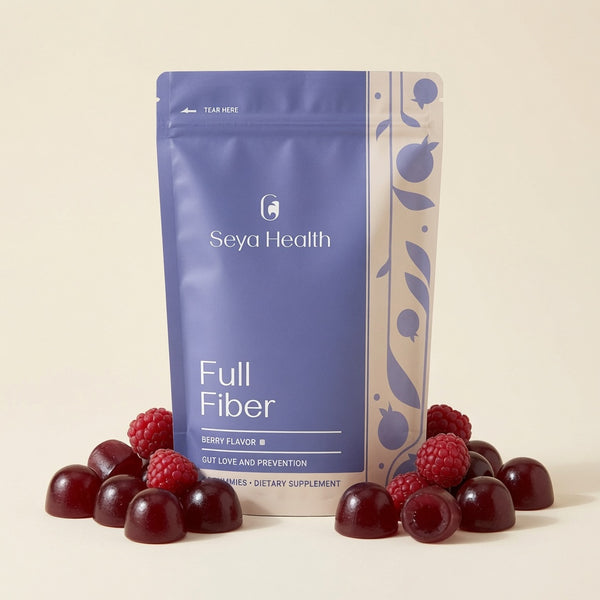
Getting enough fiber from food every day is hard. Seya Full Fiber is 6 grams from three fibers in one, in three small gummies, so you have a reliable daily floor. Plant based, no gelatin, no sugar alcohols, 60 gummies per pouch.
Shop Full FiberKeep reading
fiber
Can a Multivitamin Replace Vegetables? What Supplements Can't Do for Your Gut

constipation
The Best Way to Beat Constipation in Your 30s (and Where Fiber Gummies Fit)
fiber
The Gut-Skin Axis: Does Your Gut Health Affect Your Skin?
The gut-skin axis, explained: how your gut bacteria and blood sugar affect your skin, w...