
Home/ The Journal/ creatine
creatine
NSF Certified for Sport creatine: why third-party testing matters

Short version: NSF Certified for Sport creatine has been checked by an outside lab for 290 substances banned in sport. NSF also confirms the label matches what is inside, screens for unsafe contaminants, and audits the factory. It is the strongest everyday quality check you can look up for a tub or bag of creatine.
- What it checks: banned substances, label accuracy, contaminants, and how the product is made.
- How to verify: search the product on nsfsport.com and match the lot number on your package.
- Who needs it most: anyone who gets drug tested for sport. For everyone else, it is a fast quality shortcut.
Last updated November 2026.
Creatine is simple. Most good products hold one ingredient: creatine monohydrate.
So why would a seal matter? Because "simple" on the label does not prove what is in the package.
The FDA does not test supplements before they are sold. A seal like NSF Certified for Sport fills that gap with real lab work. Here is what it checks, how to confirm it in two minutes, and when it is worth paying for.
What does NSF Certified for Sport mean?
It means NSF, an independent testing group, has checked the product and the place it is made. NSF says the program verifies four things. See NSF's page on what its mark means.
- No banned substances. The product does not contain any of 290 substances banned by major sports groups.
- The label is true. What is printed on the label matches what is in the product.
- No unsafe contaminants. Tested products have no unsafe levels of things like heavy metals or germs.
- A checked factory. The product comes from a facility that NSF audits once or twice a year, based on its grade.
The banned substance screen covers groups such as steroids, stimulants, diuretics, SARMs, and beta blockers, per NSF's certification steps.
How does a product earn the NSF seal?
It is a three-step process, and each step builds on the last.
- Factory check. NSF audits every site that makes, packs, or stores the product. It reviews cleaning, sourcing, testing, and recall plans.
- Contents check. NSF reviews the formula and tests the finished product. It confirms the label claims and screens for heavy metals and microbes.
- Banned substance check. Production lots are tested for the 290 banned substances. Only then can the brand print the Certified for Sport mark.
Certification is not a one-time stamp. NSF re-tests products each year and reviews any change to the formula or suppliers. Tested lots are listed online at nsfsport.com and in the NSF app.
Step 2 on its own is a separate NSF mark, often called NSF Contents Certified, under the NSF/ANSI 173 standard. That one checks the label and contaminants but not banned substances. If you get drug tested, look for the words "Certified for Sport."
Why does third-party testing matter for creatine?
Because no one checks a supplement before it hits the shelf.
The FDA says it "does not test dietary supplements before they are sold to consumers." By law, it also does not approve them for safety first. The maker is on the hook for what is inside. See the FDA's dietary supplement Q&A.
When researchers have tested supplements, they have found hidden drugs:
- Of 634 supplements bought in 13 countries, 94 (14.8%) held steroids not listed on the label. See Geyer et al. (Int J Sports Med, 2004).
- Of 66 "high-risk" sports products bought from Dutch web shops, 25 (38%) held banned substances not on the label. See Duiven et al. (J Sports Sci Med, 2021).
To be fair to creatine, those were not mostly creatine products. In one national anti-doping program, the products most often tied to positive tests were pre-workouts and fat burners. Athletes blamed a supplement in 26% of 192 cases, and evidence backed that up in 27 of them. See this 18-year review (Front Sports Act Living, 2022).
A plain creatine powder is lower risk. But many factories make several products on shared lines, and creatine has its own purity issues. Our guide to creatine purity and safety covers the byproducts labs have found.

Which creatine is NSF certified?
A lot more than you might think. On November 12, 2026, a search of the NSF Certified for Sport directory returned 168 creatine listings from about 60 brands.
Some well-known names on that list:
| Brand | Listed creatine products | Form |
|---|---|---|
| Thorne | Creatine, plus flavored and blended versions | Powder |
| Klean Athlete | Klean Creatine | Powder |
| Momentous | Creatine Monohydrate and Creatine Chews | Powder, chew |
| Create | Creatine Gummies and Creatine + Electrolytes | Gummy, powder |
| Force Factor | Creatine Monohydrate Gummies | Gummy |
| Transparent Labs | Creatine HMB | Powder |
| CON-CRET | Creatine HCl | Powder |
This list changes as products are added or dropped. A seal on one flavor or size does not cover the whole line, so always check your exact product. For how gummies stack up on dose and sugar, see our guide to the best creatine gummies for women.
How do you check an NSF seal yourself?
It takes about two minutes. A logo on a package is easy to copy, so the listing is your proof. USADA, the US anti-doping agency, gives the same advice. See USADA's Reduce Your Risk page.
- Search the name. Go to nsfsport.com or open the NSF app. Search the brand and product.
- Match the details. Check the flavor, form, and package size against your product.
- Match the lot number. Find the lot code printed on your package. Many listings show the lots that were tested. Create's gummy listing, for one, names its tested lot codes.
- Buy from a clear source. USADA suggests buying through the link on the certifier's site, or from the brand, so you get a certified lot.
Be wary of vague phrases such as "lab tested" or "pharmaceutical grade" with no named program. They may be true, but you cannot look them up.
Is NSF Certified for Sport creatine worth it?
If you get drug tested, yes. If you do not, it is still a smart shortcut.
For tested athletes, the rules are strict. USADA says that if a positive test comes from a contaminated product made by a recommended program, the athlete "could get a much-reduced sanction, but there likely would still be a consequence." USADA lists five programs it recommends: BSCG, Eurofins Clean Sport, Informed Sport, NSF Certified for Sport, and TruShield. See USADA Supplement Connect.
For everyone else, the seal answers the question most of us really have. Is the creatine I paid for actually in here? NSF's label check and contaminant screen answer that, even if banned drugs are not your worry.
Keep the limits in mind, too. USADA says a seal "reduces, but does not eliminate" risk. It is not FDA approval, and it does not prove a product works for you.
What the seal does not tell you
A certified product can still be the wrong product for you. The seal does not check:
- Dose. Most research uses 3 to 5 g of creatine a day. A certified gummy that gives you 1 g a serving is still a small dose. See Antonio et al. (JISSN, 2021).
- Form. Creatine monohydrate has the most safety data. Studies of up to 30 g a day for 5 years found it safe in healthy people. See the ISSN position stand (Kreider et al., 2017).
- Fit for women. Women have 70 to 80% lower natural creatine stores than men, per a 2021 review in Nutrients (Smith-Ryan et al.). That makes a real, daily dose worth getting right.
Before you buy, it can help to read is creatine safe for women. Talk to your doctor first if you have kidney disease, are pregnant, or take regular medicine.
Where Seya fits, honestly
Seya sells one product today: a fiber gummy that supports regularity.
Our creatine gummy is coming January 2027. It is not on sale yet. We will not quote its dose, price, or test results until they are final.
When it launches, use the same checks from this post on it. Ask for the lot. Look it up. That is the bar every creatine product should clear.
This is education, not medical advice.
These statements have not been evaluated by the Food and Drug Administration. This product is not intended to diagnose, treat, cure, or prevent any disease.
Frequently asked questions
What does NSF Certified for Sport mean?
It means NSF tested the product for 290 substances banned in sport, confirmed the label matches the contents, screened for unsafe contaminants, and audited the factory. Tested lots are listed on nsfsport.com.
Which creatine is NSF certified?
On November 12, 2026, the NSF directory listed 168 creatine products from about 60 brands, including Thorne, Klean Athlete, Momentous, Create, Force Factor, and Transparent Labs. Listings change, so check your exact product and lot.
Is NSF certification worth it for creatine?
If you are drug tested for sport, yes. USADA recommends certified products. For everyone else, it is a quick way to know the label is accurate and the product was screened for contaminants.
Is NSF Certified for Sport the same as NSF Contents Certified?
No. Contents Certified, under NSF/ANSI 173, checks the label and contaminants. Certified for Sport adds lot testing for 290 banned substances.
Does the FDA test creatine before it is sold?
No. The FDA says it does not test or approve dietary supplements before they are sold. The maker is responsible for what is inside.
Can an NSF certified supplement still cause a failed drug test?
It is unlikely but possible. USADA says certification reduces, but does not eliminate, the risk of a positive test.
Is Seya's creatine gummy NSF certified?
Seya's creatine gummy is not on sale yet. It is coming January 2027, and we will share its details once they are final. Seya's fiber gummy is the product on sale today.
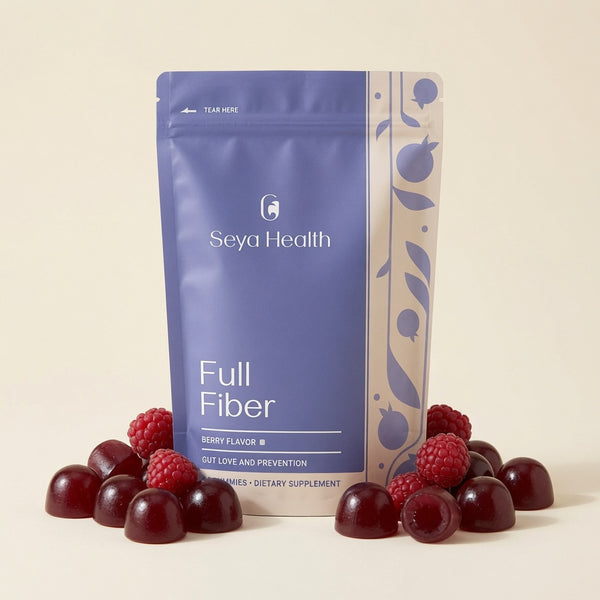
Seya Full Fiber
Most women fall short on fiber. Seya Full Fiber gives you 6 grams from three fibers in three small vegan gummies. Plant based, no gelatin, no sugar alcohols.
Shop Full FiberKeep reading

bone health
Best supplements for women over 40: what the evidence supports for heart, bones and muscles (and what's hype)

creatine
How long does creatine take to work? A realistic timeline for women

constipation