

Short version: Is creatine safe for women? Yes, for most healthy women at 3 to 5 g a day. A 2020 review pooled 29 studies with 951 women and found no deaths or serious side effects. Women on creatine had no more side effects than women on placebo.
- Long term: a 2-year trial in 237 women past menopause found side effects about equal to placebo.
- Every day: 3 to 5 g a day is the dose most studied. You do not need to load.
- Wait or ask first: if you are pregnant, breastfeeding, or have kidney disease. The data there is thin.
- The real downsides: some water weight, an upset stomach at big doses, and a higher creatinine number on blood tests.
Last updated November 2026.
You keep hearing that creatine is great for women. Then someone says it hurts your kidneys. Or makes your hair fall out. Or that it is basically a steroid.
So is it safe? The short answer is yes, for most healthy women. The longer answer has a few honest gaps.
Here is what the research says, where it is strong, and where it is still thin.
Is creatine safe for women?
For healthy women at normal doses, yes. That is the view of the research teams who study it most.
The best women-only look at safety is a 2020 review. Researchers found 29 studies that tracked side effects in 951 women. There were no deaths and no serious side effects. Total side effects, stomach issues, and weight gain were not meaningfully higher than placebo. Kidney and liver tests did not differ either. See de Guingand et al. (Nutrients, 2020).
A larger expert review in 2021 came to the same view. It also says creatine "provides a variety of benefits for females across their lifespan." See Antonio et al. (JISSN, 2021).
Why is there less research in women?
Because women were left out for years. The same 2020 review counted 656 creatine studies. Only 58 of them, about 9%, studied women alone.
That gap is shrinking. Newer trials now run for 1 to 2 years in women, and they track safety closely.
But it explains why some questions, like pregnancy, still lack firm answers. Less research does not mean harm. It means less certainty.
Is creatine safe long term?
So far, yes. Long trials have not turned up new problems.
The longest women-only trial ran for 2 years. 237 women past menopause, with an average age of 59, took creatine or a placebo. They also lifted weights and walked. The dose was 0.14 g per kg of body weight a day. For a 150 lb woman, that is about 9.5 g. See Chilibeck et al. (Med Sci Sports Exerc, 2023).
Doctors on the team checked every reported problem. Here is how the two groups compared:
| Type of problem | Women on creatine | Women on placebo |
|---|---|---|
| Kidney-related | 15 | 21 |
| Liver-related | 7 | 5 |
| Stomach or gut | 13 | 14 |
| Muscle cramps | 2 | 2 |
None of these gaps were statistically significant. Most problems were rated mild. Two women in the creatine group dropped out over side effects. One had diarrhea. The other reported an allergy to the metal on the gym machines.
What do other long-term studies show?
Older data points the same way. In a 21-month study, 98 college athletes had 69 blood and urine markers tested. Creatine users looked the same as non-users. See Kreider et al. (Mol Cell Biochem, 2003).
The International Society of Sports Nutrition goes further. Its position stand says doses up to 30 g a day for 5 years were safe and well tolerated in healthy people. See Kreider et al. (JISSN, 2017).
Most of that long-term data is in men or older women. Fewer long trials have studied women in their 20s and 30s.

Is creatine safe to take every day?
Yes. Daily use is how it is meant to work.
Creatine builds up in muscle over time. A steady 3 to 5 g a day is the dose experts recommend. It fills your stores in about 4 weeks, per the 2021 review.
A short loading phase of about 20 g a day is optional. Most stomach upset shows up at those bigger doses. Our guide to whether you need a creatine loading phase covers that choice.
Creatine monohydrate is the form with nearly all of this safety data. Other forms have far less research behind them.
Is creatine safe after 50?
The data here is some of the best we have. Women past menopause are now a major focus of creatine research.
A 2026 meta-analysis pooled 7 placebo-controlled trials in 608 women past menopause. Trials lasted 12 weeks to 2 years. Side effects were mild and about the same as placebo. Kidney markers did not change. See Naddafha et al. (JISSN, 2026).
If you take blood pressure pills, diuretics, or other daily medicines, tell your doctor before you start. Our post on creatine for menopause goes deeper on this stage.
Is creatine safe during pregnancy or breastfeeding?
We do not know yet. That is the honest answer.
A Cochrane review searched for trials of creatine in pregnant women. It found none. See Dickinson et al. (Cochrane, 2014).
Researchers are interested. A 2025 review calls the evidence in pregnancy "emerging," mostly from animal and lab work. See Smith-Ryan et al. (JISSN, 2025).
We found no trials of creatine while breastfeeding. If you are pregnant, trying to get pregnant, or nursing, skip it unless your doctor or midwife says otherwise.
Is creatine a steroid, or does it cause hair loss?
No, it is not a steroid. Creatine has a totally different chemical structure. Your body makes about half of what it uses, and the rest comes from foods like meat, fish, and dairy, per the 2014 Cochrane review above.
Hair loss is less clear-cut, but the worry rests on one small study in 20 male rugby players. It measured a hormone called DHT, not hair. See van der Merwe et al. (Clin J Sport Med, 2009). The 2021 expert review says most evidence does not support a link.
We break both myths down in is creatine a steroid? and does creatine cause hair loss?
What are the cons of taking creatine?
There are a few, and none are dangerous for healthy women. But you should know them.
- Water weight. Creatine pulls water into muscle. The scale may go up a little, mostly in the first weeks.
- Stomach upset. It is more common with big single doses. Splitting the dose or sticking to 3 to 5 g usually helps.
- A higher creatinine number. Creatine can raise creatinine on blood tests. That can look like a kidney problem when it is not. Our post on creatine vs creatinine explains why.
- Not everyone responds. In one small study, 3 of 11 people barely responded to a load. They already had more creatine in their muscles. See Syrotuik and Bell (J Strength Cond Res, 2004).
For the full list, see creatine side effects in women.
Does creatine hurt your kidneys?
Not in healthy people, based on trials that measured kidney filtering directly.
In one 12-week trial, people on a high-protein diet took creatine. Their kidney filtering rate was measured with a lab tracer, not just estimated. It did not change. See Lugaresi et al. (JISSN, 2013).
The 2021 expert review looked at case reports of kidney trouble on creatine. Those cases were muddied by things like existing kidney disease, other drugs, or doses 100 times too high.
Who should skip creatine or ask a doctor first?
Creatine is low risk for most healthy women. Talk to a doctor first if any of these apply:
- You have kidney disease, or a doctor has flagged your kidney numbers.
- You are pregnant, trying to conceive, or breastfeeding.
- You take medicines that affect the kidneys or fluid balance, such as diuretics.
- You have liver disease or diabetes, or another ongoing health condition.
- You are buying for a teen. The 2021 review says creatine "appears to be generally safe" for young people, but ask their doctor.
And before any blood test, tell your doctor you take creatine.
Are creatine gummies safe?
The creatine itself is the same. The bigger risk with gummies is the label.
In a 2024 round of lab tests, NOW Foods checked creatine gummies from about a dozen brands. Several held less creatine than their labels said. See the WholeFoods Magazine report (2024). That is a quality problem more than a safety one, but you may not get the dose you paid for. Our post on whether creatine gummies work covers the testing.
To pick a clean product, look for a third-party seal and a dose listed in grams. Our creatine purity guide walks through what to check.
Where Seya fits, honestly
Right now, the only Seya product you can buy is our fiber gummy, which supports regularity.
A Seya creatine gummy is coming January 2027. Until it launches, we will not share its dose, price, or ingredients.
New to creatine? Start with what creatine does for women. This is education, not medical advice.
These statements have not been evaluated by the Food and Drug Administration. This product is not intended to diagnose, treat, cure, or prevent any disease.
Frequently asked questions
Is creatine safe for women?
Yes, for most healthy women at 3 to 5 g a day. A 2020 review of 29 studies with 951 women found no deaths or serious side effects, and side effect rates were similar to placebo.
Is creatine monohydrate safe for women?
Yes. Creatine monohydrate is the form used in nearly all safety research, including a 2-year trial in 237 women past menopause.
Is it safe for women to take creatine long term?
So far, yes. A 2-year trial in women past menopause found kidney, liver, and stomach problems at about the same rate as placebo. Long trials in younger women are fewer.
Is creatine safe to take every day?
Yes. Creatine works by building up in muscle, so daily use is normal. A steady 3 to 5 g a day is the dose experts recommend.
Is creatine safe after 50?
The evidence is good. A 2026 meta-analysis of 7 trials in 608 women past menopause found mild side effects similar to placebo and no change in kidney markers.
Is creatine a steroid?
No. Creatine has a different chemical structure from steroids. Your body makes it, and it is found in meat and fish.
Does creatine cause hair loss?
Most evidence says no. The worry traces back to one small 2009 study in 20 male rugby players. No trial has shown hair loss in women.
What are the cons of taking creatine?
Some water weight, stomach upset at big doses, and a higher creatinine number on blood tests. None of these are harmful for healthy people, but tell your doctor you take it.
Are creatine gummies safe?
The creatine in gummies is the same compound. The main risk is underdosing, so choose a brand with third-party testing and a clear dose in grams.
Does creatine support brain health over time?
It may support short-term memory and reasoning, based on a 2018 review of trials in healthy people. Results for other areas of thinking were mixed, and long-term brain data is limited.
For more on the brain side, see Avgerinos et al. (Exp Gerontol, 2018) and our post on creatine for brain health.
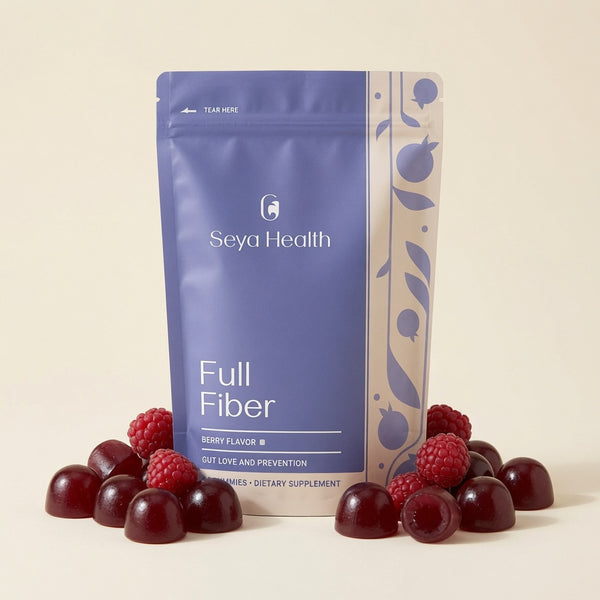
Seya Full Fiber
Most women fall short on fiber. Seya Full Fiber gives you 6 grams from three fibers in three small vegan gummies. Plant based, no gelatin, no sugar alcohols.
Shop Full FiberKeep reading

bone health
Best supplements for women over 40: what the evidence supports for heart, bones and muscles (and what's hype)

creatine
How long does creatine take to work? A realistic timeline for women

constipation