
Home/ The Journal/ gut health
gut health
Why Do Women Get UTIs? It's Biology, Not a Personal Failing
If you’ve ever felt that familiar, frantic sting, you know that a Urinary Tract Infection (UTI) is more than just a "minor inconvenience." It’s a painful disruptor that affects over 50% of women at least once in their lives. Yet, for a condition so common, there is a heavy cloud of social stigma that suggests UTIs are a result of "poor hygiene" or "lifestyle choices."

Short version: Why do women get UTIs? Anatomy, not hygiene. Women get them up to 30 times more often than men. A shorter urethra sits close to the anus, so gut bacteria have a shorter trip to the bladder. More than half of women will have at least one UTI. As many as 4 in 10 will get another within six months.
- Women get UTIs up to 30 times more often than men, per the Office on Women's Health.
- In a study of 374,171 women, 14.5% went on to have recurrent UTIs.
- In a 12-month randomized trial, women who drank 1.5 L more water a day averaged 1.7 infections versus 3.2 in the control group.
- You can be spotlessly clean and still get one. Hygiene is not the driver here.
Last updated July 2026.
The sting shows up on a Tuesday. Then the urgency. Then the running mental list of everything you must have done wrong.
Stop there. That list is the wrong list.
Why do women get UTIs so often? Anatomy. The Office on Women's Health reports that women get them up to 30 times more often than men do. That is the shape of the plumbing, not the state of your bathroom habits.
It is a structural problem. Not a character flaw, and not a cleanliness score.
Why do women get UTIs more often than men?
Because the distance is shorter. A woman's urethra is shorter than a man's, and it sits close to the anus, where E. coli lives. Gut bacteria have a short trip and an easy target.
The NIDDK puts it in plain terms:
"Females have a short urethra located close to the anus, a source of bacteria." — National Institute of Diabetes and Digestive and Kidney Diseases
That single fact drives most of the gap.
The NIDDK also reports that about half of all women will develop a bladder infection in their lifetime. About a quarter of those women will have repeat infections. The Office on Women's Health puts the lifetime figure a little higher, at more than half of women.
Nothing in that paragraph is about how clean you are.
Why do UTIs keep coming back?
Two reasons. One is how often it happens at all. The other is where the bacteria hide.
Start with frequency. As many as 4 in 10 women who get a UTI will get at least one more within six months, per the Office on Women's Health.
A 2024 study tracked 374,171 women after an index infection at Kaiser Permanente Southern California. Of those, 54,318 women, or 14.5%, met the definition of recurrent UTI within a year. Risk rose with diabetes, with more health conditions, and with 3 or more antibiotic courses in the prior year. The analysis is in the Journal of Infectious Diseases risk-factor study on recurrent UTIs.
Then there is hiding. Bacteria can tuck themselves inside the cells lining your bladder and form biofilm-like clusters. Those clusters are shielded from your immune system. Antibiotics struggle to reach them.
Researchers found them in real patients, not just lab models. One study looked at 80 women with acute cystitis and 20 controls. Intracellular bacterial communities showed up in 14 of the 80 urine samples, or 17.5%. Filaments showed up in 33 of 80, or 41%. Neither appeared in a single control. See the PLOS Medicine study on intracellular bacterial communities in human UTI.
So the infection that "came back" two weeks after antibiotics may never have fully left. That is biology doing something clever, not you doing something careless.

Are UTIs caused by poor hygiene?
No. This is the myth that does the most damage, and it needs to go.
You can be scrupulously clean and still get a UTI. The drivers are anatomy, hormone shifts, genetics, and how easily bacteria stick to your bladder wall.
The Office on Women's Health does advise wiping front to back. Worth doing. It still sits alongside anatomy rather than outranking it.
Here is the part worth hearing. The shame attached to UTIs delays care. A UTI left alone can move up to your kidneys. Being embarrassed about a short urethra is a bad reason to wait a week before you call a doctor.
It is a signal that bacteria got somewhere they should not be. Nothing more moral than that.
Does menopause make UTIs more likely?
Yes, and the mechanism is estrogen. As the Office on Women's Health explains:
"After menopause, loss of the hormone estrogen causes vaginal tissue to become thin and dry." — Office on Women's Health
Thinner tissue and a shifting vaginal microbiome make it easier for bacteria to take hold.
So here is a health problem that changes shape at midlife while the standard advice stays put. If your UTI pattern shifted in your 40s or 50s, the timing is not random. Read more on the early signs of menopause.
Talk to a clinician about it. Hormonal options exist, and they are a medical decision, not a supplement decision.
What actually helps lower the odds?
Fewer things than the internet claims, and the best-supported one is free.
| Habit | What it does | What the evidence says |
|---|---|---|
| Drink more water | Flushes bacteria out before they settle | Strongest evidence: 1.7 versus 3.2 infections a year in a randomized trial |
| Do not hold your urine | Less time for bacteria to multiply | Office on Women's Health advises going every 3 to 4 hours |
| Wipe front to back | Keeps gut bacteria away from the urethra | Standard public-health guidance |
| Ask for a urine culture | Identifies the exact bacteria | Guides the right antibiotic instead of a guess |
That water row deserves the detail. In a 12-month randomized clinical trial, 140 premenopausal women with recurrent cystitis were split into two groups. One drank an extra 1.5 L of water a day. The other changed nothing.
The water group averaged 1.7 infections over the year. The control group averaged 3.2. Across the trial that was 111 episodes against 216.
The gap between infections stretched from 84.4 days to 142.8. Antibiotic courses dropped from 3.6 to 1.9 per woman. Details are in the JAMA Internal Medicine trial on increased water intake and recurrent UTIs.
One habit. Roughly half the infections. No product required.
Where does gut health fit in?
At the edges, and honesty matters here more than a sales line.
The bacteria behind most UTIs come from your gut. There is also a documented link between constipation and repeat infections.
In a 2024 study in Nutrients, 43.6% of women with recurrent lower urinary tract infections reported frequent constipation. Among women without recurrence it was 25.8%. The difference was statistically significant. Read it in the Nutrients analysis of recurrent UTIs and bowel symptoms.
An association is not proof that fixing one fixes the other. Nobody has run the trial that shows adding fiber lowers UTI rates, so we are not going to imply one exists.
What fiber does have evidence for is regularity. That is the claim, and it stops there.
Seya's job here is to stay specific, not loud. The evidence that fiber supports regularity earns a grade of C at about 5 grams. That is roughly half the dose used in the bigger trials, so that is exactly what we claim. 3 vegan gummies with resistant tapioca fiber, ingredients you can actually name, are an honest daily fiber habit. They are not a UTI product. They do not replace antibiotics, a doctor, or a urine culture.
These statements have not been evaluated by the Food and Drug Administration. This product is not intended to diagnose, treat, cure, or prevent any disease.
When should you call a doctor?
Early, and without apology. A suspected UTI is worth a same-week call, not a wait-and-see.
Get seen urgently for back or side pain, fever, chills, nausea, or blood in your urine. Those can signal the infection has reached your kidneys.
Had 2 or more infections in six months? Ask about recurrence directly. That means a urine culture to name the bacteria, and a real conversation about what is driving the pattern.
If a provider hands you hygiene advice and nothing else, you are allowed to push. The anatomy is doing the work here.
Related reading: why most women fall short on fiber, our daily fiber gummy for women, and more from the Seya journal.
Frequently asked questions
Why do women get UTIs more than men?
Anatomy. A woman's urethra is shorter than a man's and sits close to the anus, so gut bacteria such as E. coli have a much shorter distance to travel to the bladder. The Office on Women's Health reports that women get UTIs up to 30 times more often than men do, and the NIDDK notes that about half of all women will develop a bladder infection in their lifetime. Hygiene is not the driver.
Why do I keep getting UTIs even though I am clean?
Because cleanliness is not what determines risk. Bacteria can form biofilm-like clusters inside bladder cells, where they are shielded from your immune system and hard for antibiotics to reach, so an infection can return without ever fully clearing. Researchers found these intracellular bacterial communities in 14 of 80 urine samples from women with acute cystitis and in none of 20 controls. Hormone shifts, genetics, and recent antibiotic use also raise the odds.
Does drinking more water help with recurrent UTIs?
It has the strongest trial evidence of any everyday habit. In a 12-month randomized clinical trial of 140 premenopausal women with recurrent cystitis, the group that drank an extra 1.5 L of water a day averaged 1.7 infections versus 3.2 in the control group, and used about half as many antibiotic courses. It is not a guarantee, and it does not replace medical care for an active infection.
Related reading
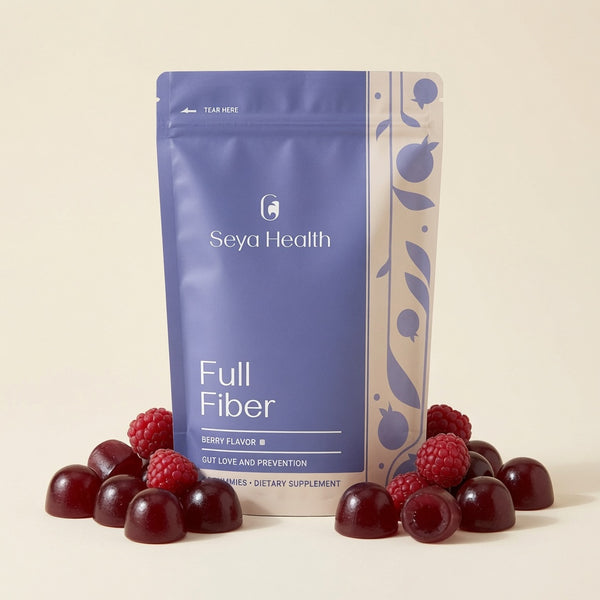
Seya Full Fiber
Your gut bacteria run on fiber. Seya Full Fiber delivers 6 grams from three fibers in one to feed the beneficial bacteria in your gut and support short-chain fatty acid production. Plant based, no gelatin, no sugar alcohols.
Shop Full FiberKeep reading

fiber
Can a Multivitamin Replace Vegetables? What Supplements Can't Do for Your Gut

constipation
The Best Way to Beat Constipation in Your 30s (and Where Fiber Gummies Fit)
fiber
The Gut-Skin Axis: Does Your Gut Health Affect Your Skin?
The gut-skin axis, explained: how your gut bacteria and blood sugar affect your skin, w...