

Short version: Here is what fiber does in a woman's body, in four jobs. It bulks and softens your stool, slows how fast food leaves your stomach, feeds your gut bacteria, and keeps the whole system moving on schedule. Your body cannot make it and cannot digest it, which is exactly the point. Most women run short: about 15 g a day against a 25 g target.
- The adequate intake for adult women is 25 g a day, or 14 g per 1,000 calories. For men it is 38 g.
- US women average about 15 g a day. That leaves a 10 g gap, running every day for years.
- Your gut bacteria ferment fiber into short-chain fatty acids, producing 400 to 600 mmol a day that feed your gut lining.
- Seya makes one product: a fiber gummy. 3 vegan gummies carry about 5 g. It supports regularity, and that is the whole claim.
Last updated August 2026.
Here is what fiber does in a woman's body, in plain terms. It bulks and softens your stool. It slows how fast a meal leaves your stomach. It feeds the bacteria living in your gut. And it keeps the whole system moving on time.
Four jobs. One nutrient your body cannot build and does not break down.
And most women run short on it. The average US woman gets about 15 g of fiber a day. The target for women is 25 g, per the dietary fiber clinical review on NCBI Bookshelf. That 10 g gap is the quiet reason behind a lot of sluggish, bloated, off-schedule days.
What fiber does in a woman's body, in four jobs
Fiber is the part of a plant your body cannot digest. It has no enzyme for it. So instead of being absorbed in your small intestine like sugar or fat, it travels almost the whole way intact, doing physical work as it goes.
It adds bulk. Insoluble fiber holds water and adds mass to your stool. More mass presses on the colon wall, and that pressure is what signals your gut to move things along. Less fiber, less bulk, slower everything.
It slows things down. Soluble fiber absorbs water and forms a gel. That gel slows how fast your stomach empties and how fast sugar crosses into your blood, which is why a high-fiber meal keeps you steadier and fuller for longer. The full machinery of that is in how fiber actually works.
It feeds your gut. When fiber reaches your large intestine, your bacteria ferment it into short-chain fatty acids, at a rate of 400 to 600 mmol a day. Those acids feed the cells lining your colon and calm inflammation, per a systematic review of fiber and short-chain fatty acids in healthy adults.
It sweeps. The bulk and the fermentation together keep your gut on a rhythm. On schedule, comfortable, predictable.
Why is the target 25 grams a day for women?
Because that is the amount tied to a real drop in heart disease risk, scaled to how much women actually eat.
The number comes from a simple ratio: 14 g of fiber for every 1,000 calories. Run that against a typical woman's intake and it lands at about 25 g a day. For men, who eat more, the same ratio gives 38 g. See the intake figures in the USDA dietary fiber data brief.
So the target is not a round number someone invented. It is a dose, pinned to an outcome, and adjusted for a woman's body rather than borrowed from a man's. That distinction is the whole reason to take it seriously.

Why does the gap hit women harder?
Because the years women most need fiber are the years their gut slows down anyway.
Through perimenopause, shifting hormones slow how fast the gut moves, so bloat and constipation climb right when the fiber gap is already open. We cover that stretch in fiber and gut health after 40.
Here is the part worth hearing plainly. A sluggish, backed-up gut is not a willpower problem. It is not proof you eat wrong or try too little. It is a signal. Your body is running the whole four-job system on 15 g when it was built for 25. Close the gap and the signal usually quiets. That is a mechanism, not a character flaw.
Are high-fiber foods hard to digest?
No. And the confusion is worth clearing up, because it is the reason some women avoid the exact foods they need.
Fiber is not hard for your body to digest. Your body does not digest it at all, on purpose. That is the definition. It passes through so it can do its bulking and feeding work in the colon instead of being absorbed early.
What people feel as "hard to digest" is usually gas from ramping up too fast. When you add a lot of fiber overnight, your gut bacteria get a sudden feast and produce more gas while they adjust. The fix is not less fiber. It is a slower ramp and more water, so the gel has something to hold.
Where does a fiber supplement fit?
In one narrow, honest spot: closing part of that 10 g gap on the days your food does not.
Seya makes one product. A fiber gummy. 3 vegan gummies a day carry about 5 g of resistant tapioca fiber. We grade our own evidence a C, and we make one claim for it: it supports regularity. It is not a constipation remedy, and it will not change a number on a scale.
Food comes first, always, because food fiber arrives with your meals and in more forms. Build the base from beans, oats, fruit, and whole grains, and figure your daily target by age in how much fiber women actually need. A gummy is the patch for the gap, not the plan. Bulk, gel, and fermentation are the levers, and viscosity is what decides how strong the gel is, laid out in the functional fiber physics review in the Journal of the Academy of Nutrition and Dietetics.
This is education, not medical advice. Talk to your clinician before adding a supplement, especially if you take medication, since fiber can change how some medicines absorb.
These statements have not been evaluated by the Food and Drug Administration. This product is not intended to diagnose, treat, cure, or prevent any disease.
Frequently asked questions
What is the role of fiber in the body?
Fiber does four jobs. It adds bulk to your stool so the colon knows to move it, it forms a gel that slows how fast a meal leaves your stomach, it feeds your gut bacteria that ferment it into short-chain fatty acids, and together those keep your digestion on a steady rhythm. Your body cannot make fiber and does not digest it, so it works physically as it passes through, mostly in the large intestine, rather than being absorbed early like sugar or fat.
Do you really need fiber in your diet?
Yes. The adequate intake for adult women is 25 g a day, or 14 g per 1,000 calories, and most US women fall short at about 15 g. That 10 g gap shows up as sluggish digestion, bloating, and irregularity, and over years a low-fiber pattern tracks with higher heart disease and diabetes risk. Fiber is not optional seasoning on a diet. It is the input a whole four-job system in your gut runs on, and running it short is the default most women are stuck in.
What are the advantages of a high-fiber diet?
Steadier digestion first: more regular, more comfortable, less bloat, because the bulk and the gel keep things moving on schedule. Beyond the gut, soluble fiber slows sugar into your blood for a flatter post-meal curve, and the short-chain fatty acids your bacteria make feed your colon lining and calm inflammation. Longer term, higher-fiber eating is tied to lower heart disease and type 2 diabetes risk. The catch is dose: most benefits are studied near the 25 g target, well above the 15 g most women actually get.
Are high-fiber foods hard to digest?
No, and the wording trips people up. Fiber is not hard for your body to digest, your body does not digest it at all, by design, which is what lets it do its bulking and feeding work further down. What feels like trouble is usually gas from adding fiber too fast, when your gut bacteria get a sudden feast and produce more gas while they adjust. The answer is a slower ramp and more water, not less fiber.
Does liquid fiber actually exist, or is it a myth?
It exists, but it is not a separate nutrient. "Liquid fiber" just means soluble fiber stirred into water, and soluble fiber genuinely dissolves, so the drink can look clear with no grit. Insoluble fiber does not dissolve, so it stays gritty. Neither is magic, and neither beats food. A dissolved soluble fiber still does the same gel work in your stomach that it would from oats or beans. The label is marketing shorthand for a texture, not evidence of a stronger or different kind of fiber.
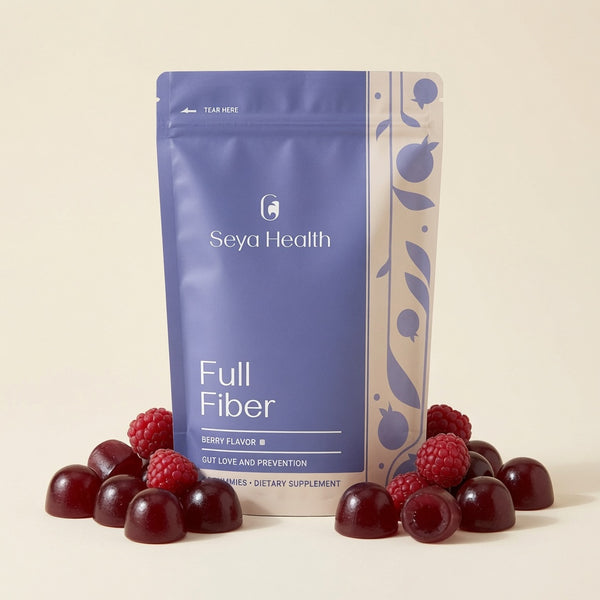
Seya Full Fiber
Getting enough fiber from food every day is hard. Seya Full Fiber is 6 grams from three fibers in one, in three small gummies, so you have a reliable daily floor. Plant based, no gelatin, no sugar alcohols, 60 gummies per pouch.
Shop Full FiberKeep reading

fiber
Can a Multivitamin Replace Vegetables? What Supplements Can't Do for Your Gut

constipation
The Best Way to Beat Constipation in Your 30s (and Where Fiber Gummies Fit)
fiber
The Gut-Skin Axis: Does Your Gut Health Affect Your Skin?
The gut-skin axis, explained: how your gut bacteria and blood sugar affect your skin, w...