
Home/ The Journal/ digestion
digestion
How Fiber Actually Works: Digestion, Satiety, and Why Your Body Needs It

Short version: How fiber works is strange once you look at it closely. You eat it. You never digest it. No enzyme in your body can cut the bonds, so fiber does its entire job by physics on the way through, and by feeding bacteria at the end.
- The FDA defines fiber as a carbohydrate with 3 or more monomeric units that your gut cannot break down.
- Across 185 prospective studies, the benefit peaked at 25 to 29 g of fiber a day.
- The cells lining your colon pull 60 to 70% of their energy from what bacteria make out of fiber.
- Hulled hemp seed is 4.0 g fiber per 100 g. A 30 g scoop gives you roughly 1.2 g.
Last updated August 2026.
You chew it. You swallow it. Then your body quits on it.
That is how fiber works, in one line. Humans make no enzyme that can cut the bonds holding fiber together, so it travels through you largely intact.
Everything fiber does, it does as a passenger.
Which sounds like a flaw. It is the whole point.
How fiber works, from the label down
Start with the legal definition, because it is unusually blunt. The US Food and Drug Administration does not describe fiber by what it gives you. It describes fiber by what your gut cannot do to it.
"Non-digestible soluble and insoluble carbohydrates (with 3 or more monomeric units), and lignin that are intrinsic and intact in plants; isolated or synthetic non-digestible carbohydrates (with 3 or more monomeric units) determined by FDA to have physiological effects that are beneficial to human health." — FDA, Questions and Answers on Dietary Fiber
Read the last clause again. A carbohydrate only counts as fiber if it does something useful on the way through.
The FDA names three of those effects. Lowering blood glucose. Lowering blood cholesterol. Raising how often you go.
Three jobs. Zero calories absorbed from the fiber itself.
What is soluble fiber, and how does it move through you?
Soluble fiber dissolves in water. Insoluble fiber does not. That is the entire distinction, and it is less useful than you have been told.
Here is what soluble fiber does in your stomach. It pulls in water and thickens whatever it is sitting in. Oatmeal left on the counter for ten minutes is that process, sped up and made visible.
Thicker contents leave your stomach more slowly. Nutrients then arrive in your small intestine over a longer stretch of time instead of all at once.
But dissolving is not the variable that matters. Thickness is.
Some soluble fibers form a real gel. Others dissolve and stay watery, and those do almost nothing to the numbers above.
How does soluble fiber change what your body absorbs?
By slowing traffic, not by blocking it.
A viscous gel makes it harder for digestive enzymes to find their targets and harder for freed sugars to reach the intestinal wall. Glucose still gets absorbed. It arrives in a longer, flatter wave.
The same gel grabs bile acids and carries some of them out. Your liver then pulls cholesterol from your blood to build replacements.
Johnson McRorie and Nicola McKeown sorted this out in a 2017 review of controlled trials, and their finding is specific. High-viscosity gel formers such as beta-glucan, psyllium, and raw guar gum moved cholesterol and blood sugar. Non-viscous soluble fibers like inulin and wheat dextrin did not, and neither did insoluble wheat bran. The full analysis sits in the Journal of the Academy of Nutrition and Dietetics (PMID 27863994).
So "high fiber" on a package tells you a quantity. It tells you nothing about which of these jobs the fiber inside can actually do.
| Fiber | Type | Forms a gel | Main job in you |
|---|---|---|---|
| Psyllium husk | Soluble | Yes | Holds water, softens stool, lowers cholesterol |
| Beta-glucan (oats, barley) | Soluble | Yes | Slows glucose, lowers cholesterol |
| Inulin, wheat dextrin | Soluble | No | Fermented by bacteria into short-chain fatty acids |
| Coarse wheat bran | Insoluble | No | Mechanically stimulates the gut wall |
How does fiber help with satiety and feeling full after a meal?
Three ways, stacked.
Volume comes first. Fiber takes up room and stretches your stomach wall, and stretch receptors report that upward.
Slower emptying comes second. Food that leaves your stomach gradually keeps the fullness signal running for hours instead of minutes.
Hormones come third. As nutrients reach further down your small intestine, L-cells there release GLP-1 and PYY, the two messengers that tell your brain the meal landed.
Now the honest part. The measured effect on how much you eat at the next meal is modest, and most trials used doses far larger than anything you would eat by accident. We laid out those effect sizes in fiber and satiety.
The mechanism is solid. The size of the payoff is smaller than the marketing suggests.
What happens when fiber reaches your colon?
It stops being your food and becomes theirs.
Trillions of bacteria in your large intestine carry enzymes you do not have. They ferment what arrives and release short-chain fatty acids as waste. Acetate, propionate, and butyrate, in roughly a 60:20:20 ratio.
Those acids are not a side note. Concentrations run 70 to 140 mM in the near end of your colon and 20 to 70 mM at the far end, and the cells lining that wall take 60 to 70% of their energy from them. Across your whole body, short-chain fatty acids supply about 10% of daily calorie needs. Those figures come from a review in the Journal of Lipid Research (PMC3735932).
So a low-fiber day is a quiet day for the cells that maintain your gut lining. What that shift looks like over decades is covered in fiber and gut health after 40.
What exactly makes stool softer?
Water. Held in place.
McRorie and McKeown are direct about how few routes there are:
"In the large bowel, there are only two mechanisms that drive a laxative effect: large/coarse insoluble fiber particles (eg, wheat bran) mechanically irritate the gut mucosa stimulating water and mucous secretion, and the high water-holding capacity of gel-forming soluble fiber (eg, psyllium) resists dehydration." — McRorie and McKeown, 2017
Both routes need the fiber to survive the trip. A fiber that gets fully fermented is gone before it can hold anything.
That is why coarse bran and finely milled bran behave differently, even though the label reads the same.
Do we actually need fiber in our diet?
Yes, and the reason is not the one you would expect.
Fiber has no Recommended Dietary Allowance. There is no fiber deficiency disease with a name, no blood test that flags you as short. The Institute of Medicine set an Adequate Intake instead, at 14 g per 1,000 calories.
What exists instead is a very large pile of outcome data. A 2019 series in The Lancet pooled 185 prospective studies and 58 clinical trials covering 4,635 adults and close to 135 million person-years. People eating the most fiber had 15 to 30% lower all-cause and cardiovascular mortality than people eating the least, and the curve flattened between 25 and 29 g a day. Read Reynolds and colleagues in The Lancet (PMID 30638909).
Your own number depends on your age and calories, and we work it out in how much fiber women need per day. Most women land nowhere near it, which we cover in the fiber gap.
Why does adding fiber make you gassy at first?
Because fermentation makes gas. That is the process working, not failing.
How much you can handle depends on which fiber. A 2022 review in Advances in Nutrition pulled together 103 clinical trials in adults without gut disease, at doses running from 0.75 to 160 g a day. Tolerable intake came out fiber by fiber, from 3.75 g a day for alginate up to 25 g a day for soy fiber. See Mysonhimer and Holscher (PMC9776669).
Which is why the standard advice is to climb slowly. The National Institute of Diabetes and Digestive and Kidney Diseases puts the adult range at 22 to 34 g a day and adds a warning worth repeating: "Be sure to add fiber to your diet a little at a time so your body gets used to the change."
If week one felt awful, that was your bacteria adapting to a new food supply. It is a signal, not proof that fiber is wrong for you. Foods worth climbing with are listed in high-fiber foods for women.
Where Seya fits, honestly
Seya makes one product at launch. A fiber gummy.
3 vegan gummies deliver about 5 g of resistant tapioca fiber. That is roughly half the dose that carried the larger constipation trials, so we grade our own evidence a C and make exactly one claim. It supports regularity.
Resistant tapioca fiber is a fermentable fiber. Its work happens in the colon, feeding bacteria, and we do not sell it as a laxative. It is a way to close part of a daily gap. Nothing more. What the ingredient is made of is explained in resistant tapioca starch.
Talk to a clinician before adding fiber if you are pregnant, on medication that slows digestion, or living with inflammatory bowel disease.
These statements have not been evaluated by the Food and Drug Administration. This product is not intended to diagnose, treat, cure, or prevent any disease.
Frequently asked questions
What exactly does fiber do to aid digestion?
Fiber does three mechanical jobs, none of which involve being digested. In your stomach it adds volume and, if it is a gel former, thickens the contents so they leave more slowly. In your small intestine that thickness slows how fast enzymes reach nutrients, which flattens the rise in blood glucose and carries some bile acids out with it.
In your colon it either holds water, which softens stool, or gets fermented by bacteria into short-chain fatty acids. The FDA lists the recognized effects as lowering blood glucose, lowering blood cholesterol, and increasing the frequency of bowel movements.
How does soluble fiber move through and interact with the body?
Soluble fiber dissolves in water and, in some cases, forms a gel. That gel raises the thickness of your stomach and intestinal contents, which slows gastric emptying and slows the mixing of enzymes with food. Viscosity is the property that matters, not solubility.
In a 2017 review in the Journal of the Academy of Nutrition and Dietetics, high-viscosity gel formers such as beta-glucan, psyllium, and raw guar gum improved cholesterol and glycemic outcomes, while non-viscous soluble fibers such as inulin and wheat dextrin did not. Fiber that survives to the colon either holds water or is fermented by bacteria into short-chain fatty acids.
How does fiber help with satiety and feeling full after a meal?
Through volume, timing, and hormones. Fiber occupies space and stretches the stomach wall, which sends fullness signals upward. Viscous fiber slows gastric emptying, so the signal lasts hours rather than minutes. As nutrients reach the lower small intestine, L-cells release GLP-1 and PYY, the hormones that register that a meal arrived.
The mechanism is well described. The measured effect on calories eaten at the next meal is modest, and most trials used isolated doses of 25 g or more in a single sitting. Fiber supports fullness. It does not override appetite.
Do we actually need fiber in our diet?
Yes, though fiber has no Recommended Dietary Allowance and no named deficiency disease. The Institute of Medicine set an Adequate Intake of 14 g per 1,000 calories instead. The case rests on outcome data.
A 2019 series in The Lancet pooled 185 prospective studies and 58 clinical trials covering 4,635 adults and roughly 135 million person-years, and found 15 to 30% lower all-cause and cardiovascular mortality among the highest fiber consumers compared with the lowest. Benefit peaked between 25 and 29 g a day. NIDDK puts the adult range at 22 to 34 g a day.
Does eating high-fiber foods like hemp really cause puffiness or bloating?
Gas and bloating are normal when you raise fermentable fiber quickly, because bacteria produce gas as they ferment it, and that usually settles as your gut bacteria adapt. Hemp is a poor example though. USDA FoodData Central lists hulled hemp seed at 4.0 g of fiber per 100 g, so a 30 g scoop supplies about 1.2 g, a small fraction of a daily target.
Tolerance also varies by fiber type. A 2022 review of 103 trials set tolerable intakes ranging from 3.75 g a day for alginate to 25 g a day for soy fiber. Add fiber gradually and drink more water alongside it.
Related reading
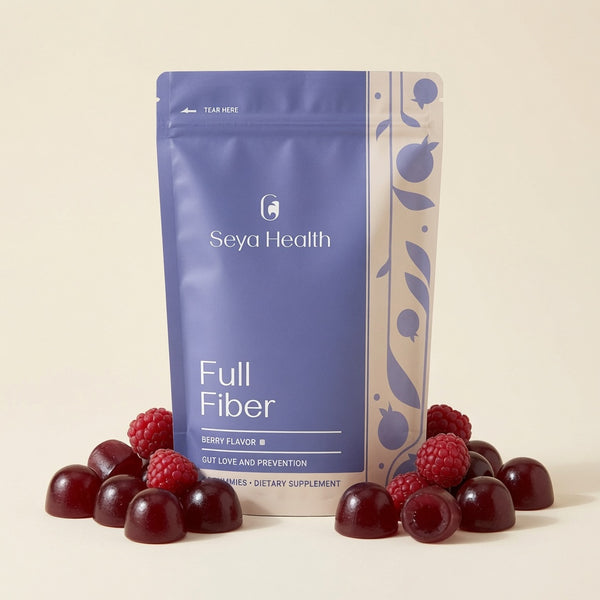
Seya Full Fiber
Getting enough fiber from food every day is hard. Seya Full Fiber is 6 grams from three fibers in one, in three small gummies, so you have a reliable daily floor. Plant based, no gelatin, no sugar alcohols, 60 gummies per pouch.
Shop Full FiberKeep reading

fiber
Can a Multivitamin Replace Vegetables? What Supplements Can't Do for Your Gut

constipation
The Best Way to Beat Constipation in Your 30s (and Where Fiber Gummies Fit)
fiber
The Gut-Skin Axis: Does Your Gut Health Affect Your Skin?
The gut-skin axis, explained: how your gut bacteria and blood sugar affect your skin, w...