
Home/ The Journal/ constipation
constipation
Fiber and Gut Health After 40: How It Eases Constipation and Feeds Your Microbiome

Short version: Gut health after 40 changes for reasons that have almost nothing to do with willpower. Fiber is the input your gut bacteria run on. Cut the input, and the whole system runs thinner.
- Butyrate covers at least 70% of the energy your colon cells use. Your bacteria make it by fermenting fiber.
- About 90% of American women eat less fiber than recommended. Average intake sits near 16 g a day against a 25 to 28 g target.
- Constipation runs 2 to 3 times higher in older women than in older men.
- In 16 trials with 1,251 adults, fiber added 1.19 bowel movements a week and 66% of the fiber group responded, against 41% on control.
- In 72 adults, 3.5 g a day of resistant starch for 4 weeks raised Bifidobacterium (p = 0.038) and cut hard, constipated stools (p = 0.0085).
- The menopause microbiome story is thinner than the headlines. One meta-analysis of 156 women found no significant diversity shift.
Last updated July 2026.
You eat about the way you did at 32. Your gut does not behave the way it did at 32.
Slower mornings. Days you skip entirely. A bloat that shows up on a Tuesday for no reason you can point to.
You have probably filed this under getting older, or under not trying hard enough. Here is the more useful frame. Gut health after 40 is largely a fuel story, and the fuel is fiber. Your colon cells get at least 70% of their energy from a molecule your bacteria build out of it.
What actually changes about gut health after 40?
Three things stack up. None of them is your character.
Your medication list gets longer. Roque and Bouras, writing in Clinical Interventions in Aging, list the usual suspects behind constipation in older adults: opiates, anticholinergics, calcium channel blockers, tricyclic antidepressants, antacids, diuretics, plus calcium and iron supplements.
You move less than you used to, on average. That same paper names "decreased mobility, altered dietary intake, dependency on others" as drivers.
And the odds were never even. Severe constipation runs "two to three times higher" in older women than in older men, per the same review.
Notice what is missing from that list. Effort.
Does the gut really slow down with age?
Less than most articles claim. The honest answer is that the research disagrees with itself.
"There has been some controversy on the effect of aging on colonic transit," Roque and Bouras write. Some studies found slower transit in older adults. Others found no significant difference against younger patients.
What does hold up is weaker push. The same review notes that "decreased propulsive forces of the colon have been described in the elderly."
So the pipe is not narrowing on a schedule. The squeeze gets softer, and the inputs get worse.
That second part is the one you can move.
What does butyrate do for your colon?
It feeds it. Butyrate is the main fuel your colon lining burns, and you do not make it yourself.
Your gut bacteria do. They ferment fiber that your small intestine could not digest, and butyrate is one of the short chain fatty acids that come out the other side.
How much does your colon depend on it? "Butyrate metabolism accounts for at least 70% of colonocyte energy requirements," write McNabney and Henagan in Nutrients. Colon cells prefer it over glucose.
Read that again. The cells lining your gut run mostly on a byproduct of bacteria eating fiber.
Less than 10% of those fatty acids ever show up in stool, per the same paper. Your body absorbs almost all of it.
So a low-fiber day is not only a slow-bathroom day. It is a day your colon lining eats less.
How big is the fiber gap for women?
Wide, and it has been wide for decades. Roughly 90% of American women eat less fiber than recommended, per a fiber summit report in the American Journal of Lifestyle Medicine.
Average intake sits around 16 g a day. The recommendation for adult women is closer to 25 to 28 g, depending on age and calories.
| What you likely eat | What is recommended | The daily shortfall |
|---|---|---|
| ~16 g | 25 g (women 31 to 50) | ~9 g |
| ~16 g | 22 g (women 51+) | ~6 g |
| ~16 g | 28 g (general adult target) | ~12 g |
A 9 g gap sounds small. It is roughly half your intake missing, every day, for years. We break the numbers down by age in how much fiber women actually need per day.
How much does fiber help constipation?
Measurably, and less dramatically than the internet promises.
The cleanest number comes from van der Schoot and colleagues in the American Journal of Clinical Nutrition. 16 randomized trials. 1,251 adults with chronic constipation.
Fiber worked for 66% of people, against 41% on control. Risk ratio 1.48 (95% CI 1.17 to 1.88, P = 0.001).
Stool frequency rose by 1.19 bowel movements a week (95% CI 0.59 to 1.78, P < 0.0001). Psyllium did more, at 3.08 a week.
Two conditions ran through the results. Doses above 10 g a day beat lower doses. And it took at least 4 weeks.
One honest side effect: fiber raised flatulence severity, and the fermentable types did it most.
Why are fiber-rich foods good for your gut bacteria?
Because fiber is the only thing on your plate they can eat in quantity, and the population shifts fast when you feed it.
Bush and colleagues ran a randomized, placebo-controlled trial in Nutrients. 72 healthy adults. 3.5 g or 7 g a day of resistant potato starch, or placebo, for 4 weeks.
At 3.5 g a day, Bifidobacterium rose more than placebo (p = 0.038). So did Akkermansia (p = 0.014).
Bowel habits moved too. That group logged zero loose Type 7 stools against 6 on placebo (p = 0.03), and significantly fewer hard Type 1 or 2 movements (p = 0.0085).
The 7 g arm trended the same way without reaching significance. More was not clearly better.
Resistant starch is the fiber family Seya uses. The mechanism is in what resistant tapioca starch actually is.
Does the gut microbiome change after menopause?
Probably, at the edges. The evidence is much weaker than the headlines suggest, and you deserve the real version.
Yang and colleagues pooled the studies in Disease Markers. Three case-control studies. 156 women total, 66 premenopausal and 90 postmenopausal.
Species diversity did not differ significantly (Shannon SMD 0.63, 95% CI −0.93 to 2.18, P = 0.43). Neither did anything at the phylum level.
Two genera did move. Odoribacter rose (P < 0.0001) and Bilophila rose (P = 0.03) after menopause.
That is a small, early signal from 156 women. Anyone selling you a menopause microbiome fix is ahead of the data.
The bathroom side of the transition is better documented. We cover it in why your gut slows down in perimenopause.
Why do two women eat the same fiber and get different results?
Because the bacteria doing the work are not the same in both guts.
Venkataraman and colleagues showed this plainly in Microbiome. 20 healthy adults took resistant starch for 3 weeks. Everyone got the same dose.
Fecal butyrate started near 8 mmol/kg for everyone. In 11 people it climbed 67%, to 15 mmol/kg. In 6 people it did not budge.
The reason sat in the census. Starch-degrading bacteria such as Ruminococcus bromii went from about 2% to 9% in responders. In the non-responders they stayed near 1.5%.
If fiber has done less for you than it did for your sister, that is a plausible reason. It is a starting population, not a personal failing.
What can Seya honestly promise here?
Regularity. That is the claim, and we stop there.
Seya's fiber gummies carry about 5 g of resistant tapioca fiber a day, in 3 vegan gummies. That is under the 10 g a day threshold the constipation trials favored, and it is one fiber, not a full diet.
The evidence grade at that dose is C. So the honest sentence is that it supports regularity. It does not treat a disease and it does not fix a microbiome.
Food does the heavy lifting. A gummy closes part of a 9 g gap on the days food does not. Our list of the best sources is in high-fiber foods for women, and the wider picture is in the fiber gap.
Ramp slowly, and drink water with it. Fiber raises gas before it settles.
Talk to your doctor before adding fiber if you are pregnant, have inflammatory bowel disease, have had bowel surgery, have swallowing difficulty, or take medication that affects digestion.
These statements have not been evaluated by the Food and Drug Administration. This product is not intended to diagnose, treat, cure, or prevent any disease.
Related reading: how fullness really works, fiber and blood sugar after 40, and our daily fiber gummy for women.
Frequently asked questions
Why do women need more fiber as they age?
The need does not rise so much as the odds get worse. Constipation runs two to three times higher in older women than in older men, per a review in Clinical Interventions in Aging. Medication lists grow, mobility drops, and the colon's propulsive force weakens with age.
Meanwhile intake stays low. About 90% of American women eat less fiber than recommended, and average intake sits near 16 g a day against a 25 to 28 g target. Fiber is also the substrate your gut bacteria ferment into butyrate, which supplies at least 70% of the energy your colon cells use. Recommended intake actually drops slightly after 50, to about 22 g a day, but most women are not close to either number.
How does fiber benefit your digestive system?
In two separate ways. Fiber that holds water adds bulk and softens stool, which is the mechanical side. Fiber that ferments feeds your gut bacteria, which is the metabolic side.
The fermentation product that matters most is butyrate. "Butyrate metabolism accounts for at least 70% of colonocyte energy requirements," per a 2017 review in Nutrients, and colon cells prefer it to glucose. Less than 10% of the short chain fatty acids produced ever appear in stool, meaning almost all of it is absorbed and used.
Why are fiber-rich foods good for your gut microbes?
Because fiber is the substrate they can actually ferment, and populations respond within weeks. In a randomized placebo-controlled trial of 72 adults published in Nutrients in 2023, 3.5 g a day of resistant potato starch for 4 weeks produced greater increases in Bifidobacterium (p = 0.038) and Akkermansia (p = 0.014) than placebo.
Bowel habits shifted alongside the bacteria. That group recorded zero loose Type 7 stools against 6 in the placebo group (p = 0.03), and significantly fewer hard Type 1 or 2 stools (p = 0.0085). A 7 g dose trended the same way without reaching significance.
How much fiber should you eat to relieve constipation?
The trial evidence points above 10 g a day of supplemental fiber, for at least 4 weeks. In a 2022 meta-analysis of 16 randomized trials with 1,251 adults, published in the American Journal of Clinical Nutrition, 66% of the fiber group responded against 41% of controls (risk ratio 1.48, 95% CI 1.17 to 1.88, P = 0.001).
Stool frequency rose by 1.19 bowel movements a week (P < 0.0001), and psyllium performed strongest at 3.08 a week. The same analysis found fiber increased flatulence severity, especially with fermentable types, so increase the dose gradually and drink water with it. Talk to your doctor first if you are pregnant, have inflammatory bowel disease, or have had bowel surgery.
Does the gut microbiome change after menopause?
The evidence is early and mostly not statistically significant. A 2022 meta-analysis in Disease Markers pooled three case-control studies covering 156 women, 66 premenopausal and 90 postmenopausal. Species diversity did not differ significantly (Shannon index SMD 0.63, 95% CI −0.93 to 2.18, P = 0.43), and no phylum-level difference reached significance.
Two genera did rise after menopause: Odoribacter (P < 0.0001) and Bilophila (P = 0.03). That is a narrow finding from a small pooled sample, so any product promising to correct a menopausal microbiome is claiming more than the data supports.
What happens if you don't eat enough fiber?
Two things, on different timelines. In the short term, stool gets harder and less frequent, because less water is held in the stool and there is less bulk to move.
In the longer term, your gut bacteria have less to ferment, so they make less butyrate. Since butyrate supplies at least 70% of colonocyte energy, a chronically low-fiber diet gives the cells lining your colon less fuel. Individual response varies: in a 20-person trial in Microbiome, identical resistant starch doses raised fecal butyrate 67% in 11 people and not at all in 6, tracking with how many starch-degrading bacteria each person started with.
Related reading
- The Gut-Skin Axis: Does Your Gut Health Affect Your Skin?
- Peptides for Gut Health: What's Hyped, What's Proven, and Where Fiber Fits
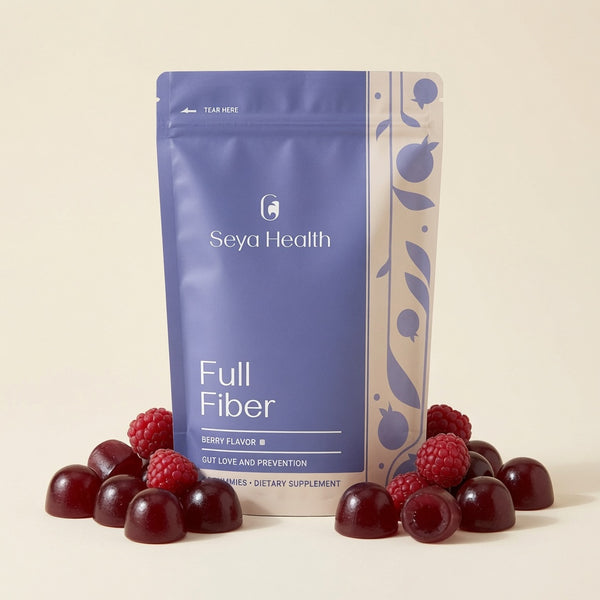
Seya Full Fiber
Getting enough fiber from food every day is hard. Seya Full Fiber is 6 grams from three fibers in one, in three small gummies, so you have a reliable daily floor. Plant based, no gelatin, no sugar alcohols, 60 gummies per pouch.
Shop Full FiberKeep reading

Fiber
Can You Take Fiber With Your Medications? A Safety Guide
Yes, but timing matters. How to take fiber safely with medications, which drugs to watc...

fiber
Antidepressants and Your Gut: Digestion, Weight, and What Actually Helps
How antidepressants affect digestion and weight, why SSRIs and older drugs differ, what...
fiber
What Supplements Should You Take on a GLP-1?
On a GLP-1 like Ozempic or Wegovy? What supplements actually matter (protein, key nutri...