Home/ The Journal/ fermented foods
fermented foods
How to improve gut health naturally: a women's guide

Short version: How to improve gut health naturally comes down to a few daily habits. Eat more fiber and more kinds of plants, add fermented foods, move most days, and cut back on ultra-processed food. In one large study, people who ate more than 30 kinds of plants a week had more varied gut bacteria than people who ate 10 or fewer.
- Fiber is the main food for your good gut bacteria. Most women eat far less than the 22 to 28 g a day that's recommended.
- Fermented foods like yogurt and kimchi raised gut bacteria variety in a 2021 Stanford trial.
- Probiotic pills did not change gut bacteria variety in healthy adults across 7 trials.
- Women are more prone to some gut issues, so the basics matter even more.
Last updated November 2026.
Gut health is everywhere right now. There are powders, shots, cleanses, and tests that cost hundreds of dollars.
Most of what helps is free, or close to it. It lives in your kitchen and your daily routine.
Here is what the research supports, ranked from strongest to weakest, and what to skip.
How does the digestive system work?
Your digestive system is a long tube with helpers along the way. Food goes from your mouth to your stomach, then to your small intestine, then to your large intestine.
The small intestine absorbs most of the nutrients from food, says the NIDDK, part of the National Institutes of Health. What's left moves on to the large intestine.
That's where most of your gut bacteria live. Per the NIDDK, they "help break down remaining nutrients and make vitamin K." The large intestine also pulls out water and turns waste into stool.
So when people say "gut health," they mostly mean two things. First, how well food moves through you. Second, how healthy that bacteria community is.
What is the gut microbiome, and why does it matter for women?
The gut microbiome is the trillions of bacteria and other microbes living in your gut. Some are helpful, some can cause trouble, and most of the time they keep each other in check.
Variety seems to matter. Healthy guts tend to hold many different kinds of bacteria, not just a lot of one kind.
For women, there are 3 extra reasons to care:
- Hormones. Gut bacteria make an enzyme that helps recycle estrogen back into your blood, per a 2017 review in Maturitas. Lower bacteria variety was linked to less of that recycling. Read more in our guide to estrogen and your gut.
- IBS. Women are about 1.67 times as likely as men to have irritable bowel syndrome. That's from a review of 56 studies with 188,229 people, per Lovell and Ford in the American Journal of Gastroenterology.
- Constipation. In that same review, women with IBS were more likely to have the constipation type.
How to improve gut health naturally: 6 habits, ranked by evidence
We ranked each habit by how strong the human research is, not by how popular it is online.
| Rank | Habit | What the research shows | Evidence |
|---|---|---|---|
| 1 | Eat more fiber | Feeds the bacteria that live in your large intestine | Strong |
| 2 | Eat 30+ kinds of plants a week | Linked to more varied gut bacteria in 10,000+ people | Moderate (observational) |
| 3 | Add fermented foods | Raised bacteria variety in a randomized trial | Moderate (one small trial) |
| 4 | Move most days | Changed gut bacteria in 6 weeks; faded when exercise stopped | Moderate (small trial) |
| 5 | Cut ultra-processed food | One food additive lowered bacteria variety in a feeding trial | Early |
| 6 | Use antibiotics only when needed | Bacteria often did not fully bounce back after a course | Moderate (small study) |
Notice what's missing: pills. The habits with the best evidence are about food and movement.
1. Eat more fiber (the biggest lever)
Fiber is the part of plant food your body can't digest. Your gut bacteria can, though. They ferment it in the large intestine, and that's how you feed the helpful ones.
How much do you need? The Dietary Guidelines for Americans set about 22 to 28 g a day for women, depending on age.
Few people get there. Only about 5% of Americans meet the fiber goal, per Quagliani and Felt-Gunderson. We dig into why in the fiber gap.
Good sources are beans, lentils, oats, berries, pears, chia seeds, and whole grains. Some fibers are called prebiotic, because they feed good bacteria on purpose. Our guide to prebiotic fiber explains the types.
Go slow. Add about 3 to 5 g a week and drink more water. Jumping up fast is the most common cause of gas and bloating.
2. Eat more kinds of plants, not just more plants
The American Gut Project studied stool samples from over 10,000 people. People who ate more than 30 kinds of plants a week had more varied gut bacteria than people who ate 10 or fewer, per McDonald and colleagues in mSystems.
Labels like "vegan" mattered less than the number of different plants people ate.
This is a link, not proof of cause. But it's an easy goal to aim for. Plants include more than fruit and vegetables:
- Beans, lentils, and chickpeas
- Whole grains like oats, barley, and brown rice
- Nuts and seeds
- Herbs and spices
A bag of mixed frozen vegetables can count as 4 or 5 kinds in one go. Swap your usual grain each week. Throw seeds on your yogurt.

3. Add fermented foods
Fermented foods are made with live microbes. Think yogurt, kefir, kimchi, sauerkraut, and kombucha.
In a 2021 Stanford trial, 36 healthy adults were split into two groups. One ate a high-fiber diet. The other ate a high-fermented-food diet.
The fermented-food diet "steadily increased microbiota diversity and decreased inflammatory markers," per Wastyk and colleagues in Cell. The high-fiber group did not gain variety during the study. Their bacteria did shift toward breaking down more fiber.
That's one small trial, so it's not the final word. But fermented foods are cheap and easy to try. Start with one serving a day and build up.
Pick plain yogurt or kefir with "live and active cultures" on the label. Shelf-stable pickles in vinegar usually aren't fermented.
4. Move your body most days
Exercise changes your gut, too. In one trial, 32 inactive adults did supervised cardio 3 days a week for 6 weeks.
Their gut bacteria changed. Lean people made more short-chain fatty acids, compounds gut bacteria make from fiber. Then the changes "were largely reversed once exercise training ceased," per Allen and colleagues in Medicine and Science in Sports and Exercise.
The lesson is that it has to be a habit. A walk most days beats one hard week.
Movement also helps food move through you. If you tend to get backed up, a short walk after meals is a simple place to start.
5. Cut back on ultra-processed food
Ultra-processed foods tend to be low in fiber. Many also contain additives called emulsifiers, which keep sauces and ice cream smooth.
In a small feeding trial, healthy adults ate the same diet for 11 days. 7 of them also got an emulsifier called carboxymethylcellulose. That group had less varied gut bacteria and more belly discomfort after meals, per Chassaing and colleagues in Gastroenterology.
That's early evidence on one additive. You don't need to fear every label. A simple rule works: cook from whole foods more often, and keep packaged snacks as extras.
6. Use antibiotics only when you need them
Antibiotics save lives. But they also hit your good bacteria.
In a Stanford study, 3 adults took 2 courses of the antibiotic ciprofloxacin over 10 months. Bacteria variety dropped within 3 to 4 days. After each course the bacteria began to come back, but "the return was often incomplete," per Dethlefsen and Relman in PNAS.
So don't push for antibiotics for a cold or the flu, which are caused by viruses. If you do need them, take the full course as prescribed. Then lean on fiber and fermented foods afterward.
What about stress and sleep?
Your gut and brain talk to each other all day. Stress can speed up or slow down digestion, and many women feel it as bloating, cramps, or a rushed bathroom trip.
The research here is mostly about symptoms, not bacteria. Still, simple habits help: slow breathing before meals, regular meal times, and a steady sleep schedule. Our guide on stress and digestion walks through each one.
Do you need a probiotic supplement?
Probably not, if you're healthy. A review of 7 randomized, placebo-controlled trials in healthy adults found no change in gut bacteria variety from probiotic pills, per Kristensen and colleagues in Genome Medicine.
Some strains can help with specific problems. That's a talk to have with your doctor. For daily gut support, food comes first. We compare both in fiber vs. probiotics.
A simple 7-day gut health starter plan
- Day 1: Add a fruit or vegetable to breakfast.
- Day 2: Swap white bread or rice for a whole grain.
- Day 3: Add beans or lentils to one meal.
- Day 4: Try one fermented food, like plain yogurt or kimchi.
- Day 5: Take a 10-minute walk after dinner.
- Day 6: Start a running count of the kinds of plants you eat this week.
- Day 7: Check your water. Fiber needs fluid to work well.
Keep what feels good. Add one new habit each week after that.
When gut symptoms need a doctor
Habits help everyday gut health. They aren't a fix for a medical problem. See a doctor if you have blood in your stool, weight loss you can't explain, ongoing pain, trouble swallowing, or a big change in your bowel habits that lasts.
Our guide to when bloating isn't normal lists the red flags.
Where Seya fits
Food is the foundation. A fiber supplement can help close the gap on busy days. Seya is a daily fiber gummy: 3 vegan gummies give you 6 g of fiber from resistant tapioca fiber, prebiotic soluble fiber, and cellulose, plus 80 mg of magnesium and 100 mg of ginger root, per our product page.
That's about a quarter of a woman's daily fiber goal. Prebiotic fiber helps nourish beneficial gut bacteria as part of a fiber-rich diet.* It works best alongside the habits above, not instead of them.
Frequently asked questions
How does the digestive system work?
Food moves from your mouth to your stomach, then your small intestine, then your large intestine. The small intestine absorbs most nutrients. In the large intestine, bacteria break down what's left, and water is pulled out to form stool.
What is the gut microbiome, and why does it matter for women?
It's the trillions of microbes living in your gut. Gut bacteria help recycle estrogen, and women are about 1.67 times as likely as men to have IBS, so a healthy gut matters for women in specific ways.
How can I fix bad gut health naturally?
Start with fiber, aiming for 22 to 28 g a day. Eat more kinds of plants, add a fermented food, move most days, and cut back on ultra-processed food. See a doctor for red-flag symptoms like blood in your stool.
How long does it take to improve gut health?
In studies, exercise changed gut bacteria within 6 weeks, and a fermented-food diet raised bacteria variety over a 17-week study. Give new habits at least a few weeks.
What are the worst foods for gut health?
The research points to diets low in fiber and high in ultra-processed foods. One emulsifier common in packaged foods lowered gut bacteria variety in a small human trial.
Are probiotics good for gut health?
For healthy adults, probiotic pills did not change gut bacteria variety across 7 placebo-controlled trials. Fiber and fermented foods have better support for everyday gut health.
*These statements have not been evaluated by the Food and Drug Administration. This product is not intended to diagnose, treat, cure, or prevent any disease. This article is educational and is not medical advice. Talk to your clinician about your own health and medications.
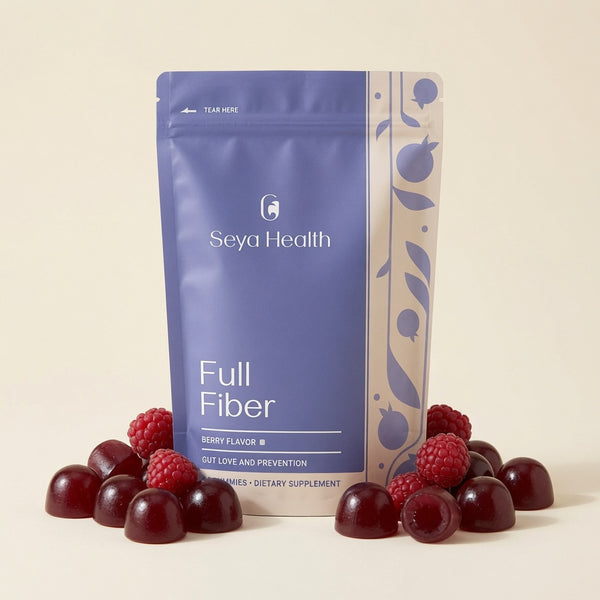
Seya Full Fiber
대부분의 여성은 식이섬유 섭취가 부족합니다. Seya Full Fiber는 세 가지 식이섬유 6그램을 작은 비건 구미 세 개에 담았습니다. 식물성, 젤라틴 무첨가, 당알코올 무첨가.
Full Fiber 쇼핑하기