
Home/ The Journal/ fiber
fiber
Estrogen Dominance and the Gut: How Your Estrobolome and Fiber Shape Estrogen After 40
Estrogen dominance is a pattern many women notice after 40. Here is the gut connection, the estrobolome, and why fiber is one of the simplest levers for helping your body clear extra estrogen.

Estrogen dominance means you have too much estrogen compared with progesterone. It is not an official medical diagnosis, but the pattern is real for a lot of women in their 40s. A big part of the story happens in your gut. A group of gut bacteria called the estrobolome helps decide how much estrogen your body clears out versus sends back into your blood. Fiber helps your body move the extra estrogen out, and most women fall short on fiber. That makes it one of the simplest things you can change.
What estrogen dominance actually means
Estrogen and progesterone are meant to work as a pair. Estrogen builds things up across your cycle, and progesterone balances it out. Estrogen dominance is when that balance tips toward estrogen. That can happen because estrogen is high, because progesterone is low, or both.1
Here is the honest part, and it matters for trust: estrogen dominance is not an official medical diagnosis. Some doctors use the term to describe a pattern of symptoms, and some do not use it at all.1 That does not make the experience any less real. It just means you should treat it as a helpful way to talk about how you feel, not a lab result you can point to.
It often shows up after 40 for a simple reason. In perimenopause, the years leading up to menopause, progesterone tends to fall first, while estrogen swings up and down before it finally drops. So the ratio between the two can tip toward estrogen for a stretch, even while your overall hormones are winding down. If you want the timeline, see our guide to how long perimenopause lasts.
Signs women notice
The symptoms people link to estrogen dominance tend to overlap with everyday perimenopause complaints. Commonly reported ones include:1
- Heavier or less predictable periods
- Weight that settles around your middle
- Mood swings and rougher PMS
- Sore or tender breasts
- A bloated, puffy feeling
- Brain fog and low energy
One caution. Many different things cause these same feelings, from thyroid issues to stress to poor sleep. This list is a starting point for a conversation, not a way to diagnose yourself at home.
What tips the balance
Several things can push estrogen up relative to progesterone:1
- Perimenopause. Progesterone usually drops first, so the ratio tips.
- Body fat. Fat tissue makes its own estrogen, so carrying more of it adds to your total.
- Stress. High, ongoing stress can lower progesterone, which widens the gap.
- Alcohol. It slows how fast your liver breaks estrogen down.
- Your liver. The liver is where estrogen gets packaged up for removal.
- Your gut. This is the piece most articles skip, and it is a big one.
Blood sugar plays a quiet role here too. When your cells stop responding well to insulin, your body tends to make more estrogen, which is one more reason steady blood sugar matters in midlife. We cover that in fiber and blood sugar for women over 40.
The part most articles skip: your gut and the estrobolome
Once your liver is done with a batch of estrogen, it packages it up and sends it into your gut to leave the body in your stool. That should be the end of the trip. But it is not always.
Certain gut bacteria make an enzyme called beta-glucuronidase. Think of it as a switch that can un-package that used estrogen and turn it back on. When that happens, the estrogen gets pulled back into your blood instead of leaving.2 Scientists call this loop enterohepatic recycling, which is just a long way of saying your body recycles estrogen between the liver and the gut.
The collection of gut bacteria that run this process has a name: the estrobolome.2 When your gut is in good shape, the estrobolome helps keep estrogen at a steady level. When your gut is out of balance, which is more common after menopause as gut diversity naturally drops, this recycling can run high, and more estrogen stays in circulation.2
Your gut is not a bystander in hormone balance. It is one of the control knobs for how much estrogen you clear versus keep.
Where fiber comes in
This is where a boring nutrient turns out to be one of the most useful levers you have. Fiber helps your body move estrogen out in two ways.
It binds estrogen in your gut. Fiber grabs onto the used estrogen your liver sent down and carries more of it out in your stool, so less gets recycled back.
It feeds the right bacteria and keeps things moving. The kind of fiber that ferments in your colon feeds the beneficial bacteria that keep that recycling enzyme in a healthier range. It also helps move waste through, so estrogen spends less time sitting around waiting to be reabsorbed.
There is a third payoff worth knowing about. When the fermentable fibers reach your colon, your good bacteria turn them into short-chain fatty acids, including one called butyrate. Butyrate is the main fuel for the cells that line your gut, so it helps keep the gut wall and the whole microbe community in better shape. A healthier gut community is exactly what keeps the estrogen recycling loop running the way it should, which is why "feed your gut" and "help your body handle estrogen" end up being the same instruction.
The research backs this up. In a controlled study, premenopausal women who added wheat bran fiber for two months had lower blood levels of estrone and estradiol, two forms of estrogen, while oat and corn bran did not do the same.3 In a separate study of 252 women, higher fiber intake tracked with lower estrogen, and when researchers accounted for fat in the diet, fiber was the factor that still mattered.4
Two honest notes so you can trust the takeaway. First, the research shows fiber helping the body clear extra estrogen, not nudging it up and down to a perfect setpoint. That is exactly why the fiber angle fits estrogen dominance, where the problem is too much estrogen to begin with. Second, much of the direct trial evidence is in younger women, but the gut mechanism, the estrobolome, is the same one at work in midlife. Fiber is support for a healthy process, not a treatment for a condition.
Why most women don't get enough fiber
Here is the catch. This only helps if you are actually eating fiber, and most of us are not. Around 95% of Americans fall short of the daily fiber target, and the average adult eats only about 17 grams a day, roughly half of what is recommended.56 For women the gap is just as wide, with more than 90% falling short.
So for most women over 40, the estrobolome is being asked to do its job without the main thing it runs on. Closing that gap is the practical move.
How to give your gut more fiber
Food first, always. The best sources are the ones you can build a plate around: beans and lentils, oats, berries, pears, avocado, chickpeas, leafy greens, and ground flax. Aim to add a little more than you did yesterday, and go slow so your gut can adjust.
It helps to picture what a real amount looks like. Six grams of fiber is about the same as half an avocado, or three quarters of a cup of chickpeas, or one medium pear. Useful, but more than most busy days deliver on their own.
That is the gap a daily fiber supplement is built to close. Seya Full Fiber gives you 6 grams of fiber from three fibers in one: a soluble tapioca fiber, a prebiotic fiber, and cellulose. The fermentable fibers feed the beneficial bacteria in your gut and support the gut bacteria involved in estrogen metabolism, which is the estrobolome we have been talking about. It is plant based with no gelatin, has no sugar alcohols, and comes as 60 gummies per pouch.
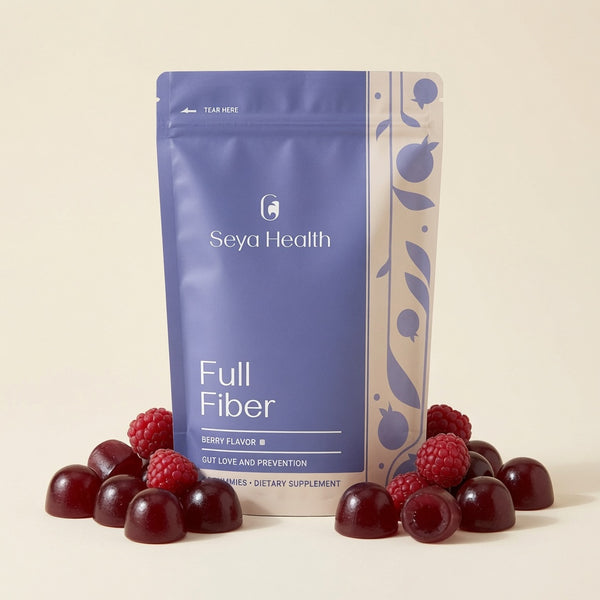
Seya Full Fiber
Three fibers in one, 6 grams per serving, to help feed your gut and close your own fiber gap. Plant based, no gelatin, no sugar alcohols.
Shop Full FiberFor your full daily target by age, see how much fiber women need per day. If your main worry is the weight settling around your middle, losing weight in perimenopause covers what actually helps, and if hot flashes are part of the picture, start with fiber and menopause.
When to see a doctor
Because estrogen dominance is not an official diagnosis, the smart move is to take symptoms that disrupt your life to a professional who can test properly and rule other things out. Very heavy or irregular bleeding, breast changes, and severe mood shifts all deserve real care, not a guess. Fiber and gut health are supportive daily habits that work alongside medical care. They are not a replacement for it.
Frequently asked questions
Can fiber really lower estrogen?
Research links higher fiber intake with lower levels of circulating estrogen, and the likely reason is that fiber helps your body clear used estrogen out instead of recycling it.34 It is support for a healthy process, not a cure for any condition.
What is the estrobolome?
It is the group of gut bacteria that help control how much estrogen your body recycles back into the blood versus clears out.2 A balanced gut helps that system run smoothly.
Does gut health really affect hormones?
Yes. Through the estrobolome and the estrogen recycling loop, the state of your gut influences how much estrogen stays in circulation.2
What foods help the body clear extra estrogen?
High-fiber foods are the core of it: beans and lentils, wheat bran and oats, ground flax, berries, and plenty of vegetables. Fiber is the common thread.
Is estrogen dominance a real diagnosis?
Not officially. It is a useful way to describe a pattern of symptoms, but it is not a formal medical diagnosis, so see a doctor if symptoms are affecting your life.1
Sources
- 1 Cleveland Clinic. High Estrogen: Causes, Symptoms, Dominance & Treatment.
- 2 Frontiers in Endocrinology (2025). Gut microbiota has the potential to improve the health of menopausal women by regulating estrogen.
- 3 Rose DP, Goldman M, Connolly JM, Strong LE. High-fiber diet reduces serum estrogen concentrations in premenopausal women. Am J Clin Nutr. 1991.
- 4 Monroe KR et al., USC Keck School of Medicine. High fiber intake reduces estrogen levels in Latina women (Multiethnic Cohort, 2004).
- 5 American Society for Nutrition. Most Americans are not getting enough fiber in our diets.
- 6 USDA Economic Research Service. Dietary fiber consumption data.
This article is general information, not medical advice. Estrogen dominance is not an official medical diagnosis. Seya Full Fiber is a dietary supplement and is not intended to diagnose, treat, cure, or prevent any disease. Talk to your healthcare provider about symptoms and before making changes, especially if you are pregnant, trying to conceive, or managing a health condition.
Keep reading

fiber
Can a Multivitamin Replace Vegetables? What Supplements Can't Do for Your Gut

constipation
The Best Way to Beat Constipation in Your 30s (and Where Fiber Gummies Fit)
fiber
The Gut-Skin Axis: Does Your Gut Health Affect Your Skin?
The gut-skin axis, explained: how your gut bacteria and blood sugar affect your skin, w...