
Home/ The Journal/ breathing
breathing
How to stop stress from wrecking your digestion: breathing, sleep, and daily habits

Short version: Stress and digestion share the same wiring, so the fix starts with calming your stress system. Slow breathing, steady sleep, regular movement, and calm meals all have studies behind them. In a 2011 trial, 75 women with IBS who learned mindfulness cut their symptom scores by 38% at 3 months.
- Breathe: 5 minutes a day of slow breathing with long exhales.
- Sleep: aim for 7 hours or more. Poor nights predicted worse belly pain the next day.
- Move and eat calmly: walk most days and eat regular meals, sitting down.
Last updated November 2026.
You have a deadline at noon. Your stomach knots by 10. By lunch you are bloated, or you are running to the bathroom.
You may already know why. Our guide to cortisol and your gut explains how stress hormones speed up the colon and turn up gut pain. This post is the other half. It is the how-to: what to do in the moment, at night, and day to day.
Each step comes with the study behind it. Many of these studies are small. We will say so when the proof is thin.
Can anxiety cause digestive symptoms?
Yes. Anxiety and the gut talk to each other all day.
The National Institute of Mental Health says that stress which does not go away can affect your digestive system, along with your sleep and immune system.
The link shows up clearly in people with IBS. A review of 73 studies found that 39.1% of people with IBS had anxiety symptoms. Their odds were about 3 times those of healthy people, per Zamani et al., Alimentary Pharmacology and Therapeutics, 2019 (PMID 31157418).
That does not mean your gut trouble is "all in your head." It means the head and the gut share one system. Calm one, and the other often follows.
What are common stress triggers?
A trigger is anything that sets off your stress response. For most women, the list is familiar.
- Work: deadlines, long days, a hard boss.
- Money: bills, debt, a job change.
- Care: kids, aging parents, a sick partner.
- Body: short sleep, skipped meals, pain, the days before your period.
- Big change: a move, a loss, a new baby.
The NIMH suggests learning what causes or triggers your stress, then testing which coping tools work for you. One easy way is a 2-week note on your phone. Write down the day, your stress level from 1 to 10, and your gut that day. Patterns tend to show up fast.
How do breathing exercises calm the gut?
Slow breathing, with a long breath out, is one of the quickest ways to dial down the stress response. Two trials point the way.
Cyclic sighing. In a remote, randomized study, people did 5 minutes of breathing practice a day for a month. One drill was cyclic sighing: breathe in through your nose, take a second short sip of air, then breathe out slowly through your mouth. It lifted mood more than 5 minutes of mindfulness meditation and slowed breathing rate, per Balban et al., Cell Reports Medicine, 2023 (PMID 36630953). That study measured mood, not the gut.
Belly breathing for reflux. Your diaphragm wraps around the valve at the top of your stomach. In a small trial, 19 people with reflux were split into 2 groups. After 4 weeks, the breathing group's time with acid in the throat fell from 9.1% to 4.7% of the day. The control group saw no change. At 9 months, those who kept practicing used less reflux medicine, per Eherer et al., American Journal of Gastroenterology, 2012 (PMID 22146488).
How to try it: sit or lie down. Put one hand on your belly. Breathe in through your nose so your belly rises, not your chest. Breathe out slowly, a bit longer than the breath in. Do it for 5 minutes.
How does sleep affect stress-related digestion?
Bad nights tend to come before bad gut days. Not the other way around.
In a study of 24 women with IBS, each kept a sleep and symptom diary for one menstrual cycle and wore a sleep tracker for a week. Poorer sleep quality predicted more belly pain, anxiety, and tiredness the next day. Gut symptoms did not predict worse sleep, per Buchanan et al., Journal of Clinical Sleep Medicine, 2014 (PMID 25142761). It was a small study, so treat it as a clue, not proof.
Sleep experts advise adults to get 7 or more hours a night on a regular basis, per the American Academy of Sleep Medicine and Sleep Research Society, 2015 (PMID 25979105).
Simple steps help most:
- Go to bed and get up at the same time, even on weekends.
- Leave a gap between a big dinner and bed, especially if you get reflux.
- Dim screens for the last 30 minutes. Do your 5 minutes of breathing in bed.
If evening stress keeps you wired, read why you can't wind down at night.

How can you manage stress to protect your gut?
Train your attention, move your body, and keep your meals calm. Each has trial data in people with gut trouble.
Mindfulness. In a trial of 75 women with IBS, one group took 8 weekly mindfulness classes. The other joined a support group. Symptom severity fell 26.4% in the mindfulness group vs 6.2% right after. At 3 months it was 38.2% vs 11.8%, per Gaylord et al., American Journal of Gastroenterology, 2011 (PMID 21691341). Free apps and local classes teach the same basic skills.
Yoga. In a trial of 59 people with IBS, 12 weeks of yoga twice a week eased gut symptoms. So did a low-FODMAP diet. Neither one clearly beat the other, per Schumann et al., Alimentary Pharmacology and Therapeutics, 2018 (PMID 29076171).
Movement. In a trial of 102 people with IBS, those coached to be more active cut their symptom score by 51 points. The control group dropped by 5, per Johannesson et al., American Journal of Gastroenterology, 2011 (PMID 21206488). About 3 in 4 people who finished were women. A brisk walk counts.
Calm meals. The NIMH lists healthy, regular meals as a stress tool. Sit down to eat. Chew well. Put your phone away for 10 minutes. Skipped meals often lead to one huge one, and a huge meal is harder on a tense gut.
How can you manage and prevent stress day to day?
Pick 2 habits, not 10. Run them for 2 weeks, then check your notes.
| Habit | How much | What the study found | How strong |
|---|---|---|---|
| Exhale-focused breathing | 5 minutes a day | Better mood than meditation over 1 month | One randomized trial, mood only |
| Belly breathing | Daily, 4 weeks or more | Acid time cut from 9.1% to 4.7% in reflux (19 people) | Small trial |
| Steady sleep | 7 hours or more | Poor sleep predicted next-day belly pain (24 women) | Small diary study |
| Mindfulness class | 8 weekly sessions | IBS scores down 38.2% vs 11.8% at 3 months (75 women) | One randomized trial |
| Yoga | Twice a week, 12 weeks | Gut symptoms eased, similar to low-FODMAP (59 people) | Small trial |
| More activity | Most days | IBS score down 51 points vs 5 (102 people) | One randomized trial |
A good starter pair: 5 minutes of breathing before bed, and a 20-minute walk after lunch. Both are free, and both are hard to overdo.
Food matters too. Most women eat far less fiber than advised, and a tense gut often gets worse when you cut whole food groups. Add fiber slowly. Our guide on fiber and IBS covers which types suit a touchy gut. If bloating is your main issue, see how to relieve bloating fast.
When should you see a doctor about stress and digestion?
Stress habits help a lot of women. They should not hide a real problem.
The NIDDK lists signs that may point to a health problem other than IBS. See a doctor if you have any of these:
- bleeding from your rectum, or bloody or black, tarry stools
- weight loss you can't explain
- anemia, or low iron on a blood test
Book a visit, too, if symptoms last for weeks despite these steps, or if celiac disease, colon cancer, or inflammatory bowel disease runs in your family. More warning signs are in when bloating isn't normal.
Where does a fiber gummy fit?
As one small part of your daily fiber. Not as a stress fix.
We make Seya Full Fiber, a vegan gummy with resistant tapioca fiber, about 6 g per 3 gummies, plus magnesium citrate and ginger root. It supports regularity as part of a food-first day. No gummy calms your stress system or stands in for the breathing, sleep, and movement steps above.
This is education, not medical advice. Talk to a clinician about new or lasting gut symptoms, and before starting any supplement, especially if you take medication.
These statements have not been evaluated by the Food and Drug Administration. This product is not intended to diagnose, treat, cure, or prevent any disease.
Frequently asked questions
Can anxiety cause digestive symptoms?
Yes. Ongoing stress and anxiety can affect your digestive system. In people with IBS, a review of 73 studies found 39.1% had anxiety symptoms, about 3 times the odds of healthy people.
What are common stress triggers?
Work pressure, money worries, caring for others, short sleep, skipped meals, and big life changes. A 2-week log of stress level and gut symptoms helps you spot your own.
How can you manage stress to protect your gut?
Combine a calming skill with movement and calm meals. In trials of people with IBS, mindfulness classes, yoga, and more physical activity all eased gut symptoms.
How do breathing exercises calm the gut?
Slow breathing with a long exhale dials down the stress response. Five minutes a day of cyclic sighing lifted mood in a 2023 trial, and belly breathing cut acid exposure in a small reflux trial.
How does sleep affect stress-related digestion?
Poor sleep tends to come before bad gut days. In 24 women with IBS, worse sleep quality predicted more belly pain the next day. Adults should aim for 7 or more hours.
How can you manage and prevent stress day to day?
Pick 2 habits, such as 5 minutes of breathing at bedtime and a daily walk. Keep them for 2 weeks and track how your gut responds before adding more.
Written and reviewed by the Seya Health Editorial Team. Every health claim on this page is sourced to primary research, as of November 2026. This article is educational and not a substitute for medical advice.
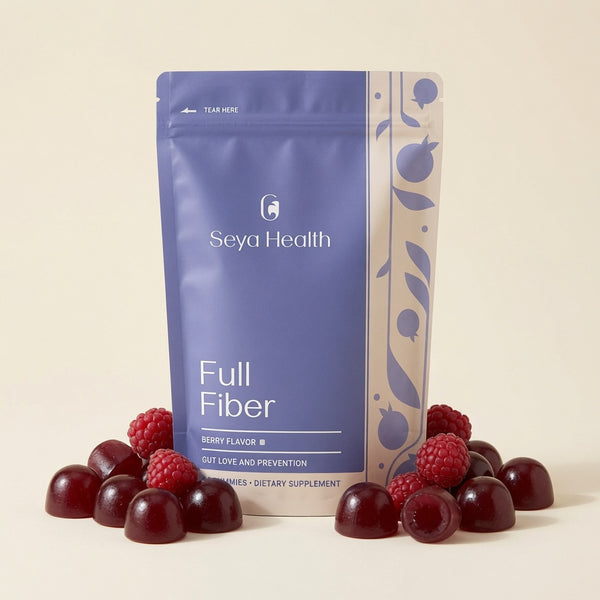
Seya Full Fiber
Most women fall short on fiber. Seya Full Fiber gives you 6 grams from three fibers in three small vegan gummies. Plant based, no gelatin, no sugar alcohols.
Shop Full FiberKeep reading

bone health
Best supplements for women over 40: what the evidence supports for heart, bones and muscles (and what's hype)

creatine
How long does creatine take to work? A realistic timeline for women

constipation