Home/ The Journal/ fiber
fiber
What Prebiotic Fiber Does for Your Gut (and How It Differs From Soluble Fiber)

Short version: Prebiotic fiber is fiber your gut bacteria can eat, and that feeding is linked to a health benefit. Soluble fiber just means fiber that mixes with water. The two overlap, but they are not the same thing. A review of 64 trials found that fiber, especially inulin-type fibers, raised levels of bifidobacteria, a helpful group of gut bacteria.
- Soluble and insoluble describe how a fiber acts in water. Prebiotic describes who uses it: your gut bacteria.
- Some soluble fibers are prebiotic, like inulin. Some are not, like psyllium, which mostly passes through as a gel.
- When gut bacteria ferment prebiotic fiber, they make short-chain fatty acids such as butyrate, a fuel for the cells lining your colon.
- Gas is the common side effect. In one trial, up to 10 g a day of native inulin was well tolerated by healthy adults.
Last updated October 2026.
Prebiotic fiber is food for the bacteria in your gut. You cannot digest it, but they can.
That sounds a lot like soluble fiber. It is easy to mix them up, and plenty of labels do. But they answer two different questions.
Soluble asks: what does this fiber do in water? Prebiotic asks: do your gut bacteria use it, and does that do you any good? This guide walks through both, with a simple table, so you can read a label and know what you are getting.
What is prebiotic fiber?
It is fiber that your gut bacteria pick out and eat, in a way that helps you.
That is close to the official wording. In 2017, a panel from the International Scientific Association for Probiotics and Prebiotics (Gibson et al., Nature Reviews Gastroenterology and Hepatology, 2017, PMID 28611480) defined a prebiotic as a substrate that is selectively used by host microorganisms to give a health benefit.
Two words in that line matter most.
- Selectively. It has to feed certain helpful microbes, not just any microbe.
- Benefit. The panel says a health benefit must be shown before something counts as a prebiotic. Being fermented is not enough.
So all prebiotics feed bacteria. But not every fiber that feeds bacteria has earned the prebiotic label.
Is prebiotic fiber the same as soluble fiber?
No. They overlap, but they sort fiber in different ways.
Soluble fiber dissolves or swells in water. Insoluble fiber does not. That split is about texture and chemistry. It says nothing about whether your gut bacteria will eat it.
Prebiotic is about fermentation. Your small intestine cannot break down most plant fibers. So they reach your colon, where bacteria get to work. As one review puts it, human digestive enzymes cannot digest most complex carbohydrates, so microbes break them down instead, per Holscher, Gut Microbes, 2017 (PMID 28165863).
Here is where it gets useful. A 2017 review sorted fiber supplements by how they behave, per McRorie and McKeown, Journal of the Academy of Nutrition and Dietetics, 2017 (PMID 27863994). It split soluble fiber into two very different kinds:
- Gel-forming soluble fiber, like psyllium and beta-glucan from oats. It turns thick in the gut. It is fermented slowly, so a lot of it stays intact and holds water in your stool.
- Non-gel soluble fiber, like inulin and fructooligosaccharides (FOS). It stays thin. Bacteria ferment it readily. This is the classic prebiotic type.
Same label, soluble. Very different jobs.
Prebiotic vs. soluble fiber: how common fibers compare
Use this table as a quick map. It shows how each fiber acts in water, how much your bacteria ferment it, and what it is mainly known for.
| Fiber | Soluble or insoluble | Fermented by gut bacteria? | Mainly known for |
|---|---|---|---|
| Inulin (chicory root) | Soluble, thin | Yes, readily | Feeding bifidobacteria |
| FOS and GOS | Soluble, thin | Yes, readily | Feeding bifidobacteria |
| Psyllium husk | Soluble, gel-forming | Slowly, partly | Softer, bulkier stool |
| Oat beta-glucan | Soluble, gel-forming | Yes, partly | Supporting healthy cholesterol |
| Resistant starch | Resists digestion | Yes | Feeding gut bacteria |
| Wheat bran | Insoluble | Poorly | Bulk and regularity |
Sources: McRorie and McKeown 2017; Holscher 2017. Fermentation varies from person to person, so treat the middle column as a general guide.

What does prebiotic fiber do for your gut?
Its main job is to feed the helpful bacteria you already have. The best evidence is for one group, bifidobacteria.
A 2018 meta-analysis pooled 64 randomized trials with 2,099 healthy adults. Compared with placebo or a low-fiber diet, adding fiber led to more bifidobacteria and more lactobacilli in stool. Fructans, the family that includes inulin and FOS, and galacto-oligosaccharides (GOS) had the clearest effect, per So et al., American Journal of Clinical Nutrition, 2018 (PMID 29757343).
The same review is honest about the limits. Fiber did not change overall gut diversity. Most other bacteria groups did not shift either.
So the fair takeaway is narrow. Prebiotic fiber reliably feeds certain helpful bacteria in healthy people. It is not a reset button for your whole gut.
What are short-chain fatty acids, and why do they matter?
They are what your gut bacteria make when they ferment fiber. Think of them as the payoff.
The three main ones are acetate, propionate, and butyrate, per Holscher 2017. They are short-chain fatty acids, or SCFAs.
Butyrate gets the most attention. It is an energy source for the cells that line your colon. SCFAs also act as signals that reach other parts of the body, per a review in Cell (Koh et al., 2016, PMID 27259147).
A word of caution. Much of that signaling work comes from lab and animal studies. In the 2018 human meta-analysis, fiber raised stool butyrate only slightly, and it did not change the other SCFAs. The science is real, but the human effects are still being mapped.
Does prebiotic fiber help with regularity?
It can help some people a little. But this is where the soluble vs. prebiotic split really matters.
Fibers that soften stool tend to resist fermentation. The McRorie review explains why. Gel-forming psyllium holds water all the way through the colon, so stool stays soft and bulky. Coarse wheat bran works by a different route. Both need to reach the end of the gut mostly intact.
Fibers that bacteria ferment quickly, like inulin, get used up along the way. The same review found no laxative effect for that group in the studies it covered. A 2025 meta-analysis of 20 trials did find modest gains in stool frequency from fibers like inulin, mostly in people who were constipated to begin with, though the certainty was low, per Chen et al., Nutrients, 2025 (PMID 41156499). Our guide to Jerusalem artichoke and inulin covers that research.
The practical lesson: if regularity is your goal, a mix of fiber types usually makes more sense than one prebiotic alone. We break down the gel and bulk side in soluble vs. insoluble fiber.
Does prebiotic fiber cause gas and bloating?
Often, yes, at least at first. Fermentation makes gas. That is part of how it works.
A small crossover trial gave 26 healthy adults 5 g or 10 g of two inulin fibers. Flatulence was the most common symptom, then bloating. Native inulin was well tolerated up to 10 g a day, and oligofructose up to 5 g a day. The 10 g dose of oligofructose caused clearly more symptoms, per Bonnema et al., Journal of the American Dietetic Association, 2010 (PMID 20497775).
Short chains ferment faster, so they tend to make gas sooner. That is why FOS can feel rougher than long-chain inulin at the same dose.
To make the switch easier:
- Start low. A few grams a day, not a full serving on day one.
- Hold for a week. Let your gut bacteria adjust before you add more.
- Spread it out. Split your fiber across meals.
- Drink water. Fiber works best with enough fluid.
If bloating comes with pain, weight loss, blood in stool, or a big change in habits, see a clinician. Our post on when bloating isn't normal lists the signs.
How much prebiotic fiber do you need?
There is no official daily target for prebiotic fiber on its own. The target is for total fiber.
Women need about 25 g of total fiber a day, and about 21 g after age 50, per the National Academies. Most people fall short. National surveys suggest only about 5% of Americans meet the fiber recommendation, per Quagliani and Felt-Gunderson, American Journal of Lifestyle Medicine, 2017 (PMID 30202317).
Food is the easiest place to start. Prebiotic-rich picks include onions, garlic, leeks, asparagus, slightly green bananas, oats, beans, and lentils. Our list of high-fiber foods for women has more.
Prebiotics also differ from probiotics. Probiotics are live microbes. Prebiotics are the food for them. If you are weighing the two, see fiber vs. probiotics.
Where does Seya fit, honestly?
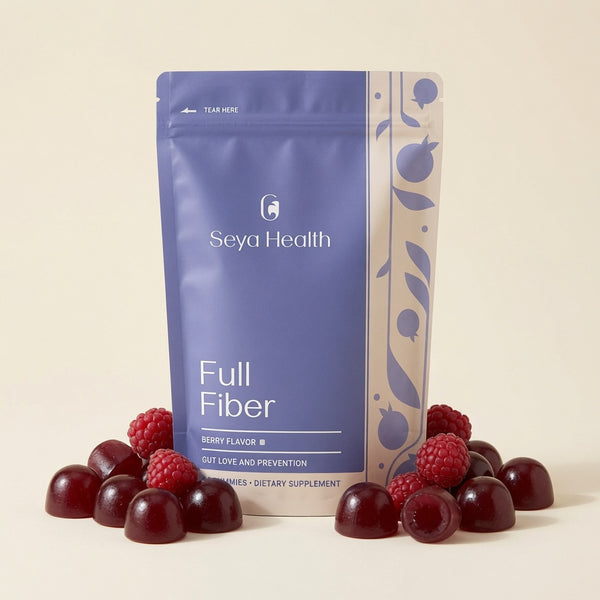
Seya makes a vegan fiber gummy. It uses resistant tapioca fiber, a fermentable fiber, with about 6 g of fiber in three gummies.
At that dose, the honest claim is simple. It supports regularity and helps you close part of your daily fiber gap. It is not a full day of fiber, and it is not a fix for any gut condition. You can read how the ingredient works in what resistant tapioca starch is, and what to look for on any label in what is actually in a fiber gummy.
If you want a steady daily fiber habit alongside food, a fiber gummy is one easy option. Start low and build up, like any fermentable fiber.
This is education, not medical advice.
These statements have not been evaluated by the Food and Drug Administration. This product is not intended to diagnose, treat, cure, or prevent any disease.
Frequently asked questions
What's the difference between probiotics and prebiotics?
Probiotics are live microbes, like the bacteria in some yogurts and supplements. Prebiotics are the food those microbes use. An expert panel defines a prebiotic as a substrate that is selectively used by host microorganisms to give a health benefit. In short, probiotics add bacteria, and prebiotics feed the helpful bacteria you already have.
Is prebiotic fiber the same as soluble fiber?
No. Soluble fiber is any fiber that dissolves or swells in water. Prebiotic fiber is fiber your gut bacteria selectively ferment with a health benefit. Some soluble fibers, like inulin, are prebiotic. Others, like gel-forming psyllium, are fermented slowly and work mostly by holding water in stool.
What is inulin?
Inulin is a soluble, non-gel fiber found in chicory root, onions, garlic, asparagus, and Jerusalem artichoke. Your body cannot digest it, so it reaches the colon, where bacteria ferment it. A meta-analysis of 64 trials found that fructans, the fiber family that includes inulin, raised bifidobacteria in healthy adults.
Which fibers count as prebiotics?
The best-studied are inulin, fructooligosaccharides (FOS), and galacto-oligosaccharides (GOS). In a 2018 meta-analysis, fructans and GOS led to the clearest rise in bifidobacteria and lactobacilli. Resistant starch is also fermented by gut bacteria. Fibers like psyllium and wheat bran are useful for regularity but are not classic prebiotics.
Does inulin cause gas or bloating?
It can, because bacteria make gas when they ferment it. In a trial of 26 healthy adults, flatulence was the most common symptom, followed by bloating. Native inulin was well tolerated up to 10 g a day, while 10 g of shorter-chain oligofructose caused more symptoms. Start with a few grams and build up slowly.
What role do short-chain fatty acids play in health?
Short-chain fatty acids, mainly acetate, propionate, and butyrate, are made when gut bacteria ferment fiber. Butyrate is a key energy source for the cells lining the colon, and SCFAs act as signals elsewhere in the body. Much of the signaling research is from lab and animal studies, so human effects are still being studied.
Seya Full Fiber
Most women fall short on fiber. Seya Full Fiber gives you 6 grams from three fibers in three small vegan gummies. Plant based, no gelatin, no sugar alcohols.
Shop Full Fiber