
Home/ The Journal/ comparisons
comparisons
Seya vs Metamucil Fiber Gummies: tapioca fiber vs Metamucil's formula, dose, and gut comfort

Short version: Metamucil Fiber Gummies are not psyllium. Three gummies give you 5 grams of fiber from inulin and Fibersol, a soluble corn fiber, sweetened with xylitol. Seya Full Fiber gives you 5.65 grams, mostly resistant tapioca fiber, with 3 grams of added sugar and no sugar alcohols. Neither gummy carries the trial record of Metamucil's psyllium powder.
- Metamucil Fiber Gummies: 5 g fiber per 3 gummies, 2 g total sugar, 0 g added, xylitol, ages 12 and up.
- Seya Full Fiber: 5.65 g fiber per 3 gummies, 3 g added sugar, no xylitol or sorbitol, vegan.
- Gut comfort: inulin made the most colon gas of any fiber tested in a 2022 MRI trial. Start any gummy low and build up.
Last updated October 2026.
Most people assume a Metamucil gummy is Metamucil in candy form. It is not.
The orange tub you grew up with is psyllium husk. The gummy is a different recipe. Per its label in the NIH Dietary Supplement Label Database, a 3-gummy serving holds 5 grams of fiber from inulin and Fibersol. There is no psyllium on the ingredient list.
That matters because psyllium is the fiber with the proof. So if you are weighing Seya against Metamucil gummies, you are really weighing two non-psyllium gummies against each other. Here is how they compare, line by line, and where each one falls short.
Seya vs Metamucil Fiber Gummies: what is the difference?
The fiber source and the sweetener. Both gummies land near 5 grams of fiber. They get there with different fibers and sweeten them in different ways.
| Label line | Metamucil Fiber Gummies (orange) | Seya Full Fiber |
|---|---|---|
| Serving | 3 gummies | 3 gummies |
| Fiber per serving | 5 g (18% DV) | 5.65 g |
| Main fibers | Inulin, Fibersol (soluble corn fiber) | Resistant tapioca fiber 4,500 mg, prebiotic soluble fiber 950 mg, cellulose 200 mg |
| Sugar | 2 g total, 0 g added | 3 g added |
| Sweetener | Xylitol (a sugar alcohol) | Sugar, no sugar alcohols |
| Gelatin? | No, uses pectin | No, vegan |
| Extras | None listed | 80 mg magnesium (citrate), 100 mg ginger root |
| Daily limit on label | Up to 3 servings, ages 12+ | Follow the pouch directions |
| Psyllium? | No | No |
Metamucil facts come from the NIH entry and the brand's Fiber Gummies page. Seya facts come from our product page. Metamucil also sells a Fiber Plus Vitamins gummy. It uses the same inulin and Fibersol base, plus vitamins C, D, and B12.
Labels change. Read the jar in your hand before you buy.
Does either gummy contain psyllium?
No. This is the most common mix-up we see.
Metamucil's powders and capsules are psyllium husk. The heart-health line on Metamucil's site, about 7 grams a day of soluble fiber from psyllium, refers to psyllium. It rests on an FDA health claim written for psyllium husk under 21 CFR 101.81. The gummy is not psyllium, so that claim does not carry over to it.
Why care? A 2022 meta-analysis in the American Journal of Clinical Nutrition pooled 16 trials of fiber for chronic constipation. Psyllium and pectin were the fibers with clear effects. Results were best above 10 grams a day, taken for at least 4 weeks. The 2023 AGA-ACG constipation guideline called the data on inulin "very limited and uncertain." We found no constipation trials of resistant tapioca fiber.
So be honest with yourself about the goal. If you want the strongest proof for regularity, a psyllium powder or capsule beats both gummies. Our look at what is better than Metamucil covers psyllium options in depth.
How much fiber is in Seya vs Metamucil gummies?
Close to a tie. Seya has 5.65 grams per 3 gummies. Metamucil has 5 grams per 3 gummies.
The Daily Value for fiber is 28 grams, set in 21 CFR 101.9. One serving of either covers about a fifth of that. Neither one gets you to 10 grams in a single serving, the level where trials saw the clearest benefit. Metamucil's label allows up to 3 servings a day, so 15 grams is possible on paper. Most people will not chew 9 gummies a day.
Think of either one as a top-up. Food still has to do most of the work. Our guide to how much fiber women need per day helps you find your gap.
Which is gentler on bloating: tapioca fiber, inulin, or psyllium?
For gas, inulin has the worst record of the three. Psyllium has the best. Tapioca fiber sits in between on what we know, with less data.
The clearest test came from a 2022 trial in the journal Gut. Researchers in Nottingham gave 19 adults with IBS drinks of inulin, psyllium, both, or a dummy sugar. Then they used MRI to measure gas in the colon over 6 hours. Inulin caused the biggest rise in colon gas. Breath hydrogen, a sign of fermentation, rose after inulin but not after psyllium. These were 20-gram doses, about 4 times a gummy serving, and the people had IBS. Still, the order is useful.
At gummy doses, inulin is usually fine. A 2010 trial of 26 healthy adults in the Journal of the American Dietetic Association found up to 10 grams a day of inulin was well tolerated. Gas was the first complaint, then bloating.
Resistant tapioca fiber also ferments in the colon. That is what makes it prebiotic. We have no head-to-head trial of tapioca fiber vs inulin for gas, so we will not claim one. Read more in our guide to resistant tapioca starch.

Does xylitol in Metamucil gummies cause gas?
It can, mostly at higher intakes. Xylitol is a sugar alcohol. Your gut does not fully absorb it, so some of it reaches the colon and ferments.
A 2016 review in the International Journal of Dentistry found xylitol is easier on the gut than sorbitol. Most adults handle moderate amounts. Loose stools and gas show up as the dose climbs, and they fade as the body adapts.
Metamucil does not print the xylitol grams on the gummy label. It is the fourth ingredient, after water. If sugar-free candy upsets your stomach, that is the line to watch.
Seya takes the other trade. It uses 3 grams of added sugar instead of a sugar alcohol. That is about an eighth of the roughly 25-gram daily cap, or 100 calories, the American Heart Association suggests for most women. If you count every gram of sugar, Metamucil wins this row.
Is Seya a good alternative to Metamucil gummies?
It can be, for a specific person. Here is how we would choose.
- Pick Metamucil Fiber Gummies if you want zero added sugar, you do fine with sugar-free candy, and you want a widely sold jar you can grab at most stores.
- Pick Seya Full Fiber if sugar alcohols bother you, you want a vegan gummy, or you want magnesium citrate and ginger root in the same chew.
- Pick a psyllium powder if regularity is the main goal and you can handle a drink. The evidence favors it over both gummies.
- Talk to your doctor first if you have IBS, take daily medicine, or are on a GLP-1. Fiber can change how some drugs absorb. Our guide to fiber and medications explains spacing.
We make Seya, so weigh our view with that in mind. We grade our own evidence a C. One serving is about half the daily dose that worked best in trials. Our claim is plain: fiber supports regularity. Seya also has a creatine gummy coming January 2027. It is not on sale yet.
Can you switch from Metamucil to fiber gummies?
Yes, but go slow. Swapping one fiber for another changes what your gut bacteria get to eat.
- Start with 1 gummy a day for 3 to 4 days. Metamucil's own label says the same: start with 1 to 3 gummies and build up.
- Add a gummy every few days until you reach a full serving.
- Drink a glass of water with each serving.
- Give it 2 to 4 weeks before you judge it. Fiber works over weeks, not hours.
If you are leaving psyllium powder for a gummy, expect less fiber per day. A few daily doses of powder can add up to more fiber than one gummy serving. You may need more fiber from food to keep the same rhythm. See what is actually in a fiber gummy for how to read the rest of the label.
This is education, not medical advice. If you have a gut condition, a sudden change in bowel habits, or take prescription drugs, talk to your clinician before you add fiber.
These statements have not been evaluated by the Food and Drug Administration. This product is not intended to diagnose, treat, cure, or prevent any disease.
Frequently asked questions
Is Seya a good alternative to Metamucil gummies?
Yes, if you want to avoid sugar alcohols. Seya Full Fiber gives 5.65 grams of fiber per 3 vegan gummies with no xylitol, while Metamucil Fiber Gummies give 5 grams with xylitol and no added sugar. Seya has 3 grams of added sugar, so Metamucil is the better pick if you count every gram of sugar.
How much fiber is in Seya vs Metamucil gummies?
Seya has 5.65 grams per 3 gummies, mostly resistant tapioca fiber. Metamucil Fiber Gummies have 5 grams per 3 gummies, from inulin and Fibersol. Both cover about a fifth of the 28-gram Daily Value per serving.
Which is gentler on bloating: tapioca fiber or psyllium?
Psyllium has the best data on gas. In a 2022 MRI trial, inulin caused the most colon gas and psyllium raised breath hydrogen far less. Tapioca fiber has not been tested head to head with psyllium for bloating. Whatever fiber you choose, start with a small dose and build up over 2 to 4 weeks.
Are Metamucil gummies made with psyllium?
No. Metamucil Fiber Gummies use inulin and Fibersol, a soluble corn fiber. Only Metamucil's powders and capsules are psyllium husk, which is the fiber behind the brand's heart-health claim.
Can you switch from Metamucil to fiber gummies?
Yes. Start with 1 gummy a day, add one every few days, drink water with each serving, and give it 2 to 4 weeks. A gummy serving usually gives less fiber than a day of psyllium powder, so add more fiber from food if you need it.
Sources
- NIH Dietary Supplement Label Database. Metamucil Fiber Gummies Orange, entry 274295.
- Metamucil. Fiber Gummies product page.
- van der Schoot A, et al. The effect of fiber supplementation on chronic constipation in adults. Am J Clin Nutr. 2022.
- Chang L, et al. AGA-ACG clinical practice guideline: pharmacological management of chronic idiopathic constipation. 2023.
- Gunn D, et al. Psyllium reduces inulin-induced colonic gas production in IBS. Gut. 2022.
- Bonnema AL, et al. Gastrointestinal tolerance of chicory inulin products. J Am Diet Assoc. 2010.
- Makinen KK. Gastrointestinal disturbances associated with the consumption of sugar alcohols. Int J Dent. 2016.
- 21 CFR 101.81. Health claims: soluble fiber and coronary heart disease.
- 21 CFR 101.9. Nutrition labeling of food.
- Johnson RK, et al. Dietary sugars intake and cardiovascular health. Circulation. 2009.
Related reading
- Best fiber gummies for women (2026): 4 labels compared
- Better Than Metamucil? Fiber Supplements Worth Switching To
- What is resistant tapioca starch?
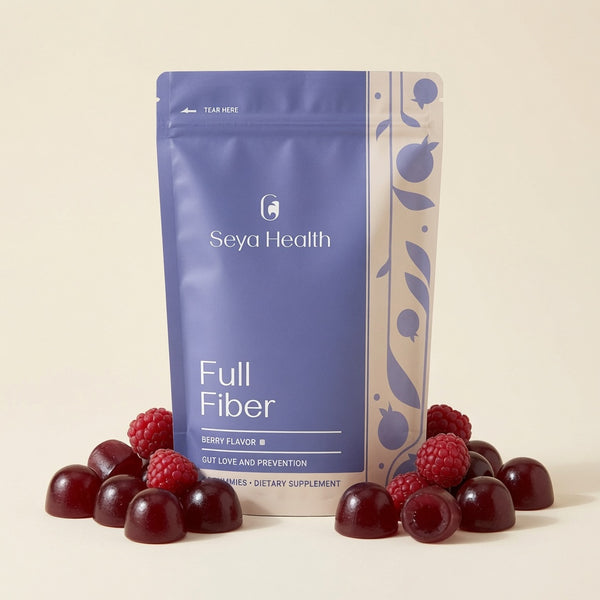
Seya Full Fiber
Most women fall short on fiber. Seya Full Fiber gives you 5.65 grams from three fibers in three small vegan gummies. Plant based, no gelatin, no sugar alcohols.
Shop Full Fiber

