
Home/ The Journal/ fiber
fiber
Antidepressants and Your Gut: Digestion, Weight, and What Actually Helps
How antidepressants affect digestion and weight, why SSRIs and older drugs differ, what actually helps, and the honest limits of what fiber can do.

Antidepressants can change your digestion, and sometimes your weight, because so much of your gut runs on the same serotonin system these medications act on. Which side effect you get depends on the drug: some cause nausea or loose stools, others cause constipation. Most stomach-related effects ease within the first couple of weeks. What helps depends on your medication and is a conversation with your doctor. Never stop or change an antidepressant on your own.
The gut-brain connection, in plain English
Here is the part most people are never told. Serotonin is the brain chemical antidepressants are famous for, but around 95% of your body's serotonin is actually made and used in your gut, where it helps run digestion.1 So when a medication changes serotonin signaling, it does not only reach your brain. It reaches your digestive tract too.2
That single fact explains most of what follows. It is why a medication for your mood can give you a queasy stomach or back you up. Your gut and brain are on the same wiring, and the drug talks to both.
One important caution before we go further. It is tempting to jump from "the gut makes serotonin" to "so fixing my gut will fix my mood." The science does not support that leap, and we are not going to make it. This article is about your digestion, not a mental-health treatment.
The digestion side effects, and why they differ
Stomach and gut complaints are among the most common reasons people struggle with antidepressants early on. The usual ones are nausea, loose stools or diarrhea, constipation, and general stomach upset.1 Which one you get is not random. It tends to track with the type of drug:
- SSRIs (the most common type today) raise serotonin activity in the gut, which can speed things up. That often shows up as nausea or diarrhea, especially in the first weeks.1
- Older antidepressants, like tricyclics, work differently and tend to slow the gut down, which is more likely to cause constipation.1
The encouraging news is that the early stomach side effects often settle on their own. For many people they improve substantially within about two weeks as the body adjusts.1 If they do not, that is worth a conversation with your doctor rather than quietly toughing it out, because there are often options.
The constipation side, and where fiber may help
If your antidepressant is one of the types that slows the gut, you may be dealing with constipation. For milder cases, the everyday basics genuinely help: more water, movement, and building up fiber gradually from food. A fiber supplement can help fill the gap, but add it slowly so you do not trade one problem for gas. We go deeper in medications that cause constipation and why your system hits a standstill.
One honest caveat: if your medication is causing the opposite problem, like loose stools from an SSRI, then piling on fiber is not the fix, and you should talk to your doctor about what is. Match the tool to the actual problem.
Antidepressants and weight gain
Weight change is one of the most talked-about antidepressant side effects, and it is real for some people, though far from everyone.3 It varies a lot by the specific drug and the person. Some antidepressants are more likely to nudge weight up than others, through a mix of appetite changes, shifts in metabolism, and simply feeling well enough to eat normally again after a rough stretch.3
If weight gain is bothering you, the productive move is a conversation with your doctor, who can look at whether a different medication in the same family might suit you better, alongside the usual food, movement, and sleep basics. What will not solve it is a supplement. No fiber, pill, or powder counteracts a medication's effect on your weight, and anyone selling you that is not being straight with you. We are including this section to inform you, not to sell you something for it.
A supplement does not offset what a medication is doing. Where we can genuinely help is your gut and your fiber gap, and we will keep it to that.
What about your gut bacteria?
There is growing interest in whether long-term antidepressant use changes the gut microbiome, the community of bacteria living in your digestive tract. Early research, much of it still in animals, suggests some antidepressants can shift the mix of gut bacteria.4 It is genuinely interesting, but it is early, and it is not something to draw firm conclusions from yet. The sensible takeaway is not a new supplement to chase. It is the same unglamorous advice that supports a healthy gut for everyone: eat a variety of plants, get enough fiber, and stay hydrated.
What actually helps (with your doctor)
If antidepressant side effects are hitting your gut, these steps help most people, and none of them involve stopping your medication:
- Give it two weeks. Many stomach side effects fade as your body adjusts. Knowing that alone makes the early days easier.1
- Take it with food if nausea is the issue. Ask your doctor or pharmacist whether that fits your specific medication.
- Hydrate and move. Both support digestion whichever direction it has gone.
- Adjust fiber to the problem. Build it up gradually for constipation; do not pile it on for diarrhea.
- Talk to your doctor if it lasts. Persistent side effects often have a solution, including a possible change of medication. That decision is theirs to guide, not yours to make alone.
Where Full Fiber fits (and where it does not)
Let us be very clear, because this topic invites overreach. Fiber is not a treatment for depression or anxiety, it does not improve your mood, and it is not a substitute for your medication or a fix for medication weight gain. In fact, a 2024 review of the research found that fiber supplements do not improve depression or anxiety symptoms.5 We would rather tell you that plainly than imply otherwise.
What a daily fiber can do, for the many people whose diets fall short, is support everyday digestion and help close the fiber gap. More than 90% of women do not get enough fiber, eating only about half of what is recommended.6 Seya Full Fiber gives you 6 grams of fiber from three fibers in one, in three small gummies that feed the beneficial bacteria in your gut. It is plant based with no gelatin, no sugar alcohols, and 60 gummies per pouch. If your doctor agrees fiber is a good fit for you, take it a couple of hours apart from your medication, and treat it as everyday gut support, nothing more.
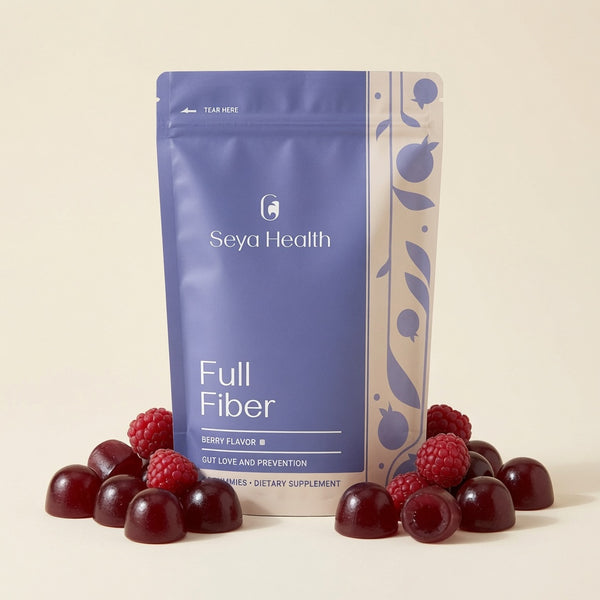
Seya Full Fiber
6 grams of fiber in three gummies to help close the fiber gap and feed the beneficial bacteria in your gut. Plant based, no gelatin, no sugar alcohols. Not a treatment for depression, mood, or medication side effects. Ask your doctor if fiber is right for you.
Shop Full FiberFor more on supporting your gut day to day, see fiber and gut health, and for your baseline fiber target, how much fiber women need per day.
When to call your doctor
Reach out if stomach side effects are severe, last well beyond the first few weeks, or come with warning signs like blood, ongoing vomiting, or significant weight change. And always talk to your doctor before changing anything about how you take your antidepressant. Side effects are common and usually manageable, but the fix should come from the person who prescribed it, working with you.
Frequently asked questions
Do antidepressants affect your gut?
Yes. Because around 95% of your body's serotonin is in your gut, medications that change serotonin signaling commonly cause digestive side effects like nausea, diarrhea, or constipation.1 Most ease within the first couple of weeks.
Which antidepressants cause constipation, and which cause diarrhea?
It depends on the type. SSRIs, the most common today, more often cause nausea or diarrhea early on, while older tricyclics tend to cause constipation.1 Your prescriber can tell you what to expect from yours.
Does fiber help with antidepressant side effects?
It can help with the constipation type, taken gradually with plenty of water, but it is not the answer for diarrhea or nausea. Match the approach to the actual problem, and check with your doctor first.
Can fiber or a healthy gut improve my mood or depression?
No. It is an appealing idea, and the gut-brain link is a real area of research, but a 2024 review found fiber supplements do not improve depression or anxiety symptoms.5 Fiber is for your gut, not a mental-health treatment, and it is never a substitute for your medication or your doctor.
When should I see a doctor?
See your doctor if side effects are severe, last beyond the first few weeks, or come with blood, vomiting, or notable weight change, and always before changing how you take your medication.
Sources
- 1 Psychopharmacology Institute. Gastrointestinal Side Effects of Antidepressants: Mechanisms, Comparison and Management.
- 2 NYU. Scientists Find Promising New Target for Antidepressants, In the Gut.
- 3 Mayo Clinic. Antidepressants and weight gain: What causes it?
- 4 Lukic I, et al. Antidepressants affect gut microbiota and microbiome function (animal research). PMC. Read.
- 5 Aslam H, et al. Fiber intake and fiber intervention in depression and anxiety: a systematic review and meta-analysis of observational studies and randomized controlled trials. Nutrition Reviews. 2024;82(12):1678 (10 RCTs, 740 participants: no difference vs placebo). Oxford Academic.
- 6 American Society for Nutrition. Most Americans are not getting enough fiber in our diets.
This article is general information, not medical advice, and it is not a substitute for guidance from your doctor or pharmacist. Seya Full Fiber is a dietary supplement and is not intended to diagnose, treat, cure, or prevent any disease or condition, including depression, anxiety, or medication side effects. Do not start, stop, or change any medication or supplement without talking to your healthcare provider.
Keep reading
Fiber
Can You Take Fiber With Your Medications? A Safety Guide
Yes, but timing matters. How to take fiber safely with medications, which drugs to watc...
fiber
What Supplements Should You Take on a GLP-1?
On a GLP-1 like Ozempic or Wegovy? What supplements actually matter (protein, key nutri...
constipation
Medications That Cause Constipation (and How to Get Relief)
Which medications cause constipation, why opioids are the exception, and how to get rel...