
Home/ The Journal/ constipation
constipation
Constipation Explained: Why Your System Hits a Standstill
We’ve all been there—that heavy, bloated feeling where your digestive system seems to have hit a permanent red light. While it’s often a "hush-hush" topic, constipation affects millions of women in the US, often tied to our unique hormonal shifts and lifestyle stressors.

Short version: Constipation in women is a transit problem, not a discipline problem. Either your colon pulls out too much water, or the muscle wave that moves stool gets slow. Fiber, fluid, and movement are the daily floor. If those are already in place and nothing moves, the issue is often the exit, not the input.
- Fewer than 3 bowel movements a week is the clinical line, and about 16 out of 100 adults have symptoms.
- Chronic constipation affects about 14% of adults, and women carry roughly 2.2 times the odds men do.
- In 7 randomized trials, 77% of people on fiber responded versus 44% on placebo.
Last updated August 2026.
Three days. Maybe four. You are bloated, your jeans are annoying you, and somewhere in the back of your head you are running the list of what you did wrong.
Probably nothing. Constipation in women is a plumbing problem with a clinical definition: fewer than 3 bowel movements a week, or stool that is hard, dry, and hard to pass (NIDDK). About 16 out of 100 adults have symptoms. The chronic version runs near 14% of adults, and women carry about 2.2 times the odds men do (Suares and Ford, 2011).

That number is worth sitting with. This is not a willpower gap. It is a pattern with a mechanism, and mechanisms have levers.
What is actually happening inside?
Your colon has two jobs: pull water out of waste, and push what is left toward the exit.
The push is peristalsis, a wave of muscle contraction. Constipation shows up when one of those two jobs drifts. Too much water comes out, or the wave goes slow. Either way you get stool that is hard, dry, and stubborn.
So there are really only two questions worth asking. Is it moving too slowly? Or is it moving fine and getting stuck at the end?
Those have different answers. Most advice online only ever answers the first one.
What causes constipation in women?
Usually a stack of small things, not one big thing.
Low fiber is the common one. Daily routine is another: pregnancy, aging, travel, and holding it when you get the urge all show up on the list of causes, along with a long list of medicines (NIDDK).
That medicine list is the one most people skip. Iron supplements are on it. So are antacids with aluminum or calcium, calcium channel blockers, diuretics, narcotic pain medicines, and some depression medicines.
If your gut changed at the same time your prescription did, that is not a coincidence you have to solve alone. It is a question for your prescriber.
Why does your cycle change your bathroom pattern?
Because progesterone slows the wave down.
Researchers measured gut transit in 15 women twice in one cycle: once on days 8 to 10, and once on days 18 to 20, after ovulation. Transit was significantly slower in the second window, when progesterone was high (p < 0.01) (Wald et al., 1981).
Same food. Same water. Slower trip.
That is why the back half of your cycle can feel like a different digestive system than the front half. More on that in luteal phase bloating.
How much fiber do you need, and why is water not optional?
Adults need 22 to 34 grams of fiber a day (NIDDK). Most women land near 15.
Fiber does have real evidence behind it. Across 7 randomized trials, 77% of people taking fiber responded, against 44% on placebo, and stool frequency went up while consistency softened (Christodoulides et al., 2016).
But fiber without fluid backfires. Fiber works by holding water in the stool. Add a lot of fiber to a dehydrated gut and you have built a firmer mass, not a softer one.
Two rules make it work. Add a few grams at a time over a couple of weeks, and add water every single time you add fiber.
The daily target and where the grams actually come from are broken down in how much fiber women need per day.
What if you are doing everything right and nothing moves?
Then look at the exit, not the input.
Passing stool needs coordination: the pelvic floor muscles have to relax while the abdomen pushes. When that timing breaks, you get dyssynergic defecation. You strain, you feel like you are pushing against a closed door, and you never feel finished.
It is not rare. It affects up to half of people with long-running constipation (Rao and Patcharatrakul, 2017).
This is the part fiber cannot solve, because fiber is not the problem. Biofeedback and pelvic floor therapy are the tools that match this one, and getting there starts with saying the words "I think it might be my pelvic floor" out loud to a clinician.
Does stress really slow your gut down?
Your daily routine changes your bathroom pattern, and stress is usually bundled into that routine.
Travel is on the NIDDK list of causes by name. So is ignoring the urge to go, which is exactly what a packed workday trains you to do.
Neither of those is a character flaw either. They are inputs. Different schedule, different sleep, different food, different bathroom, and the pattern you had at home does not survive the trip.
What survives travel is the boring stuff: water, fiber, and a walk after meals.
Your advocacy checklist for the appointment
Bring answers to these 4 things and you will get a much better 15 minutes with your doctor.
- Count the week. How many bowel movements in the last 7 days? Fewer than 3 is the clinical line, and a number beats "not often."
- Read your own medicine list. Ask directly whether your iron supplement, antacid, blood pressure medicine, or depression medicine could be slowing your gut.
- Say if it tracks your cycle. If the slowdown lands after ovulation every month, that is a real clinical signal, not a detail to leave out.
- Name the exit question. If you strain, feel blocked, or never feel finished, ask about pelvic floor coordination instead of accepting one more suggestion to drink water.
Most women are handed "eat more fiber and drink more water" and sent home. That advice is correct and incomplete. You are allowed to ask what comes after it.
Where does a fiber supplement fit?
As the daily floor. Not the rescue.
Seya's daily fiber gummies deliver about 5 grams. That is roughly half the dose used in the research, so the claim stays where the evidence actually sits: fiber supports regularity. It is a habit that works on the average of your week, not on the next hour.
It does not replace food, water, movement, or a conversation with your doctor.
These statements have not been evaluated by the Food and Drug Administration. This product is not intended to diagnose, treat, cure, or prevent any disease.
When should you call your doctor?
Call if constipation is new for you and it has lasted more than 3 weeks.
Call for severe belly pain, vomiting, or a belly that stays swollen.
Call if you see blood, or if you are losing weight without trying.
Call if you are straining every time or never feel emptied, because that pattern points at the pelvic floor and it has its own path.
And call before you start a daily laxative routine. A blog post cannot see your history, your medicines, or your exam.
Frequently asked questions
What counts as constipation?
Fewer than 3 bowel movements a week, or stool that is hard, dry, or lumpy and difficult to pass (NIDDK). About 16 out of 100 adults have symptoms, and that rises to about 33 out of 100 among adults 60 and older. Frequency alone is not the whole picture. Straining and never feeling finished count too, even if you are going daily.
Why is constipation more common in women?
Chronic constipation runs near 14% of adults overall, and women carry roughly 2.2 times the odds men do (Suares and Ford, 2011). Part of it is hormonal: gut transit measurably slows in the luteal phase, when progesterone is high (Wald et al., 1981). Pregnancy and the period after giving birth also raise the risk, and pelvic floor problems are more common in women.
How much fiber should you eat for constipation?
Adults need 22 to 34 grams a day, and most women get about 15. In 7 randomized trials, 77% of people on fiber responded versus 44% on placebo, with more frequent and softer stools (Christodoulides et al., 2016). Build up a few grams at a time and drink more water as you go, because fiber needs fluid to soften stool instead of hardening it.
Why is fiber not working for me?
Two common reasons. You may not be drinking enough water, which turns added fiber into a firmer mass. Or the problem may be coordination at the exit rather than transit through the colon. Dyssynergic defecation affects up to half of people with long-running constipation, and fiber does not fix a muscle timing problem (Rao and Patcharatrakul, 2017).
Can medicines cause constipation?
Yes, and the list is long. NIDDK names iron supplements, antacids containing aluminum or calcium, calcium channel blockers, diuretics, anticholinergics and antispasmodics, anticonvulsants, narcotic pain medicines, and some depression medicines. If your pattern changed when a prescription changed, bring that timeline to your prescriber rather than working around it.
Does constipation get worse before your period?
It can. In 15 women measured twice in one cycle, gut transit was significantly slower on days 18 to 20 than on days 8 to 10, when progesterone was low (p < 0.01) (Wald et al., 1981). Slower transit means more water pulled out and more time for stool to sit. If your slowdown lands after ovulation every month, that is worth telling your doctor.
Sources
- NIDDK: Definition & Facts for Constipation.
- NIDDK: Symptoms & Causes of Constipation.
- NIDDK: Treatment for Constipation.
- Suares NC, Ford AC. Prevalence of, and risk factors for, chronic idiopathic constipation in the community: systematic review and meta-analysis. Am J Gastroenterol. 2011;106(9):1582-91.
- Christodoulides S, et al. Systematic review with meta-analysis: effect of fibre supplementation on chronic idiopathic constipation in adults. Aliment Pharmacol Ther. 2016;44(2):103-16.
- Rao SSC, Patcharatrakul T. Review article: dyssynergic defaecation and biofeedback therapy in the pathophysiology and management of functional constipation. Aliment Pharmacol Ther. 2017.
- Wald A, et al. Gastrointestinal transit: the effect of the menstrual cycle. Gastroenterology. 1981;80(6):1497-500.
Related reading: perimenopause constipation.
Related reading
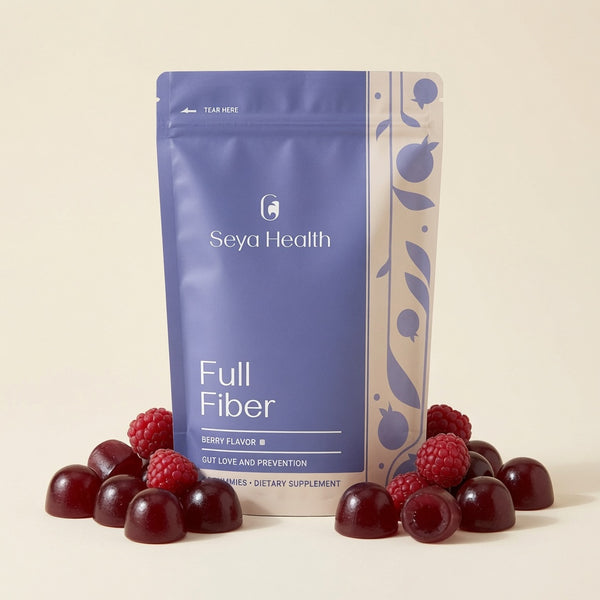
Seya Full Fiber
Getting enough fiber from food every day is hard. Seya Full Fiber is 6 grams from three fibers in one, in three small gummies, so you have a reliable daily floor. Plant based, no gelatin, no sugar alcohols, 60 gummies per pouch.
Shop Full FiberKeep reading

fiber
Can a Multivitamin Replace Vegetables? What Supplements Can't Do for Your Gut

constipation
The Best Way to Beat Constipation in Your 30s (and Where Fiber Gummies Fit)
fiber
The Gut-Skin Axis: Does Your Gut Health Affect Your Skin?
The gut-skin axis, explained: how your gut bacteria and blood sugar affect your skin, w...